Venice Cruise Route Approval Hinges on Five-Knot Safety Test
The funded first phase would deepen the channel to eight metres, allowing ships up to about 230 metres long and 50,000 gross tons to return from mid-2028.
Venice’s cruise route plan still has a five-knot question to answer
The proposed cruise route back to Venice’s Marittima terminal was modelled at five knots to limit erosion. The project’s proponent says safe navigation can require six knots in some circumstances.
I’d put resolving that difference ahead of celebrating the terminal’s return to more cruise ships. In a lagoon where the canal’s original excavation altered water movement, the speed used to assess environmental effects needs to stand up to operational scrutiny.
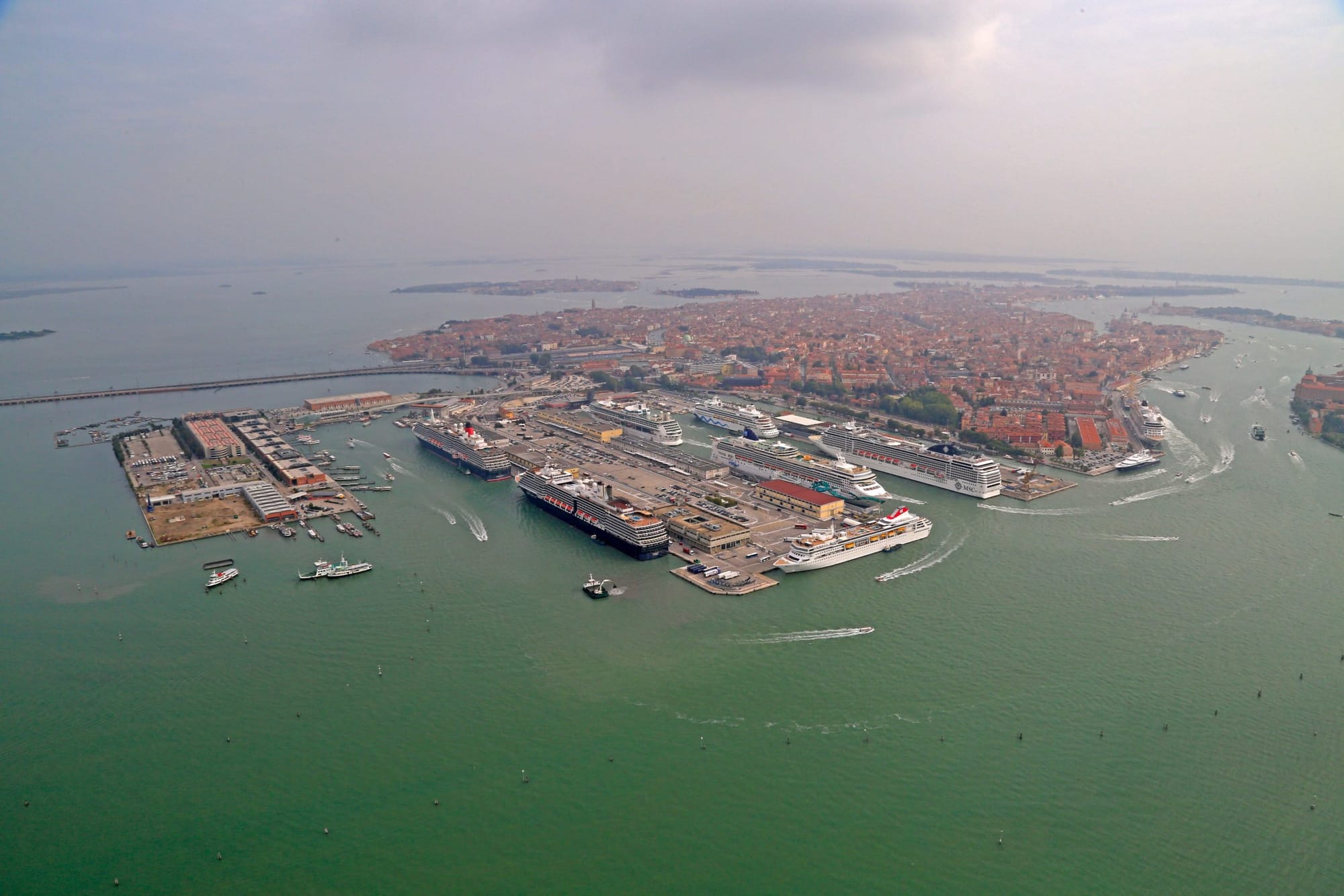
Italy’s environment ministry has now issued conditional environmental approval for dredging the Vittorio Emanuele III canal. A funded €32.7 million first phase would restore access for ships up to approximately 230 metres long and 50,000 GT from mid-2028.
The route would take ships through the Malamocco-Marghera canal and Porto Marghera’s industrial waterways, avoiding the Giudecca canal and San Marco waterways restricted since 2021. That offers a way back to Marittima without reopening the protected central route. It does not yet settle all the questions about how ships would get there.
The speed assumption needs testing
The decree, dated November 3 and issued jointly with the culture ministry, includes a positive habitat impact assessment and landscape authorisation. Those approvals carry environmental conditions.
The environmental commission has requested a detailed-design assessment of whether the modelled five-knot speed is operationally feasible for different ship classes and weather conditions. The proponent’s own six-knot figure is what makes that assessment consequential.
This is not evidence that the route cannot work. It is a specific issue the next stage must resolve, rather than an operating detail to leave until ships are ready to use it.
A €1.7 million accessibility study of the Malamocco-Marghera canal began in 2021, combining navigation and hydrodynamic simulations with field measurements. The Vittorio Emanuele III canal’s original excavation helped create a preferred route for tidal propagation.
What is funded, and which ships could return
The project would remove approximately 1.1 million cubic metres of sediment across two phases. The first, financed through the cruise commissioner’s resources, would deepen the channel to eight metres below mean sea level. Supplementary assessment documentation places construction between July 2027 and June 2028.
The larger-ship option remains unfunded. A second phase, budgeted at €14.5 million, would deepen the channel to nine metres and allow ships up to approximately 265 metres long and 74,000 GT. Its proposed construction window is October 2029 to February 2030.
Those dimensions are not an automatic admission ticket. Individual vessels would still need permission to transit. According to the proponent, assessments would consider gross tonnage, draught, length, wind-exposed area and propulsion, alongside prevailing weather and sea conditions.
A different route, not a reversal of the restrictions
Italy’s Decree-Law No. 103 of July 2021, converted into law that September, barred vessels meeting specified thresholds from the protected central waterways from August 1. The restrictions cover ships exceeding 25,000 GT, 180 metres in waterline length or 35 metres in height, as well as vessels using manoeuvring fuel with a sulphur content of 0.1% or more.
The legislation designated the San Marco Basin, San Marco Canal and Giudecca Canal as a national monument. It also established an extraordinary commissioner to arrange temporary docking infrastructure, including up to five berths in Marghera. Medium-sized cruise ships consequently lost access to Marittima.
Cruise operations have since been spread among Porto Marghera, Fusina, San Basilio and Marittima. Venice recorded approximately 548,000 cruise passengers in 2024, up 7.8% year on year. About 487,000 were embarking or disembarking passengers, with roughly 61,000 visiting in transit.
The approval is a meaningful step, but the detailed design now has a more demanding job than drawing a route around restricted waterways. It must show that erosion control and safe shiphandling can work at the same speed.
See cruises departing Venice on Cruise Lookup.