Carnival Half Booked for 2027 as Demand Supports Higher Fares
More than half of Carnival’s onboard revenue is now booked before departure through bundled packages, while Celebration Key welcomed almost 2.5 million guests in its first year.

Carnival’s Booking Rebound Gives It Room to Put Price First
Carnival is already half booked for 2027, with occupancy and pricing at record levels for this stage of the booking cycle. CEO Josh Weinstein says demand is growing faster than planned capacity, giving the company room to prioritize pricing.
I like that priority. A booking recovery is welcome, but a recovery that gives Carnival room to defend its fares is considerably more useful. The numbers give management a credible basis for that stance, even with some parts of the travel market still proving difficult.
Customer deposits reached a third-quarter record of approximately $7.6 billion, up about 7% from $7.1 billion a year earlier, despite flat capacity growth over the next 12 months. Carnival also reported record quarterly net income of $1.9 billion on revenue exceeding $8.4 billion. Management credited stronger demand and cost controls for the better-than-expected results.
During the September 29 third-quarter earnings call, Weinstein said booking momentum turned positive year over year in June and strengthened in July and August, despite economic uncertainty and the Iran war.
That recovery did not arrive as quickly as Carnival expected. The company had anticipated benefiting from comparisons with the booking volatility following U.S. tariffs and the stock-market shock in 2025. Instead, this spring’s consumer pressures lasted longer, with second-quarter patterns continuing into the third quarter.
Citi analyst James Hardiman put his finger on the puzzle: bookings had improved without relief from macroeconomic or geopolitical pressures, or lower airfares. He asked whether the gains came from customers living within reach of homeports, Europeans’ commitment to holidays, or fatigue with negative headlines.
Weinstein said all three contributed, alongside cruising’s value and convenience. He said Americans were increasingly adopting the European view that “vacations are sacrosanct and they will take them in good times and in bad.”
That is a broad reading of consumer behavior. The itinerary detail is more useful. Disruption affected bookings for the first quarter of 2027, although reservations for that period have recovered substantially over the past three months. Long-haul flights and more exotic itineraries remain a greater challenge than Carnival expected a year ago. Weinstein called those obstacles “not insurmountable.”
Peak-summer European sailings, meanwhile, are drawing particularly healthy demand. Weinstein said a substantial group of customers who decided during the spring and early summer not to visit Europe this year had chosen 2027 instead. Some of this business was postponed rather than abandoned, an important distinction when judging how durable the recovery might be.
The spending story starts before passengers board
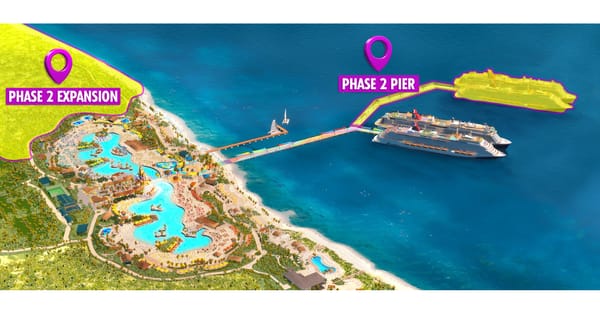
Onboard revenue grew nearly 7% during the quarter. Celebration Key, Carnival’s destination on Grand Bahama, received almost 2.5 million guests during its first year. Asked how much of the onboard gain came from the destination rather than spending aboard ships, Chief Financial Officer David Bernstein said the gains extended across Carnival’s brands and both American and European customers.
“We are not seeing any slowdown in the strength of the consumer,” Bernstein said.
More than half of onboard revenue is now booked before departure, supported by bundled packages. That makes “onboard spending” a less straightforward label than it sounds.
Bernstein said advance purchases give Carnival a meaningful benefit from passengers’ “second wallet” once aboard. He also said bundles make the distinction between ticket revenue and onboard revenue less useful than it once was. For judging total passenger spending, I agree. Looking at either category in isolation risks missing what customers have bought as a package.
Strong bookings do not settle the fuel question
Carnival reported a $150 million fuel-cost impact, which management said it overcame through cost controls and improved net yields. On a normalized basis, yields rose almost 3%. Weinstein described 2026’s operational performance as “pretty good” under the circumstances.
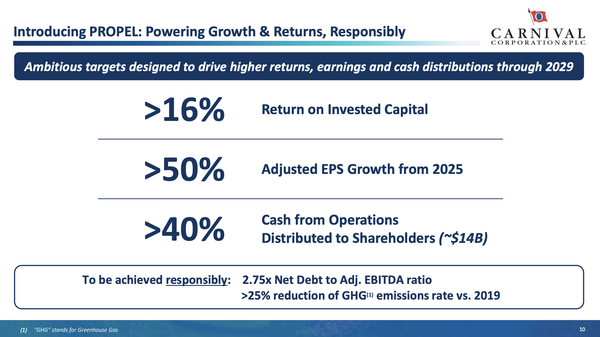
The longer-term earnings ambition deserves a tougher standard than that. Analysts questioned whether higher oil prices, the war and Caribbean rates would affect the roughly 20% annual earnings growth targeted through 2029 under PROPEL, announced in the first quarter. The initiative also targets a return on invested capital above 16% and a net-debt-to-adjusted-EBITDA ratio of 2.75 times.
Carnival is maintaining its longstanding policy against fuel hedging. Weinstein said the company does not consider paying other parties to execute trades worthwhile as a way to reduce fuel-price volatility. Fuel prices cannot be predicted, he said, but consumption can keep falling.
There is measurable progress there. Fuel consumption per available lower berth day has fallen 13% over the past three years and 26% since 2019. Fuel consumption is down 4% so far this year. Those reductions are a concrete operating achievement, though they do not remove the exposure illustrated by this quarter’s fuel bill.
Weinstein said Carnival’s booking curve now extends further ahead than at any comparable point in the year. He added that 2028 was off to an excellent start, with higher occupancy and prices than last year.
For passengers hoping economic uncertainty will force cheaper fares, management’s message offers little encouragement. Carnival’s forward bookings give it good reason to hold firm on price.