Barcelona Terminal C Gives Berthing Priority to Shared-Terminal Lines
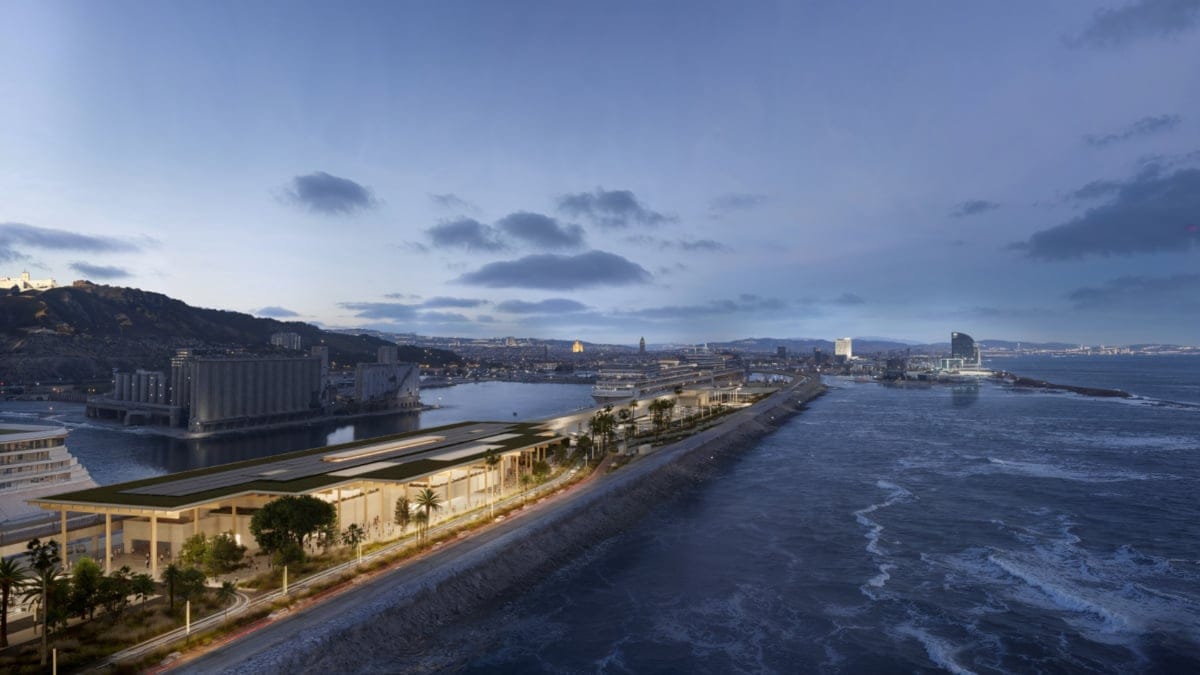
Terminal C will accommodate up to 7,000 passengers at once, with new roads, a passenger walkway, solar generation and shore-power infrastructure also planned.
Barcelona’s New Terminal C Gets Its Berthing Priorities Right
Cruise lines without a dedicated terminal will get berthing priority at Barcelona’s replacement Terminal C, alongside ships starting or ending voyages in the city and smaller vessels. That is the decision worth paying attention to in this €104.5 million redevelopment.
I like that use of a shared terminal. Barcelona already has substantial investment in facilities tied to individual cruise companies. Keeping a useful place for operators without their own terminal should be a deliberate port policy, rather than something left to whatever space remains.
Barcelona Cruise Port received approval for the redevelopment at Adossat Wharf on October 30, 2026. Its agreement with the Port of Barcelona also extends the operator’s contract through 2050, with an option to continue until 2053.
More than €50 million of the investment is allocated to constructing the 11,253-square-meter terminal, which will accommodate up to 7,000 passengers simultaneously. The facility will be publicly accessible and available to all cruise lines. The priority rules do not make it exclusive to operators without dedicated facilities.
That distinction matters in a port where Carnival operates Terminals D and E and MSC Cruises began receiving passengers at its own terminal in February 2025. MSC built, owns and operates that facility.
Seven terminals become five, but traffic is another question
The existing Terminal C stopped operating on November 1, 2026. It will be cleared and demolished before construction begins. Once the replacement enters service, Terminals A and B will also be demolished, bringing Barcelona’s total from seven cruise terminals to five.
That is a consolidation of facilities, not evidence on its own that fewer cruise passengers will use Barcelona.
Port-wide cruise traffic reached a record 3,655,981 passengers in 2024, up 2.4% from 3,568,901 in 2023. Ship calls moved in the opposite direction, falling from 803 to 793. Those figures are a useful reminder that counting terminals, ships and passengers tells three different stories.
The redevelopment forms part of Barcelona’s effort to concentrate cruise activity at Adossat Wharf and move it away from the city center. A partial restriction introduced in 2023 prevented cruise ships from docking at the World Trade Center’s northern terminal.
The access policy is clearer than the construction schedule
The works extend beyond the terminal building. Plans include relocating Adossat Wharf’s current access roundabout, building new roads and adding a passenger walkway for embarkation and disembarkation.
Solar electricity generation and shore-power infrastructure are also included, with shore power intended to reduce emissions from ships at berth. Carnival’s Terminals D and E became the port’s first terminals with solar panels in 2024.
The approval came two days after an October 28 protest in which port workers blocked access to the cruise terminal during a collective bargaining dispute.
The outstanding practical detail is the delivery date. When the Terminal C redevelopment was announced in July 2025, completion was scheduled for 2030. The port has not issued an updated construction timetable or confirmed whether that target still stands.
Operators planning future Barcelona calls need that clarity. Still, the berthing policy is a sound commitment: as Barcelona consolidates its terminals, owning a dedicated facility should not become the price of having a useful place in the port.
See cruises departing Barcelona on Cruise Lookup.