Aurora Expeditions Adds Scientists to 2026-27 Antarctic Voyages
Voyages will run nine to thirty-four days aboard Greg Mortimer, Sylvia Earle and Douglas Mawson, with routes reaching the Weddell and Ross seas.
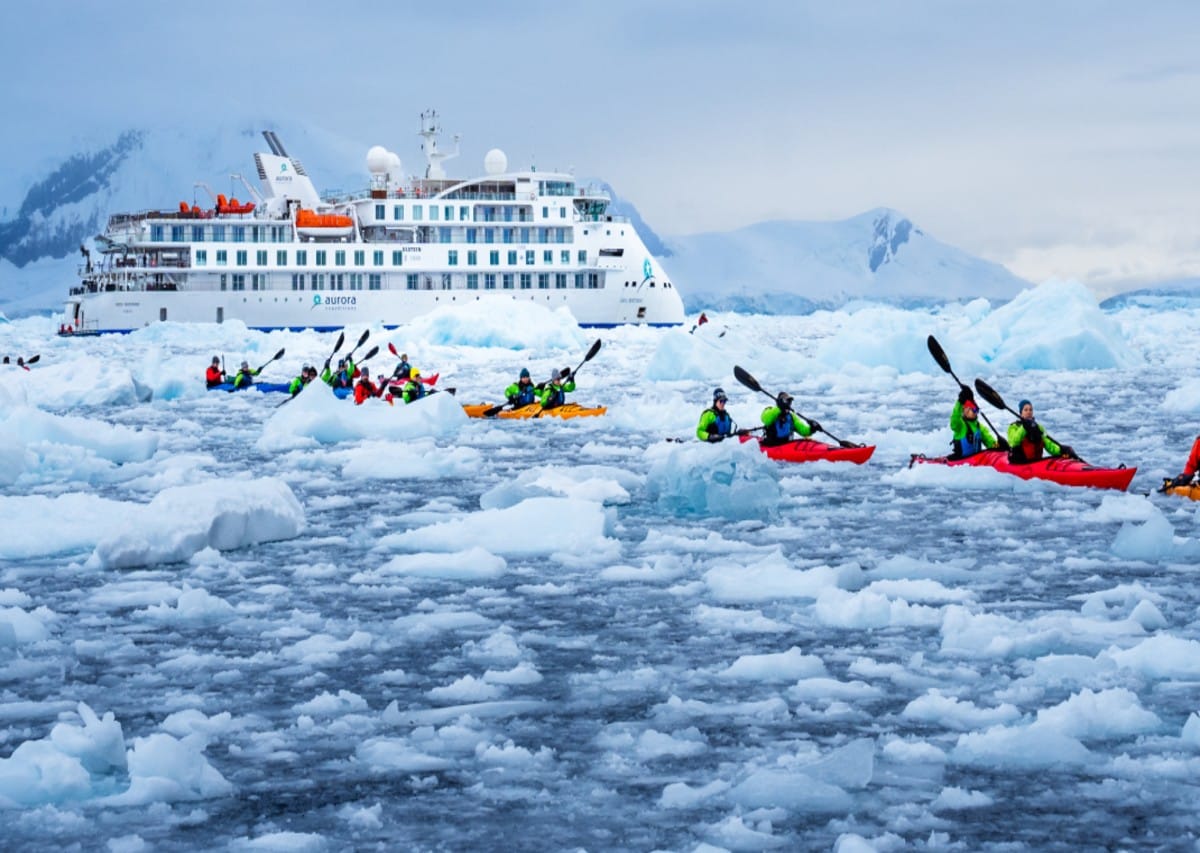
Aurora Expeditions will operate 27 Antarctic voyages aboard Greg Mortimer, Sylvia Earle and Douglas Mawson during its 2026-27 season, with active scientific fieldwork scheduled on 11 departures. Eighteen scientists representing five projects will join selected sailings to study whales, penguins, wildlife health, marine biodiversity and the deep sea.
The voyages will range from nine to 34 days, covering the Antarctic Peninsula and Circle, the Weddell and Ross seas, South Georgia, the Falkland Islands and East Antarctica. Aurora did not disclose departure-level dates or pricing in the announcement. The ships will serve as fieldwork platforms, Aurora said, giving passengers access to research teams while their work is underway.
Research teams join passenger voyages
The Friedlaender Lab at the University of California, Santa Cruz will examine Antarctic whale ecology, behavior and health. Its researchers will combine visual observations with calibrated drone imagery and samples collected through minimally invasive methods.
Six Oceanites scientists will conduct ground and drone surveys for the Antarctic Site Inventory, monitoring penguin numbers, breeding activity and population changes at selected sites along the Antarctic Peninsula. The vessel-based inventory began fieldwork in 1994 and had completed more than 2,100 census visits at over 258 locations by 2020.
Inventory researchers typically collect data during Zodiac landings or tours. They count adult birds, active nests and chicks. The work also covers GPS mapping, site observations and repeat photography.
Researchers from the University of Tasmania’s Institute for Marine and Antarctic Studies will investigate whales, seals and seabirds. Their work will include pathogen surveillance and research into how environmental variability and climate change affect Antarctic predators and ecosystems.
A separate University of Tasmania team will undertake Reef Life Survey biodiversity work underwater. Divers will record fish, mobile invertebrates and cryptic species along 50-meter transects, and photographs will document habitat cover, including corals and seaweed.
The participating teams will include marine ecologists, wildlife biologists, conservation specialists, drone pilots and deep-sea technologists.
The fifth research project is scheduled for the Epic Antarctica: Crossing the 7th Continent voyage. Scientists from the Museum of New Zealand Te Papa Tongarewa and Auckland University of Technology will undertake Project ESCA, focused on colossal squid and deep-sea exploration.