SS United States Set for Florida Reef Deployment in November 2026
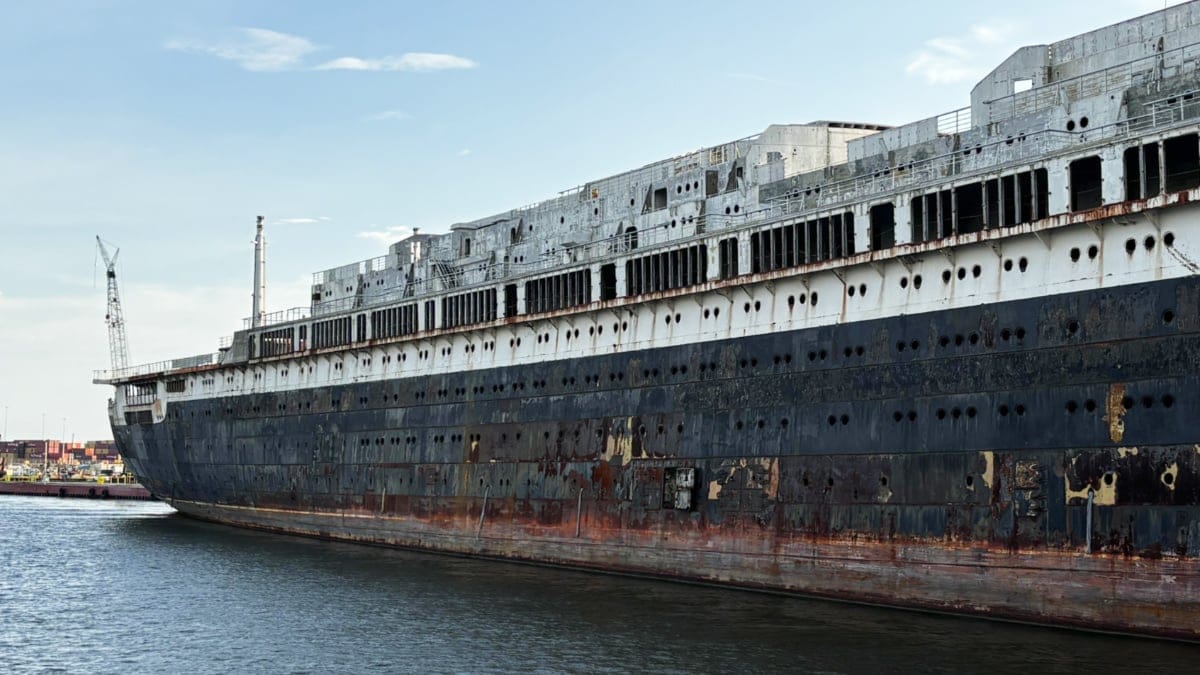
Before deployment, crews drained and inspected 128 fuel and oil tanks, removed more than 400 portholes and sealed spaces considered unsafe for divers.
SS United States’ Planned Museum Should Not Be a Footnote to Its Sinking
The uppermost deck of SS United States is expected to sit about 55 feet underwater. That is the detail I keep coming back to as plans advance to turn the liner into the world’s largest artificial reef. The ship will have a new purpose, but getting close to it will mean going diving.
That makes the SS United States Conservancy’s planned shore-based museum essential. I want the liner’s history to be accessible to people who will never enter the water, not overshadowed by the sheer size of the wreck.
Okaloosa County, Florida, has scheduled the sinking for the second week of November 2026, 22 nautical miles southwest of Destin-Fort Walton Beach. The county announced that window on October 9. There is no exact deployment date yet because the operation depends on weather.
Remediation is complete. According to the Conservancy, the U.S. Army Corps of Engineers has granted final approval, with no opposition from the Environmental Protection Agency. The project is now moving from preparing the 990-foot liner to putting it on the seabed.
A controlled sinking, with spectators kept back
SS United States will be towed from Mobile, Alabama, where contractor Coleen Marine prepared it for reefing. The Conservancy expects the vessel to remain at anchor at the deployment site for approximately two days while crews finish their preparations.
No explosives will be used. Controlled flooding is intended to settle the liner upright on the seabed, approximately 180 feet below the surface, with its uppermost deck about 55 feet down.
Anyone hoping to watch from a nearby boat needs to adjust their expectations. The U.S. Coast Guard and other authorities will enforce a broad security perimeter. Private boats and charter excursions may observe from outside it, but there will be no close-range spectator access.
The Conservancy plans to livestream the sinking, although broadcast arrangements have not been released.
The preparation has been extensive, and waiting added costs
Turning an ocean liner into a reef requires a substantial stripping-out operation. Crews drained, cleaned and inspected 128 fuel and lubricating-oil tanks. They removed ventilation equipment, wiring, flaking exterior paint and more than 400 portholes. Exterior flooring containing high concentrations of PCBs was removed for appropriate disposal.
Spaces considered unsafe for divers have been sealed. The deployment site was scanned and visually inspected for historical features or natural resources that could be damaged by placing the ship there.
County documents say the work complied with applicable laws and the EPA and Maritime Administration’s best-management practices for preparing reef vessels. Those practices call for documented inspections, a stability analysis, contaminant removal and modifications addressing diver safety.
These details deserve attention alongside the spectacle of the sinking. A ship this large needs to be made suitable for its next use. Its size alone is no recommendation.
Final approval also followed a costly wait in Mobile. On September 15, county commissioners approved a $1.242 million increase to Coleen Marine’s agreement, bringing the contract value to $11.42 million.
The amendment secured a berth through December 31, 2026, and funded regulatory compliance associated with preparation, towing and deployment. County documents attributed additional dockage expense to months spent awaiting the Army Corps’ decision, calling the costs “outside the county’s control and beyond what was reasonably expected.”
The county said Coleen Marine’s core contracted work remained within approximately 10 percent of its original budget.
The ship’s story needs somewhere to go
SS United States was built by Newport News Shipbuilding and launched in 1951. The approximately 53,330-gross-ton liner entered United States Lines service in 1952, with capacity for about 1,984 passengers.
On its maiden eastbound Atlantic crossing, it averaged 35.59 knots and completed the passage in three days, 10 hours and 40 minutes, earning the Blue Riband. That achievement gives the planned museum something far more compelling to explain than the dimensions of an artificial reef.
The liner left commercial service in November 1969. It had been berthed in Philadelphia since 1996 before a rent dispute ended its stay at Pier 82. Okaloosa County commissioners approved its purchase in October 2024. Its roughly 2,000-mile tow to Alabama began on February 19, 2025, and reached Mobile Bay on March 3.
The Conservancy is continuing plans for a museum near departure locations for future dive excursions. Planned exhibits include the liner’s six-story funnels, radar mast and other salvaged components, alongside artwork and historical artifacts.
Those are substantial pieces of a ship that deserves a substantial account of its working life. I would judge the museum by how well it delivers that, not simply by how many objects were saved. Going underwater should not be the price of getting close to this liner’s history.