Seven Royal Caribbean Ships Earn Perfect 2026 CDC Sanitation Scores
The seven ships ranged from Grandeur of the Seas, built in nineteen ninety-six, to Icon and Star of the Seas, each carrying five thousand six hundred ten guests at double occupancy.
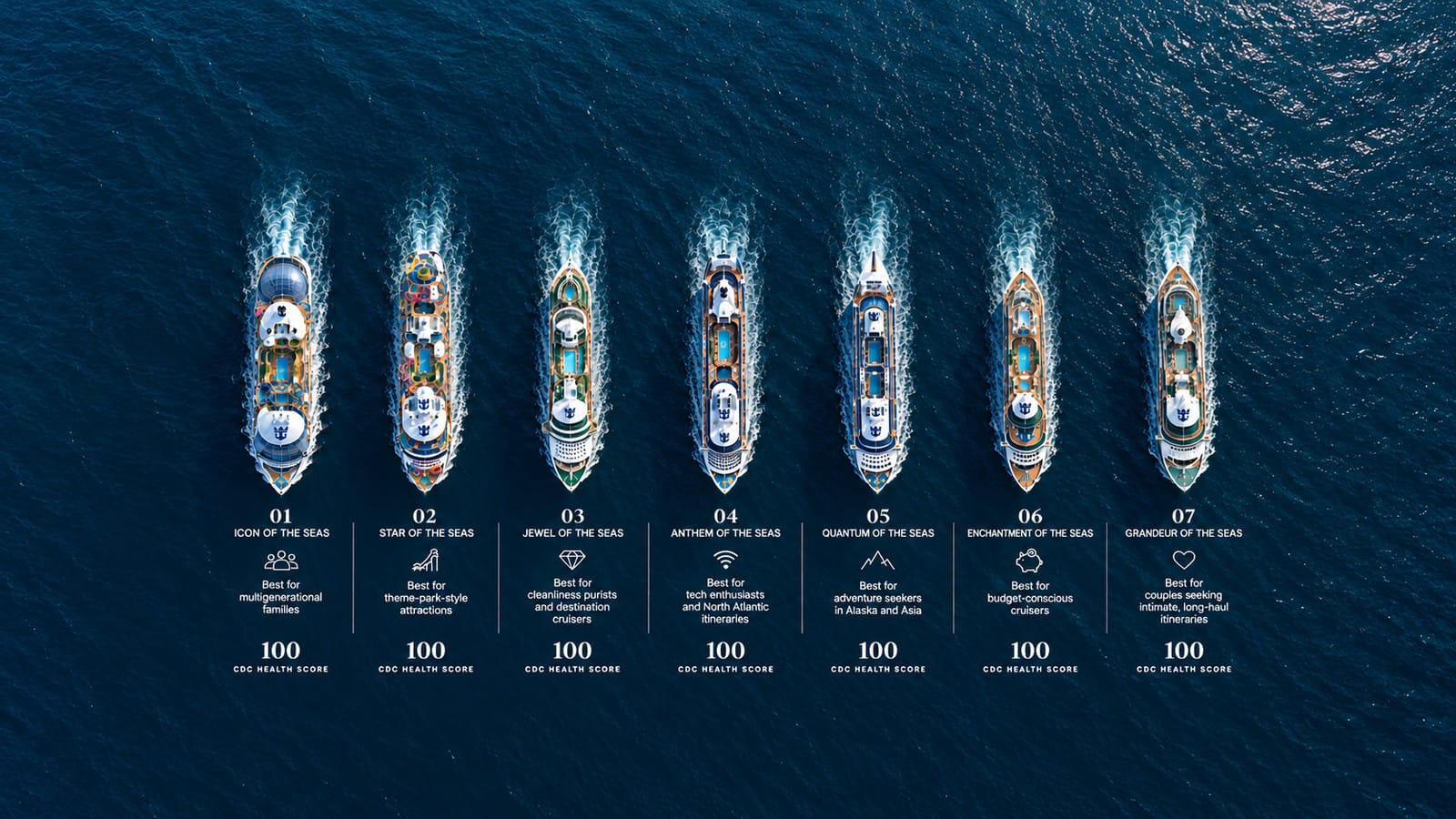
Seven Royal Caribbean ships received perfect 100-point scores in unannounced U.S. public health inspections during 2026. The group comprises Grandeur of the Seas, Enchantment of the Seas, Quantum of the Seas, Anthem of the Seas, Jewel of the Seas, Star of the Seas and Icon of the Seas.
The vessels were among 42 cruise ships that received perfect scores. The Centers for Disease Control and Prevention’s Vessel Sanitation Program grades ships on a 100-point scale, with 86 required to pass and scores of 85 or lower considered unsatisfactory.
Perfect scores span multiple ship generations
Royal Caribbean’s results covered ships ranging from two of its oldest vessels to its newest Icon-class ships. Grandeur of the Seas, built in 1996, is a 73,817-gross-ton vessel carrying 1,992 guests at double occupancy. Enchantment of the Seas followed in 1997 and was lengthened in 2005; the 82,910-gross-ton ship can accommodate more than 2,200 passengers.
Jewel of the Seas has received 14 scores of 100 across 37 inspections, with a lifetime average of 97.24.
Quantum of the Seas and Anthem of the Seas also scored 100. Both belong to Royal Caribbean’s Quantum class.
At the other end of the fleet’s age and size range, Icon of the Seas and Star of the Seas each earned perfect scores. Each 248,663-gross-ton ship carries 5,610 passengers at double occupancy and up to approximately 7,600 at maximum capacity, supported by crews of about 2,350.
What the inspections cover
The Vessel Sanitation Program conducts periodic, unannounced inspections of cruise ships at U.S. ports. Inspectors examine medical facilities, potable water systems, swimming pools and whirlpools, galleys and dining rooms, child activity centers, cabins, ventilation systems and common areas.
The CDC’s 2025 Environmental Public Health Standards are the current published standards used for the program. They draw primarily on the U.S. Food and Drug Administration Food Code and the World Health Organization’s Guide to Ship Sanitation.
Gavin Macgregor-Skinner, an infection-prevention expert and epidemiologist affiliated with Penn State College of Medicine, said participating ships can generally expect two unannounced inspections annually.
“Without strong cleaning and hygiene practices, germs can spread quickly,” Macgregor-Skinner said.
Scores provide a snapshot of onboard conditions
An inspection score records conditions observed during a particular visit and can change substantially at the next inspection. Carnival Breeze, for example, received a perfect 100 earlier in 2026 before scoring 86 during a subsequent inspection, leaving it at the program’s passing threshold.
Norwegian Dawn received an 84 in March, the only score below the passing threshold among the seven lowest-scoring vessels. Norwegian Cruise Line submitted a report to the CDC five days later detailing corrective measures taken after the inspection.
A lower sanitation score does not by itself establish that an illness outbreak occurred. Macgregor-Skinner also cautioned against equating the cruise sector’s more routine reporting of illnesses to federal authorities with a higher incidence rate than in hotels, restaurants or aircraft.
Compare Royal Caribbean sailings by price on Cruise Lookup.