Royal Caribbean’s $3 Billion Sandals Stake Faces 2027 Earnings Test
The September agreement covers 18 Caribbean resorts and more than 1,000 acres of undeveloped land; the Stewart family will retain the remaining half.

Royal Caribbean’s $3 Billion Sandals Bet Needs More Than Cross-Selling Potential
Royal Caribbean Group has agreed to invest roughly $3 billion for half of Sandals and Beaches Resorts. Management expects the investment to add to earnings immediately after closing, but its contribution in 2027 will be immaterial. That distinction deserves more attention than the word “immediately.”
I like the customer logic behind the deal. Approximately 30% of Royal Caribbean Group guests also take all-inclusive vacations, and a similar share of Sandals and Beaches guests take cruises. That gives the company a credible audience to sell to. Whether those travelers will book the other business is the test worth watching.
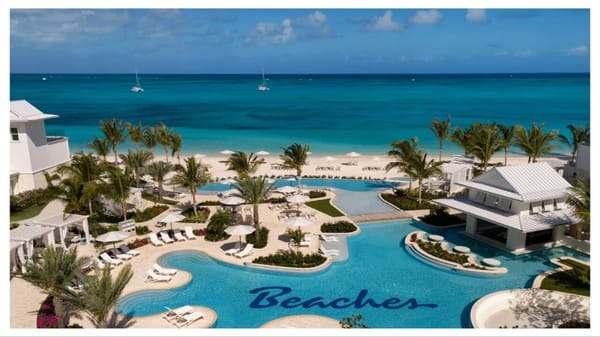
The agreement, announced in September, covers 18 Caribbean resorts and more than 1,000 acres of undeveloped land, including sites beside existing properties. Plans include three new Beaches resorts and additional rooms at existing locations. The Stewart family would retain the other 50%, with the brands keeping their identities and operating leadership.
Chairman and CEO Jason Liberty said Royal Caribbean intends to use its loyalty, distribution, revenue-management and technology capabilities to introduce customers to the respective businesses. That is a sensible use of what the group already has.
Closing is expected in early 2027, subject to regulatory approvals and customary conditions. CFO Naftali Holtz said the first year’s earnings contribution would depend on the closing date. The stake will be accounted for under the equity method, with earnings recognized one quarter in arrears, and will enter financial guidance after closing.
The more consequential qualification is that Royal Caribbean does not currently expect to provide capital beyond the purchase price. Holtz said the resort business can finance its development plans from its own cash generation. I would put more weight on that expectation holding up than on a small initial earnings contribution.
The cruise business is supplying the earnings growth
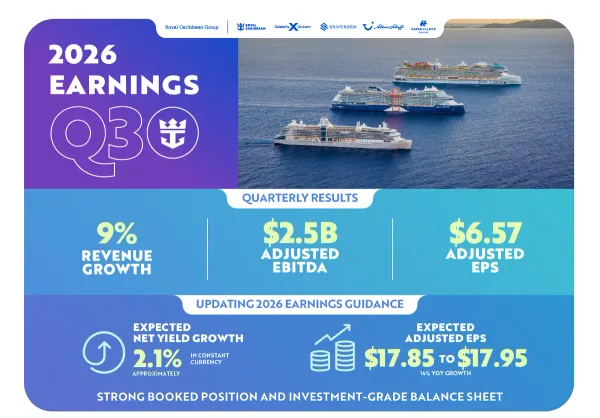
Royal Caribbean raised its full-year 2026 adjusted earnings outlook to $17.85–$17.95 per share on October 27, following third-quarter adjusted EPS of $6.57, up from $5.75 a year earlier. Revenue increased 9% to $5.6 billion.
The adjusted EPS result beat the midpoint of management’s guidance by $0.26. Stronger late bookings in Europe and the Caribbean helped, as did expenses deferred into the fourth quarter. Holtz attributed approximately $0.05 of the outperformance to that favorable expense timing. Higher projected fuel costs and unfavorable currency movements partially offset the annual forecast increase.
Net income was $1.7 billion, or $6.45 per share, against $1.6 billion, or $5.74 per share, a year earlier. Adjusted net income reached $1.8 billion, adjusted EBITDA was $2.5 billion, and operating cash flow totaled $1.6 billion.
The operating figures show why the revenue headline needs some unpacking. The group carried 2.7 million guests, up 9%, on 8% capacity growth, with a 112% load factor. Net yields increased a much more modest 0.9% as reported and 0.6% in constant currency. Gross margin yields declined 0.8%.
More guests and more capacity are delivering growth. The quarter’s yield improvement was less emphatic. Net cruise costs excluding fuel per available passenger cruise day fell 1.9% as reported and 1.8% in constant currency, although the expense deferral belongs in any reading of that performance.
Bookings provide a stronger forward-looking signal. Since the July earnings call, booking volumes increased by a mid-teens percentage year over year across major sales channels. Reservations for 2027 sailings grew by a high-teens percentage over the same comparison period.
“Our booked position for both 2026 and 2027 is ahead of prior year at record rates,” Liberty said.
Third-quarter pre-cruise and onboard revenue rates exceeded year-earlier levels, and fourth-quarter pre-cruise revenue rates were also ahead. Liberty said onboard spending had surpassed management’s expectations.
Close to half of this year’s guests were repeat customers, while 40% were loyalty members. Those are separate measures, but both help explain the appeal of using an established customer base to sell another kind of holiday. Liberty also linked some late-booking strength to shorter itineraries and to a guest mix in which millennials and younger travelers make up half of guests.
A stronger fourth quarter has some built-in help
For full-year 2026, Royal Caribbean expects revenue growth of 9% on a 6.6% capacity increase. Net yields are forecast to rise approximately 2.7% as reported and 2.1% in constant currency. Unit net cruise costs excluding fuel are expected to increase approximately 0.4% as reported and remain broadly unchanged in constant currency.
Fourth-quarter adjusted EPS is forecast at $3.48–$3.58, with revenue up 9% and capacity up 5%. Expected net yield growth is 4.4%–4.9% as reported, or 4.2%–4.7% in constant currency.
That would be a clear acceleration from the third quarter, but it should not all be read as stronger pricing momentum. Holtz said a more favorable annual comparison, deployment changes and dry-dock timing contribute approximately 200 basis points to the fourth-quarter yield outlook. Unit net cruise costs excluding fuel are forecast to decline 0.9%–1.4% in constant currency.
Annual fuel expense is expected to be approximately $1.35 billion, including $379 million in the fourth quarter. The company has hedged 58% of anticipated fourth-quarter consumption.
Royal Caribbean ended the quarter with $7.4 billion in liquidity and leverage below three times. It also issued $1.25 billion of senior unsecured notes due in 2034, using the proceeds to repay part of its floating-rate term loans and debt due in 2027.
Sandals will not carry the 2027 target
Liberty said the group remains on course for its Perfecta target of 20% compound annual adjusted EPS growth from 2024 through 2027. That implies earnings in the $20 range next year, based on the forward fuel-price curve. The group has already exceeded the program’s return-on-invested-capital target.
Capacity is expected to increase 4.5% in 2027 through new ships and fewer dry-dock capacity days. Holtz expects yield growth to be weighted toward the second half, with approximately 200 basis points of structural headwinds in the first quarter, including dry-dock timing.
Hero of the Seas is scheduled to enter the seven-night Miami program next year, allowing Icon of the Seas to move to Galveston as that port’s first Icon-class ship. Celebrity River is also scheduled to begin operating in 2027.
With Sandals expected to contribute an immaterial amount next year, that earnings ambition still rests overwhelmingly on the cruise business.
Royal Caribbean has identified customers who already buy both kinds of vacation. For $3 billion, it now has to give them a reason to buy both from its businesses.