Rockland Weighs 7,200-Passenger Weekly Cruise Cap
A 2025 city-commissioned survey found 76% of cruise passengers visited downtown, spending an average of three hours ashore; 71% explored on foot.
Rockland’s proposed weekly cruise cap is smarter than a ship-size limit
Two days of 3,600 cruise passengers would use up Rockland’s proposed allowance for an entire seven-day period. I like that constraint. It leaves room for busier individual days without leaving the rest of the week wide open for more arrivals.
That rolling weekly limit is the strongest part of the Maine city’s managed-growth proposal. Rockland’s current policy restricts the largest visiting ship to a capacity of 3,000 passengers. The proposal would address something a ship-size limit alone cannot: how much cruise traffic the city accepts across several days.
The City Council reviewed the proposal at a workshop but has not adopted it. Daily passenger ceilings would be 2,500 from May 15 through August 14 and 3,600 from August 15 through October 15. No more than 7,200 cruise passengers would be allowed during any seven consecutive days, with a maximum of two foreign-flagged cruise ships per day.
Two ships can comply individually with a size restriction and still bring a concentrated wave of visitors. A daily ceiling addresses that problem. A rolling weekly ceiling gives the city another way to control the schedule, rather than assessing each arrival in isolation.
There is a financial incentive to allow growth. The scenario under consideration could raise annual municipal cruise revenue to between $280,000 and $540,000 over the next few years. At the workshop, City Manager Tom Luttrell presented estimated revenue of $180,000 from eight ship visits, about $4,000 above the preceding season.
A short visit, concentrated downtown
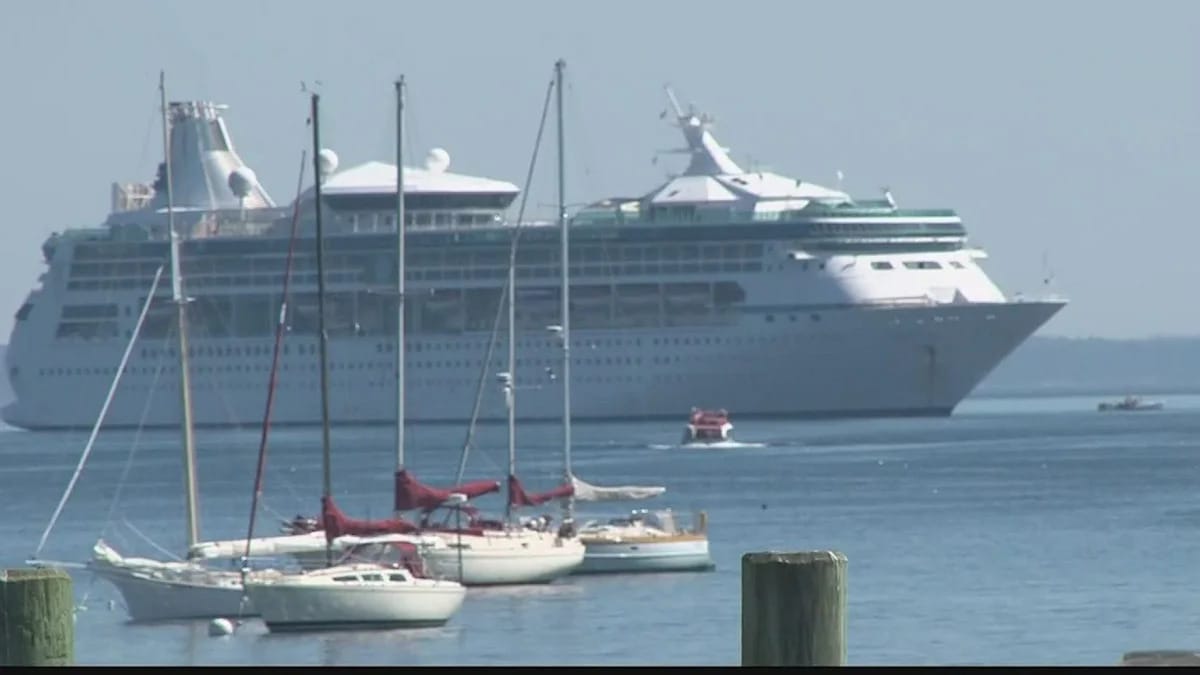
Large cruise ships generally anchor in Rockland Harbor and tender passengers to the Public Landing beside Harbor Park, a short walk from downtown. That makes the arrival schedule relevant well beyond the harbor.
A city-commissioned study of the 2025 season found that passengers spent an average of three hours ashore. Some 76% visited downtown and 71% explored on foot. Among downtown visitors, 43% ate in restaurants and 34% shopped.
Those figures do not establish that Rockland is overcrowded. They do show why the city should pay attention to the concentration of arrivals, rather than treating an annual passenger total as a sufficient management plan.
Visitors also traveled beyond Rockland. Seventeen percent visited Camden, 10% went to Rockport and 5% visited Owls Head. Overall, 82% described themselves as highly satisfied with their shore experience.
The spending case
Digital Research, Inc. surveyed 232 passengers and crew members during 11 cruise arrivals for the 2025 study. It estimated that cruise activity generated $1.7 million in spending in the Rockland area, supported 20 full-time-equivalent jobs and produced $113,000 in state tax revenue.
Passengers and crew accounted for an estimated $875,000 in direct local spending. Cruise lines spent approximately $600,000 on municipal charges, port and marine services, and Maine food and entertainment. Average visitor spending was $81 per person per shore visit, including $24 on food and beverages and $20 on shopping.
Rockland paid $5,400 for its portion of the research, which was part of a broader state-commissioned study. Those findings also provided assumptions for estimating the smaller 2026 season.
Nine calls had originally been scheduled for 2026, but Seabourn Ovation’s second planned visit was canceled because of a Cape Cod Canal transit issue. The remaining calls represented approximately 13,574 published lower berths.
Applying the earlier study’s occupancy, shore-participation and spending assumptions produced an estimate of about $610,000 in potential passenger spending. Scaling cruise-line purchases by the number of calls suggested another $270,000 in local spending on services, food, goods and entertainment.
A separate calculation using the city’s charge of $14 per lower berth projected approximately $190,000 in municipal revenue. That capacity-based projection is distinct from Luttrell’s $180,000 workshop estimate. Neither should be confused with the broader estimates of spending in the local economy.
The numbers make a reasonable case for taking cruise business seriously. They do not, by themselves, tell the council how many passengers should arrive in a particular week.
Residents still need to weigh in
The 2026 season was also the pilot year for PortShare Promise Midcoast, a cruise-tourism management initiative addressing passenger services alongside the needs of residents, businesses, cultural organizations and the working waterfront.
Its measures included a Harbor Park welcome center, a pilot trolley service, real-time communication with downtown businesses, trained community volunteers and improved visitor information. These are practical ways to organize visits. They are not substitutes for deciding how much traffic to accept.
Luttrell said the city plans to conduct a resident sentiment survey. I’d want that feedback before settling on the weekly ceiling. The rolling limit is a sensible tool, but 7,200 is still a proposed number, not an established measure of what works for Rockland.
The city already knows that most surveyed cruise visitors enjoyed their time ashore. The people who live there should help determine how often, and at what scale, that visit gets repeated.