MSC’s Meyer Werft Takeover Talks Put Ship Financing in Focus
MSC Cruises and Meyer Werft said detailed design work and negotiations on a formal contract for four New Frontier-class ships were nearing completion.
MSC’s Meyer Werft Talks Need to Tackle How the Ships Get Funded
Meyer Werft’s largest customer could become its controlling owner. That puts an awkward shipbuilding problem squarely in view: the yard has blamed part of its financial strain on building ships without progress payments. I’d judge an MSC takeover by what it does about that funding burden, rather than simply celebrating a return to private ownership.
MSC Group is in preliminary talks to acquire the 80.73% stake held by Germany’s federal government and the state of Lower Saxony, Bloomberg reported, citing people familiar with the discussions. No final decision has been made. The talks could end without a deal, and other bidders could emerge.
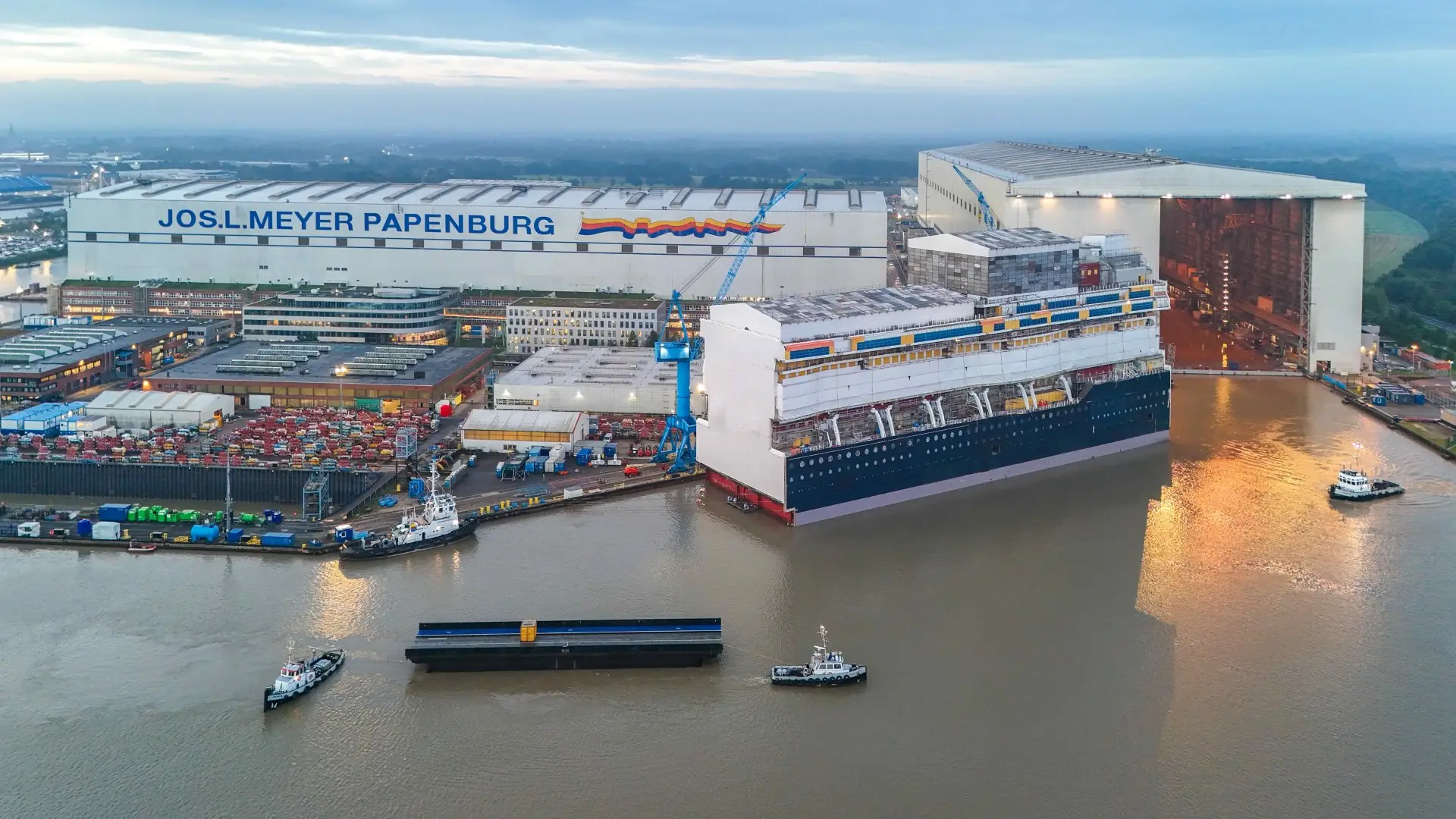
The acquisition would cover the shipbuilder’s facilities in Papenburg, near the Dutch border, and Rostock on the Baltic Sea. MSC Cruises is already Meyer Werft’s largest customer, according to Bloomberg. Owning the builder would give that relationship a very different set of responsibilities.
Meyer Werft projected a loss of approximately €384 million for 2025, citing losses on legacy contracts and the financing burden of constructing ships without progress payments. A busy yard can still be an expensive business to keep running. More orders alone do not resolve that.
Management expected losses to narrow toward break-even in 2026 as supply and labour costs declined, despite having no cruise ship deliveries scheduled that year. That would be meaningful progress, though it remains an expectation rather than a reported result.
The MSC construction contract has not been announced
The privately owned, Geneva-based MSC Group is negotiating ownership while a final shipbuilding contract with the yard has yet to be announced.
In December 2025, MSC Cruises signed a letter of intent for four New Frontier-class ships, with options for two more. The proposed vessels would measure approximately 180,000 gross tons and accommodate up to 5,400 passengers each.
Under the proposed six-ship program, deliveries would begin in 2030 at a rate of one vessel annually, keeping the Papenburg yard occupied through 2035. Bloomberg put the potential package value at up to €10 billion.
That schedule gives the ownership discussions a concrete industrial logic: MSC would be buying a yard with years of its own construction potentially ahead of it. But the distinction between a letter of intent and a construction contract matters here. The six-ship schedule also depends on the two options.
In a joint statement in late June, MSC Cruises and Meyer Werft said detailed design work and negotiations on the formal construction contract were nearing completion, with an agreement expected within weeks. A final shipbuilding contract has not been announced.
Bloomberg also reported in July 2026 that the German federal government had approved €11.5 billion in state loan guarantees for the cruise ship project. Whoever ends up owning the yard, public backing is already part of the proposed program.
The rescue needs more than an exit price
Government officials want to recover at least the €400 million invested in the equity stake in 2024, Bloomberg reported. The rescue also included €2.6 billion in loan guarantees to support refinancing and completion of existing orders.
Recovering that equity investment is a reasonable objective. It is too narrow a test of whether the rescue has worked. The yard’s ability to fund and complete its contracts deserves at least as much attention as the price paid for the governments’ shares.
Meyer Werft’s difficulties began during the Covid-19 pandemic, when supply-chain disruption delayed deliveries and new vessel orders declined. Inflation and higher costs following Russia’s 2022 invasion of Ukraine added further pressure.
The consequences extend well beyond MSC. Meyer Werft says it directly employs about 5,000 people, with more than 20,000 additional regional jobs tied to the company and its suppliers. Its work includes Carnival Cruise Line’s Carnival Festivale and Carnival Tropicale, Disney Cruise Line’s Disney Believe and three smaller Disney ships. It is also building river vessels for Viking, with delivery schedules extending to 2030.
Ownership is not a straightforward negotiation between MSC and the governments, either. The Meyer family, which owned the business for seven generations before the restructuring, retains just under 20% but no longer has management control. It holds a right of first refusal to repurchase the governments’ shares before 2028.
Spokespeople for the federal government, Lower Saxony and Meyer Werft declined to comment to Bloomberg on the ownership discussions. MSC did not respond to the news agency’s request for comment.
The strongest case for MSC ownership would be a yard that can afford to deliver the work MSC wants it to do. Securing years of construction is useful. Making that construction financially sustainable would be the achievement.