MSC Cruise Division Hits IMO 2030 Carbon-Intensity Target Early
MSC said it mapped full value-chain greenhouse gas emissions for the first time, extending beyond ship operations to shipbuilding, drydocks and procurement.
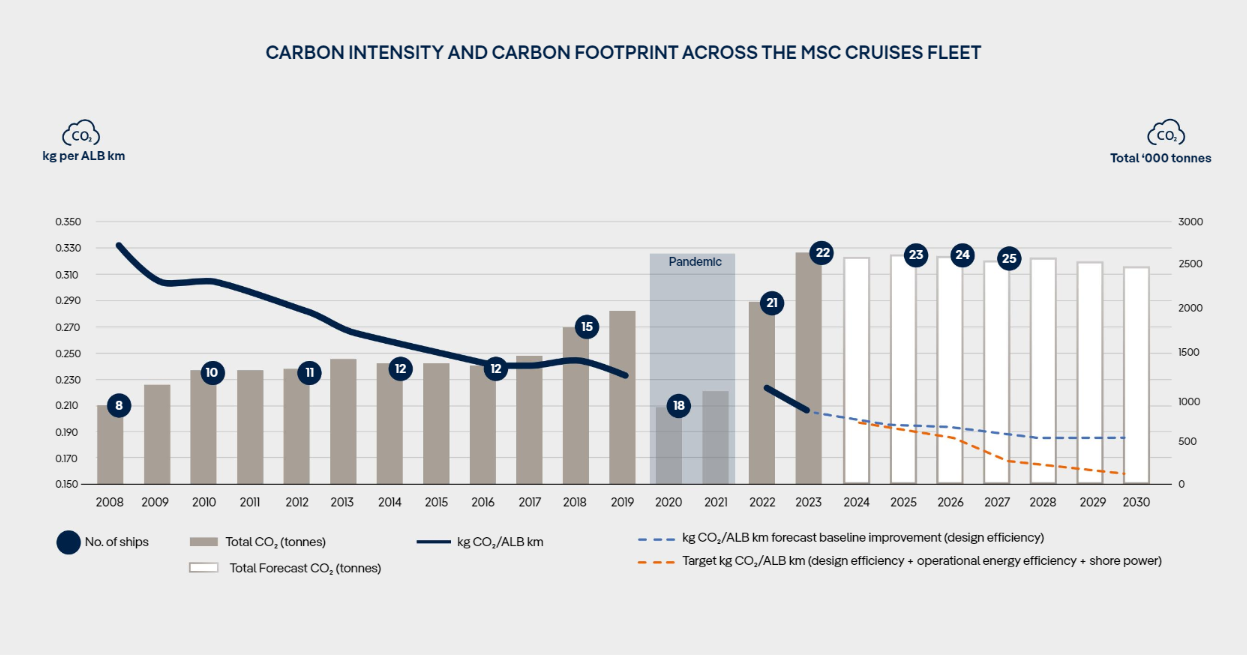
MSC Group's Cruise Division said it has achieved the International Maritime Organization's 2030 carbon-intensity reduction target five years ahead of the deadline, in its 2025 Sustainability Report published May 28. The seventh annual report covers MSC Cruises and Explora Journeys and says both brands remain on track for net-zero greenhouse gas emissions from marine operations by 2050.
The IMO target is a 40% cut in CO2 emissions per transport work by 2030 against a 2008 baseline, implemented through measures including EEXI and the Carbon Intensity Indicator framework. The metric measures efficiency, not an absolute cap on total emissions.
"We are advancing our energy transition while investing in our people, strengthening relationships with communities and taking a more structured approach to biodiversity," said Pierfrancesco Vago, executive chairman, MSC Group's Cruise Division.
The division used more than 9,800 tons of renewable fuels in 2025, with an associated emissions reduction of 48,714 tons of CO2e. It also made 217 shore-power connections during the year, cutting emissions at berth when ships could connect to shoreside electricity.
For cruise operators calling at major EU ports, shore-power readiness is also becoming a compliance issue: passenger ships over 5,000 GT will be required to connect to shore power in major ports from 2030. MSC's report also says the division mapped greenhouse gas emissions across its full value chain for the first time, extending beyond ship operations to shipbuilding, drydocks, employee travel, food and beverage procurement, logistics and waste.
On water resource management, MSC said 84.4% of freshwater was produced onboard, reducing volumes taken from shore. The company also continued port investments in 2025 with new terminals in Barcelona and Miami, both developed with environmental considerations.
LNG fleet and onboard efficiency projects
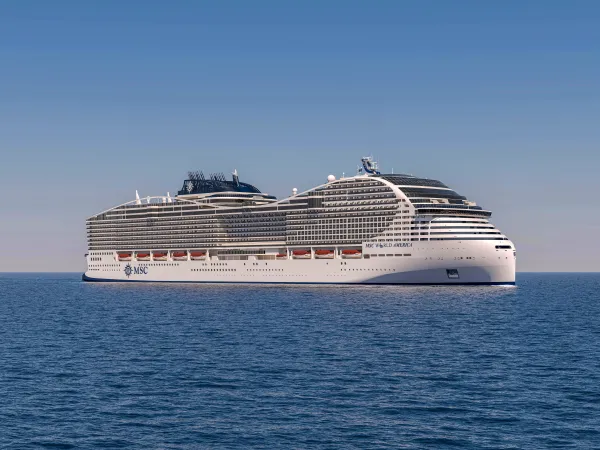
MSC World America, a World-class ship, entered service in 2025 as the company's third LNG-powered vessel with dual-fuel engine technology, joining MSC Euribia and MSC World Europa.
All future newbuilds across MSC Cruises and Explora Journeys will carry dual-fuel engine capability, MSC said. Michele Francioni, MSC Cruises' chief energy transition officer, said ships designed today will enter service in about five years and operate for 35 years or more, meaning they must be prepared for requirements beyond current sustainability targets.
Francioni said crew readiness is part of that transition. "A big challenge is ensuring that the crew is fit for purpose and well-trained to deal with these technologies," he said. He also cited an artificial intelligence project optimizing air-conditioning systems, saying the work saved "an enormous amount of energy."
Francioni named MSC World Asia in 2026 and MSC World Atlantic in 2027 as the next World-class LNG deliveries. MSC has also ordered four New Frontier-class ships with deliveries beginning in 2030, although details of those vessels' energy systems had not been confirmed.
Destination stewardship and marine protection
MSC refreshed its biodiversity strategy with actions focused on marine protection, whale-strike mitigation, route adjustments in sensitive areas and responsible tourism. At Ocean Cay MSC Marine Reserve in the Bahamas, the company completed a marine conservation facility in 2025; the island has also been designated a Mission Blue Hope Spot.