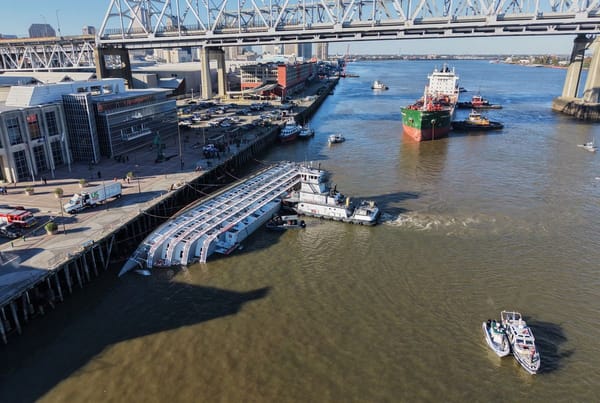
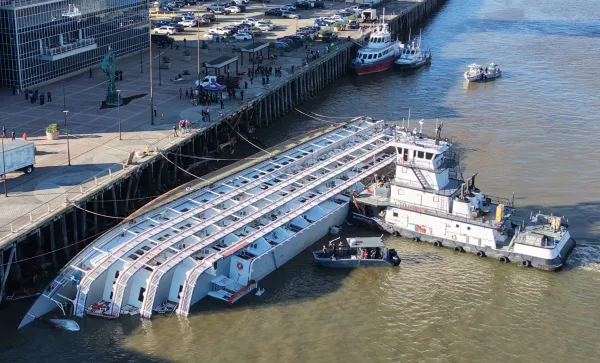
Tanker Steering Failure Capsizes Riverboat in New Orleans
About 87 passengers had disembarked before the American Heritage overturned, while Captain Leonard Stewart remained on the bridge coordinating assistance.
Updated November 23, 2026
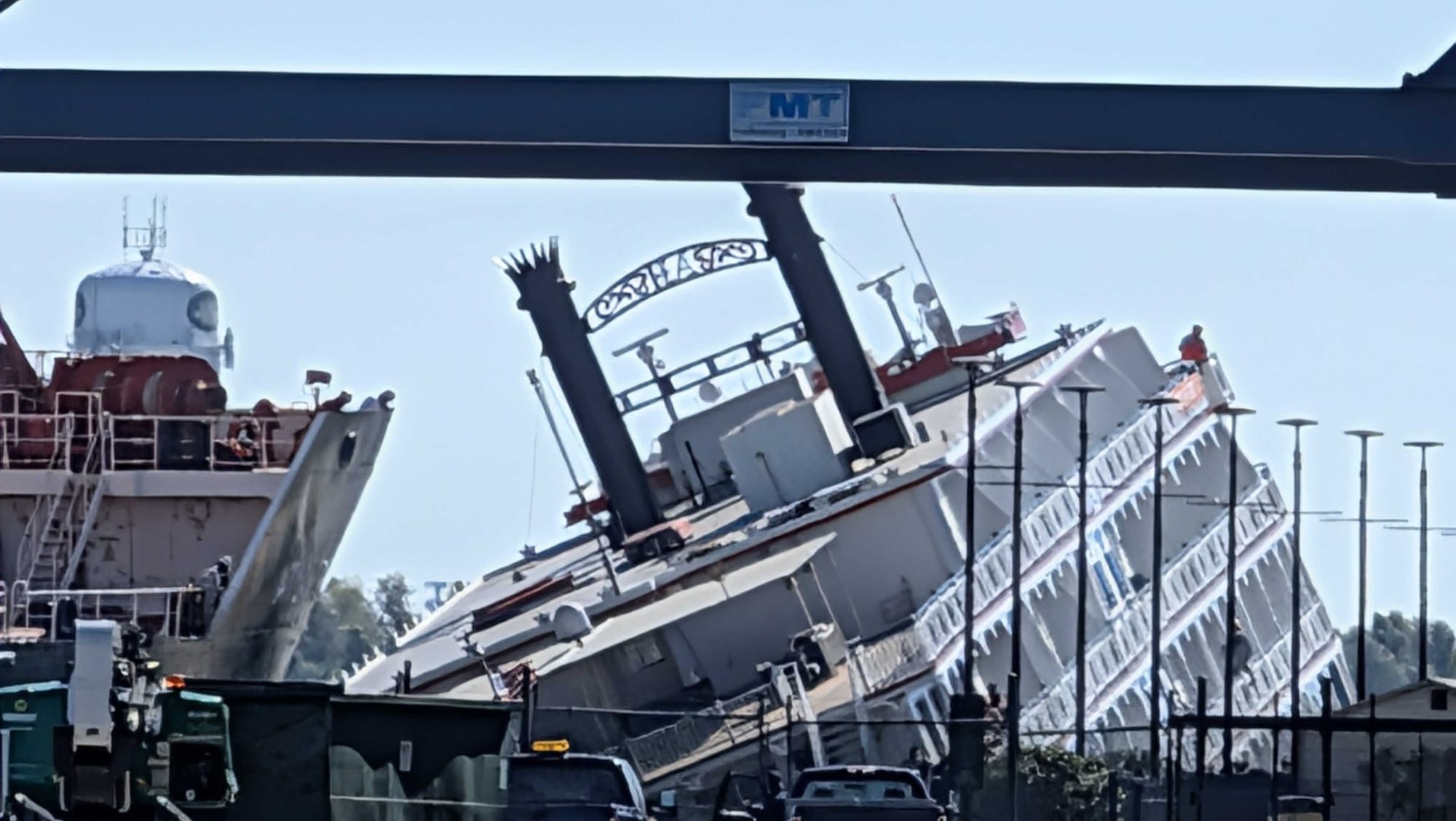
Thirty-two people were taken to hospitals after the tanker Atlantic Asphalt struck American Cruise Lines’ docked American Heritage on the Mississippi River in New Orleans on Friday, Nov. 13, causing the riverboat to capsize. Everyone aboard both vessels was accounted for. No deaths were reported.
The riverboat had been tied up near the Crescent City Connection for about two hours, and passengers had begun to disembark. Federal investigators have identified a steering casualty aboard the tanker but have not established what caused the failure.
Two Harbor Police officers involved in the rescue were among those initially hospitalized. In the latest hospitalization update, five people remained hospitalized: two in serious condition and three in stable condition.
Evacuation and assistance ashore
About 87 passengers got off before the riverboat overturned, Harbor Police Chief Melanie Montroll said. Others entered the river or held onto the exposed side of the vessel as police, firefighters, Coast Guard crews and nearby commercial vessels moved in to help. Firefighters lowered ladders from the dock. Rescuers pulled people from the water.
“As soon as it was reported, everybody ran to it,” New Orleans Mayor Helena Moreno said.
American Cruise Lines credited Captain Leonard Stewart and the crew with organizing the evacuation. The company said Stewart stayed on the bridge as the vessel capsized, requesting assistance and keeping the riverboat beside the dock for as long as he could.
Survivors were taken into the nearby Port of New Orleans Administration Building for medical assessment and a roll call. LCMC Health hospitals treated injured passengers. American Red Cross volunteers handed out refreshments and blankets and offered emotional support.
Lt. Gov. Billy Nungesser secured 85 hotel rooms for affected travelers. The city and American Cruise Lines also arranged transportation and assistance returning home. Some passengers had lost phones, identification, keys and medications. Louisiana State Police helped with replacement identification, while city partners assisted with prescription needs. The city subsequently closed its Family Assistance Center and directed passengers and crew needing further support to American Cruise Lines at 203-487-9252.
What investigators have found so far
The National Transportation Safety Board recovered the tanker’s voyage data recorder. Its initial reconstruction places Atlantic Asphalt upriver-bound near the Crescent City Connection at 12:26 p.m., when a steering casualty left its rudder turned to starboard. The tanker then veered toward the east bank and struck the docked riverboat at 12:28 p.m.
Recorded bridge audio included the ship’s whistle, marine-radio warnings and calls for assistance. It also captured instructions to deploy anchors and emergency maneuvering commands. Video evidence shows that the tanker’s anchors were deployed, although investigators are still determining which anchors were used and how far they were lowered.
Investigators continue to analyze the recorder and other electronic evidence. The NTSB said American Heritage capsized approximately 22 minutes after impact.
Investigators later put the riverboat’s complement at 140 passengers and 50 crew members. American Heritage is a roughly 295-foot, U.S.-flagged paddlewheeler with capacity for 150 guests. Chesapeake Shipbuilding in Salisbury, Maryland, built the vessel in 2015. It had been completing an eight-day voyage through Louisiana and Mississippi.
Atlantic Asphalt, a Marshall Islands-flagged asphalt and bitumen tanker, is approximately 525 feet long and was built in 2017. All 19 crew members aboard the tanker were accounted for, and no injuries were reported among them. Its manager, OSM Thome, activated an emergency response team and said it would cooperate with U.S. authorities.
Navigation limits remain during recovery work
The Coast Guard initially stopped vessel movements between river miles 93 and 96. Navigation later resumed under restrictions. A 500-foot safety zone remains in effect between miles 95.5 and 96.5, and the alternate channel is closed. Limited two-way passage is permitted through the main span, but deep-draft vessels and tows with at least 10 barges remain subject to one-way transit.
Vessels must coordinate passage with Vessel Traffic Service Lower Mississippi River and travel at their slowest safe speed. Canal Street–Algiers Point ferry operations resumed at 6:30 p.m. Friday after a precautionary suspension.
A Unified Command comprising the Coast Guard and American Cruise Lines is overseeing fuel removal and salvage planning. Divers began examining submerged hull damage on Sunday, Nov. 15. Crews are working to remove more than 16,000 gallons of diesel from the capsized riverboat.
Containment boom remains around American Heritage. The Coast Guard said an initial sheen had dissipated and no further pollution had been observed. Atlantic Asphalt has been towed away, but officials have not announced a timetable for removing the riverboat.
The Board of Commissioners of the Port of New Orleans also filed a federal maritime property-damage lawsuit against Atlantic Asphalt, Nave Shipping and Thome Ship Management. The court docket lists a $1 million demand. A federal judge granted the port’s request for a warrant to arrest the tanker.
The NTSB is seeking video evidence from witnesses at witness@ntsb.gov as it examines the vessels, personnel and surrounding conditions. A preliminary investigation report is expected within about 30 days.