Atlantic Asphalt Rudder Stayed Starboard Before New Orleans Collision
Preliminary findings indicate Atlantic Asphalt's rudder remained turned to starboard; its recovered voyage recorder captured radio warnings and emergency orders.
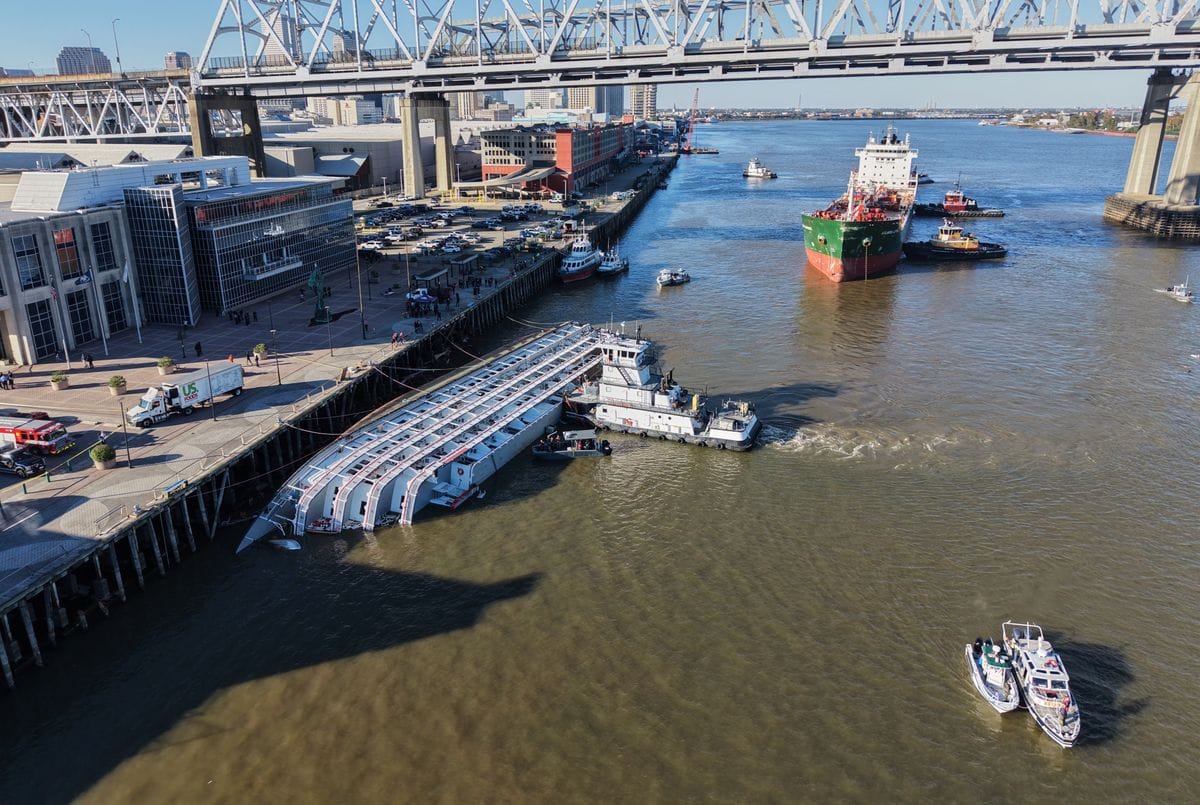
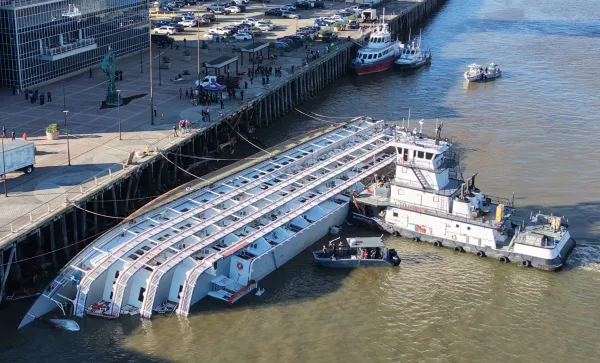
All passengers and crew survived after the tanker Atlantic Asphalt struck American Cruise Lines' docked American Heritage in New Orleans on Friday, Nov. 13, 2026, causing the riverboat to capsize and partially sink. Thirty-two people, including two harbor police officers involved in the rescue, were taken to hospitals.
By Monday, Nov. 16, four people remained hospitalized, according to New Orleans officials. One was in serious condition and the other three were stable.
The Port of New Orleans initially reported that 129 passengers, plus crew members, were aboard the riverboat. Investigators subsequently put the count at 140 passengers and 50 crew members, with another 19 crew aboard the tanker. Everyone on both vessels was accounted for, and no injuries were reported aboard the tanker.
Preliminary findings indicate that the tanker's rudder remained turned to starboard, sending it toward the Mississippi River's east bank, where the passenger vessel was moored. Investigators have not determined what caused the steering problem.
The tanker's voyage data recorder was recovered for examination. Its contents included sounds consistent with whistle signals, along with radio warnings, calls for assistance, anchor commands and emergency maneuvering orders.
Evacuation at the dock
The collision occurred at about 12:30 p.m. outside 1350 Port of New Orleans Place. The riverboat had tied up roughly two hours earlier for disembarkation after an eight-day itinerary visiting destinations in Louisiana and Mississippi.
New Orleans Harbor Police Chief Melanie Montroll said 87 passengers got ashore before the vessel rolled over. Crew members distributed life jackets and helped organize the evacuation as emergency personnel and nearby boats approached.
“Unfortunately, we were not able to get everyone off before the boat started to take on water,” Montroll said.
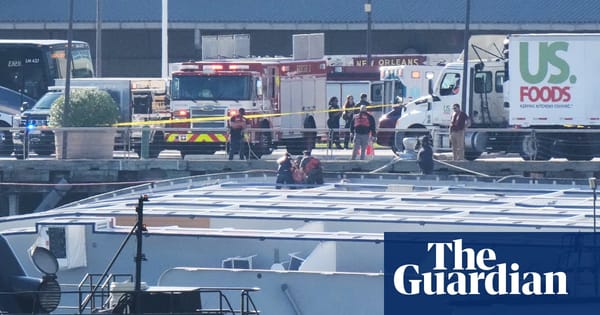
Harbor police, firefighters, New Orleans police, emergency medical personnel and the U.S. Coast Guard responded. Tugboat crews, workers along the waterfront and people aboard other vessels also helped pull survivors from the 66-degree Fahrenheit river. The rescue took approximately 45 minutes.
Passenger Joe Knab told WDSU-TV that repeated blasts from the tanker's horn provided the first warning. He said the crew gathered people on the third deck to don life jackets. He estimated that he spent about 15 minutes in the water.
American Cruise Lines said it was coordinating its response with the Coast Guard and local authorities and expressed concern for everyone affected.
Survivors who did not need hospital treatment were taken to a nearby auditorium, where cruise personnel checked names against the passenger list. New Orleans Mayor Helena Moreno said many travelers were from outside the city and had lost identification, phones, keys and other belongings.
City officials arranged food, accommodations and transportation, while Louisiana State Police assisted with replacement identification. The city and cruise operator also helped passengers contact relatives and organize their journeys home.
Built in 2015 by Chesapeake Shipbuilding in Salisbury, Maryland, the approximately 295-foot American Heritage is a U.S.-flagged paddlewheeler with accommodation for up to 150 guests.
Port sues, and moving the riverboat could take weeks
The Board of Commissioners of the Port of New Orleans filed a lawsuit Friday alleging that the tanker caused at least $1 million in damage to its terminal. A judge issued a warrant placing the tanker under federal control.
The vessel's owner, Liberia-registered Nave Shipping SA, was among the defendants. International Maritime Organization records identify Nave as the registered owner, while MarineTraffic identifies it as a subsidiary of China State Shipbuilding Corp. The Chinese company did not respond Friday to an Associated Press request for comment.
The Marshall Islands-flagged Atlantic Asphalt measures about 520 feet and has a gross tonnage of 14,485. It carries asphalt and bitumen, although whether it had cargo aboard at the time of the collision was not immediately established.
The Coast Guard halted vessel traffic near the scene after the impact. Restrictions remained in place Saturday, and cross-river RTA ferry operations had also been suspended as a precaution.
By Saturday, the tanker had been towed away, but the riverboat remained on its side against the terminal. U.S. Coast Guard Capt. Melanie Burnham, chief of Sector New Orleans, said moving the damaged passenger vessel could take weeks. She said the first step was safely removing approximately 16,000 gallons of fuel.
The National Transportation Safety Board is examining the collision alongside the Coast Guard. The safety board expects to publish a preliminary report within about 30 days.