Tanker Steering Failure Capsizes American Heritage in New Orleans
The riverboat rolled onto its side about 22 minutes after the collision; 87 passengers escaped while it remained afloat as rescue crews and nearby boats recovered others.
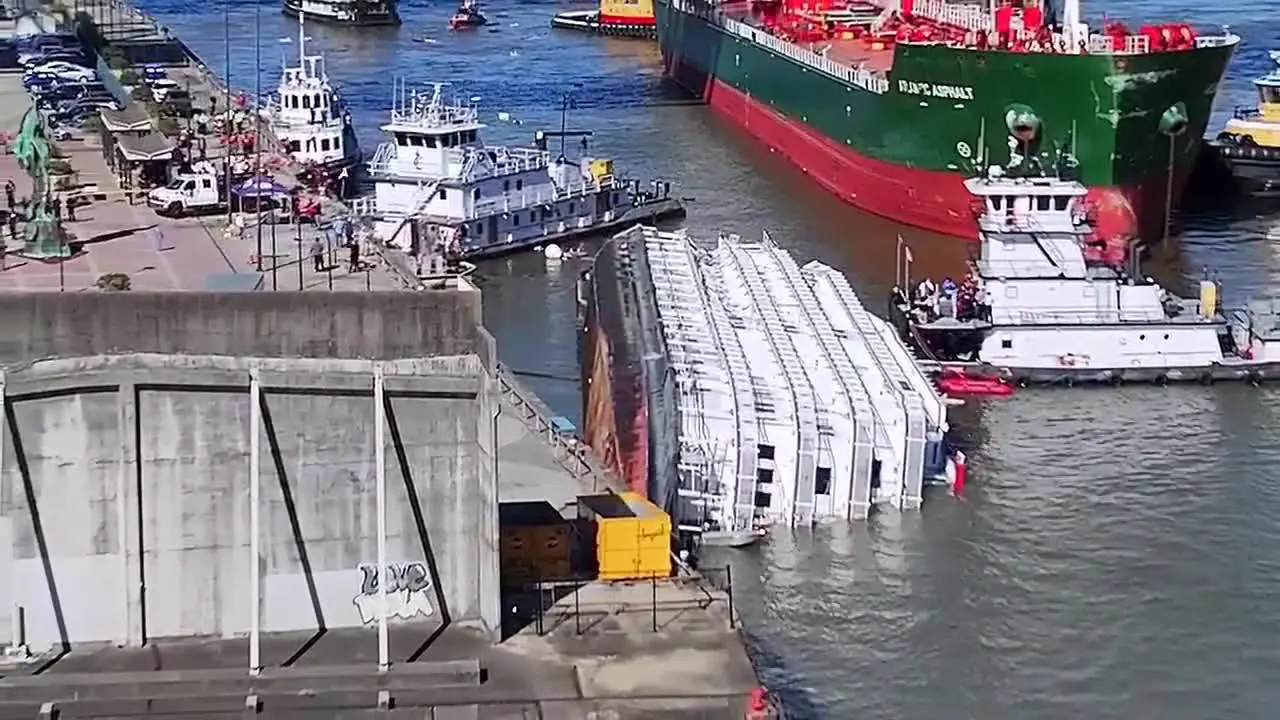
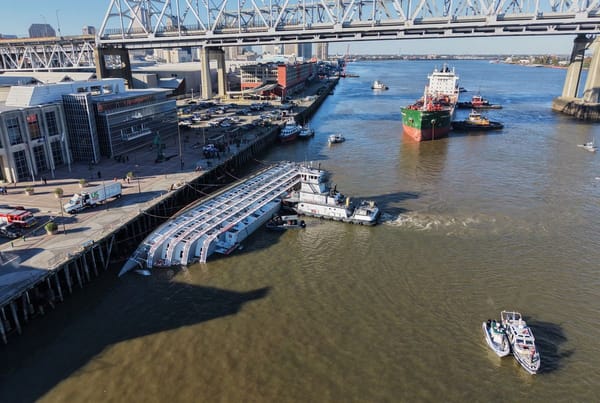
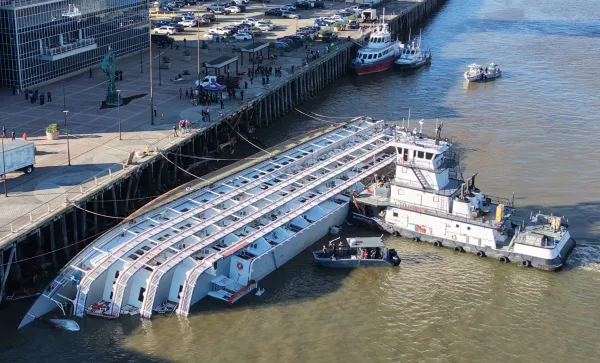
American Cruise Lines’ American Heritage capsized in New Orleans on Friday, Nov. 13, 2026, after the tanker Atlantic Asphalt struck the docked riverboat, sending passengers and crew into the Mississippi River. Everyone aboard both vessels was accounted for, with no fatalities; 32 people were hospitalized, including two harbor police officers involved in the rescue.
National Transportation Safety Board investigators identified a steering failure that left the tanker’s rudder turned to starboard and sent the ship toward the river’s east bank. Investigators have not determined what caused the steering malfunction.
Officials initially described the injuries as non-critical. By Monday, Nov. 16, four people remained hospitalized, including one in serious condition and three in stable condition, according to New Orleans officials.
The Coast Guard reopened the river on Saturday, Nov. 14, with a 500-foot safety zone around the damaged riverboat and one-way navigation between mile markers 95.5 and 96.5. The agency had initially halted all vessel movements between mile markers 93 and 96; cross-river RTA ferry service was also suspended after the impact.
Evacuation continued as the riverboat overturned
American Heritage had tied up outside the Port of New Orleans Administration Building about two hours before the approximately 12:30 p.m. impact. The vessel was completing an eight-day Mississippi River itinerary through Louisiana and Mississippi.
Investigators later counted 140 passengers and 50 crew members aboard the riverboat, following varying early estimates. Atlantic Asphalt carried 19 crew members, none of whom was injured.
The riverboat began taking on water after the strike and rolled onto its side approximately 22 minutes later, according to the NTSB. New Orleans Harbor Police Chief Melanie Montroll said 87 passengers escaped while the vessel remained afloat. Others entered the river or held onto exposed railings as the ship overturned.
Harbor police officers and firefighters boarded the damaged vessel during the evacuation. Firefighters lowered ladders from the dock, while tugboats, nearby commercial vessels and private boat operators helped recover people from the water. The Coast Guard deployed boats, cutters and helicopters.
“We are grateful for all of our partners that showed up immediately. It made a difference in our rescue efforts,” said Capt. Melanie Burnham, commander of Coast Guard Sector New Orleans.
Survivors were taken into the nearby port administration building for medical assessments and a roll call. New Orleans Mayor Helena Moreno said many passengers were from out of town and had lost identification, phones, keys and other belongings.
American Cruise Lines arranged hotel accommodations and assistance with travel home. City officials and partner organizations also helped passengers obtain replacement prescriptions, food, transportation and access to phones; Louisiana State Police assisted travelers needing replacement identification.
“We are in close coordination with the U.S. Coast Guard and local authorities,” American Cruise Lines said in a statement.
A paddlewheeler and an asphalt tanker
American Heritage is a roughly 295-foot paddlewheeler built by Chesapeake Shipbuilding in Salisbury, Maryland, in 2015 and refurbished in 2022. The five-deck riverboat accommodates up to 150 guests.
Atlantic Asphalt is a 160-meter, 14,485-gross-ton asphalt and bitumen tanker built in 2017 and registered in the Marshall Islands. Its registered owner is Liberia-based Nave Shipping SA. Vessel manager OSM Thome said the tanker had separated from the riverboat and was stable at anchor while damage assessments continued.
Authorities had not established whether the tanker was carrying cargo at the time of the accident or whether hazardous materials had entered the river.
What the tanker’s recorder captured
NTSB investigator-in-charge Bart Barnum said Atlantic Asphalt was traveling upriver toward an oil facility in Reserve when the steering casualty occurred near the Crescent City Connection bridge. The tanker struck American Heritage about two minutes later.
Investigators recovered the tanker’s voyage data recorder and reviewed bridge audio and vessel-movement information. Barnum said the recordings captured the ship’s whistle, radio warnings and requests for assistance, orders to deploy anchors and emergency ship-handling commands.
NTSB Member John DeLeew said video showed the tanker’s crew responding to orders to drop its anchors. Investigators were still examining whether there was sufficient time for that action to prevent the impact.
The Coast Guard is leading the marine casualty investigation and assessing salvage requirements for the capsized riverboat. Authorities have not announced a removal timetable. The NTSB expects to issue a preliminary report within about 30 days.