Taiwan to Open Penghu Cruise Terminal in Early 2027
Automated Immigration Clearance Lanes became available to all foreign cruise passengers in June, bringing Keelung to 12 lanes and Kaohsiung to eight.
Taiwan is preparing to open the Penghu International Cruise Terminal in early 2027 for ships of up to 150,000 gross tons, alongside plans to expand Keelung’s capacity to handle two 250,000-ton ships simultaneously. High-capacity shore-power systems are also under construction at Keelung and Kaohsiung for service next year.
Taiwan’s cruise passenger volume exceeded 800,000 through July 2026, up 22 percent year on year, according to Joe Y. Chou, chairman of Taiwan International Ports Corporation (TIPC). Chou said the market’s performance remained in line with expectations for the full-year season.
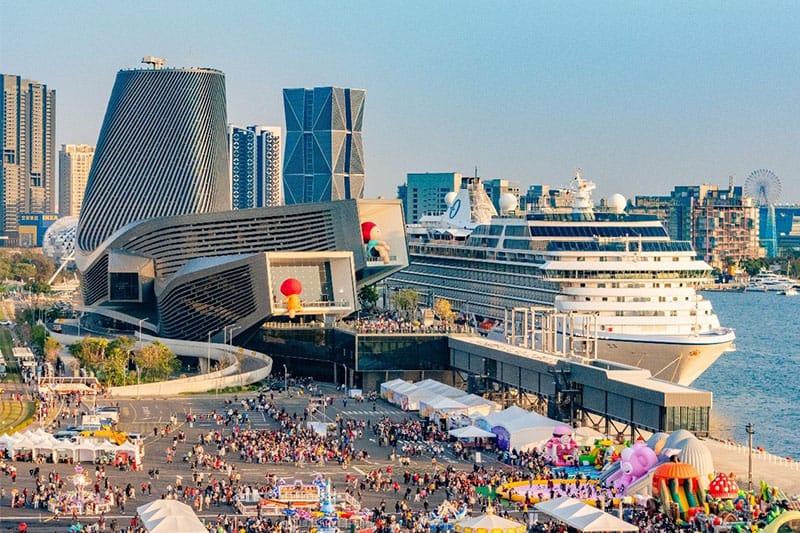
Keelung hosted three cruise ships simultaneously for the first time in seven years and received inaugural visits from The Ritz-Carlton Yacht Collection’s Luminara and AIDAdiva. At Kaohsiung, MSC Bellissima made its homeport debut; the port’s newer cruise terminal can berth two vessels of up to 225,000 gross tons at once.
“Major hubs like Keelung and Kaohsiung continue to elevate their homeport capabilities, and emerging ports are actively expanding international transit itineraries,” Chou said.
Building out Penghu, Keelung and Kaohsiung
The Penghu passenger terminal at Magong Port follows a berth-extension project completed in April 2024. No. 1 Wharf was lengthened from 190 meters to 380 meters, increasing the maximum vessel size from approximately 50,000 gross tons to the limit planned for the new terminal.
The berth works cost approximately NT$829 million, while the separate passenger-terminal project carries an investment of about NT$631 million. The shoreside building will provide waiting areas, immigration and customs facilities, passenger circulation routes, and leisure and retail space.
At Keelung, redevelopment will proceed in phases across the East Cruise Terminal and its surrounding waterfront. The two-ship capacity comes at the end.
The shore-power projects at Keelung and Kaohsiung will allow suitably equipped vessels to draw electricity from land while berthed and shut down their diesel generators.
Moving passengers through the terminals
TIPC also plans to introduce an AI-based travel customer-service system, Chou said. A crowd-monitoring and security system will run alongside it to analyze passenger movements, immigration processing, boarding, baggage handling and ground transport, with the findings used to refine terminal operations.
Automated Immigration Clearance Lanes, known as e-Gates, became available to all foreign cruise passengers in June. Additional installations brought Keelung’s total to 12 lanes and Kaohsiung’s to eight.
Terminal signs use traditional Chinese, English, Japanese and Korean, supplemented by pictograms. Barrier-free infrastructure, nursing rooms and family spaces support passengers with different mobility and age-related needs.
For onward journeys, terminals provide real-time information for regional trains, high-speed rail and bus services. At Kaohsiung’s newer cruise terminal, the light-rail Cruise Terminal Station is approximately a one-minute walk away.
Chou said cruise-line partnerships require an understanding of operators’ needs and early knowledge of deployment plans and market conditions. TIPC has also developed a range of shore itineraries, including port and city tours, matched to ships’ schedules and passenger preferences.
Chou expects a more varied mix of cruise callers in the coming year. TIPC’s outlook includes 305 cruise calls, with projected year-on-year increases of 7 percent in calls and 4.3 percent in passenger volume.