Pangolin Voyager’s Electric Design Enhances Chobe Photo Safaris
A separate eight-seat photography boat departs at first light and before sunset, equipped with articulated camera-support arms and 360-degree rotating gimbals.
Pangolin Voyager’s Quiet Electric Design Deserves More Attention Than Its Trophy
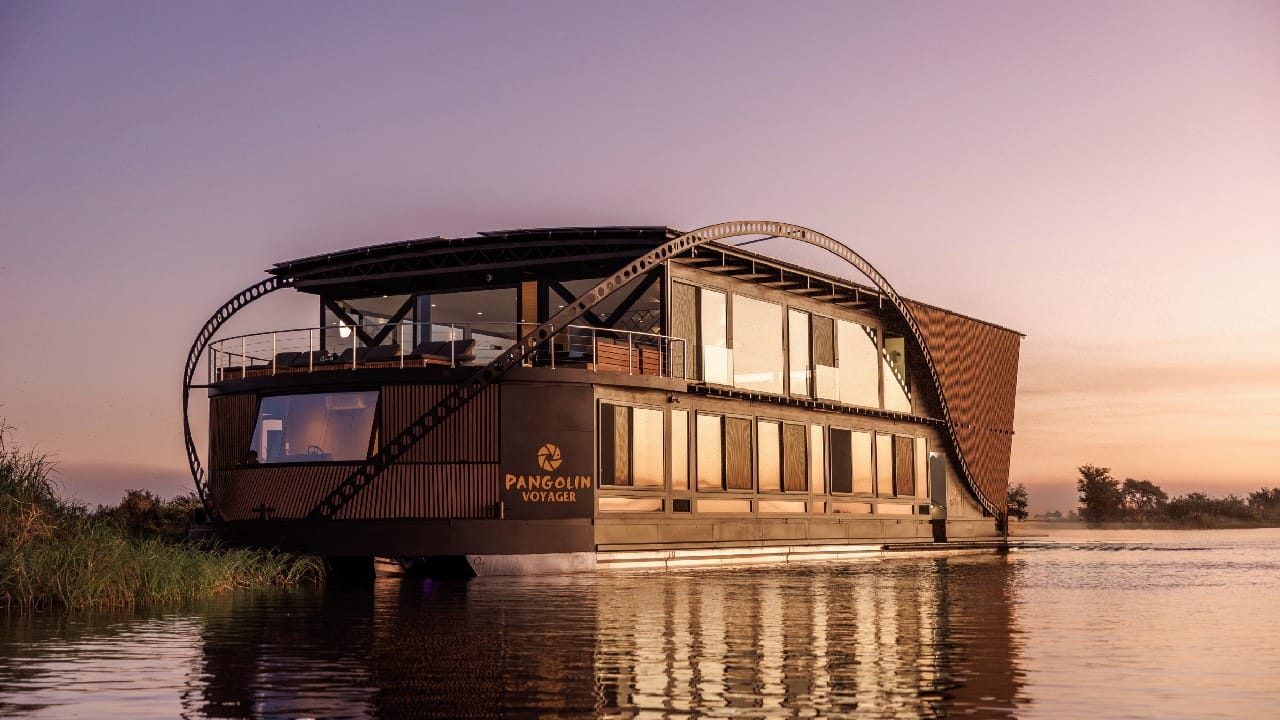
Pangolin Voyager’s four electric outboards were chosen with a specific job in mind: giving wildlife photographers a quieter experience on the Chobe River. For a houseboat carrying just 10 guests, that strikes me as a more persuasive selling point than a “World’s Best” title.
The solar-electric trimaran, operated by Pangolin Photo Safaris from the Namibian side of the river, received both World’s Best River Cruise Ship and Africa’s Best River Cruise Ship for 2026 at the sixth World Cruise Awards on October 12.
Those awards are decided by cruise-industry professionals and public voters, and the highest vote total wins each category. That is recognition worth having, but it tells us who won the vote. The vessel’s design tells prospective guests considerably more about the trip.
Electric propulsion with a clear purpose
“We wanted a boat that let photographers experience it quietly and with as little disturbance as possible,” said Gerhard “Guts” Swanepoel, co-founder of Pangolin Photo Safaris.
I like the clarity of that brief. Quiet operation has an obvious place on a houseboat built around observing wildlife. Pangolin says it is also among the features guests have singled out in their feedback, alongside the photography boat, food and onboard service.
The propulsion system uses four RAD 40 electric outboards from UK supplier RAD Propulsion, each rated at 40 kW. Two are positioned forward and two aft. A pair of 61-kWh batteries stores electricity for use aboard.
On the roof, 80 solar panels have a reported output of approximately 20–30 kW, depending on conditions. The array supplies propulsion and onboard systems, feeding the drives directly during daylight operation. Those figures describe the equipment. They do not establish how long the vessel can operate on solar power alone.
The 31.7-meter aluminium vessel was built by Edelstahlbau CC, also known as ESB Boats, in Windhoek, Namibia, and assembled on the banks of the Zambezi. Construction took nearly two years. Pangolin describes Voyager as Africa’s first solar-powered, all-aluminium houseboat.
A small boat with a specific audience
The accommodation follows the same focused approach. Five en suite cabins can be configured with double or twin beds, and each has air conditioning and floor-to-ceiling windows fitted with mosquito netting. Upstairs are the lounge, dining space and bar, plus a darkened suite for editing photographs.
A separate eight-seat photography boat accompanies the houseboat, departing at first light and again before sunset. It has articulated camera-support arms and gimbals that rotate through 360 degrees.
Based in Kasane, Botswana, Pangolin caters to photographers from beginners to professionals and offers hosted safaris led by resident wildlife photographers. The editing space and camera supports give that specialism substance.
Voyager’s appeal rests on that consistency. The accommodation, excursions and propulsion have been designed around a recognisable purpose. I’d like to see more cruise design decisions judged that way: by how well they serve the trip guests actually booked.