Fincantieri Holds 56% of Cruise Ships Due for Delivery by 2039
Fincantieri operates 18 shipyards across three continents, while T. Mariotti accounts for the remaining percentage point in Italy’s 57% vessel share.
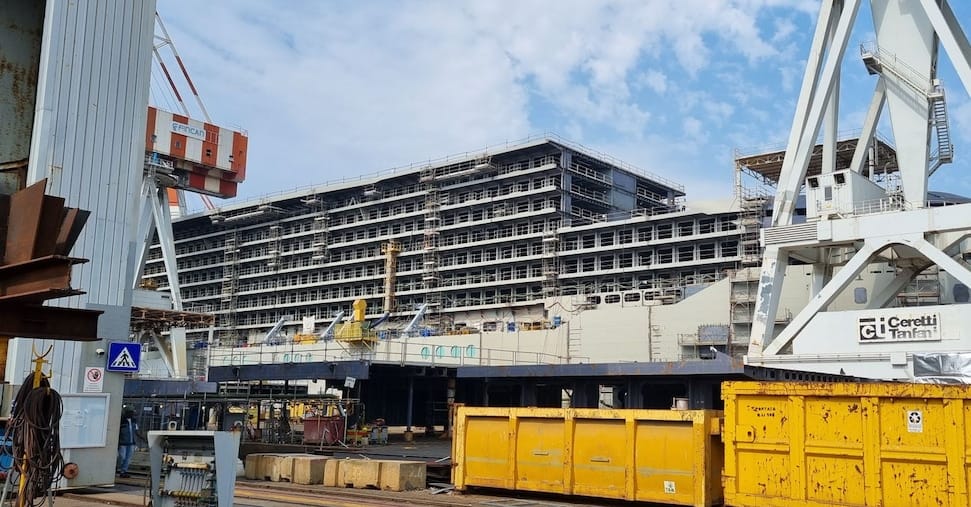
Italy’s cruise shipbuilding lead rests overwhelmingly on Fincantieri
Fincantieri accounts for 56% of cruise vessels scheduled for delivery between 2026 and 2039. More than half the ships in that orderbook sit with one shipbuilding group. That is a level of concentration I’d want cruise executives to take seriously.
A study by Cassa Depositi e Prestiti (CDP), with findings disclosed in advance by Il Sole 24 Ore, puts Italian builders’ combined share at 57% of vessels and 54.4% of contract value. Genoa-based T. Mariotti supplies the additional percentage point by vessel count. Italy’s lead is substantial, but it is overwhelmingly Fincantieri’s lead.
Fincantieri accounts for 54% of the worldwide cruise orderbook’s value, with T. Mariotti contributing another 0.4%. That is dominance by both measures.
Fincantieri operates 18 shipyards across three continents, an important qualification: the concentration sits within one group, not at one yard. Even so, much of the cruise industry’s future fleet programme rests with a single company.
The other major builders are well behind
CDP assigns 19% of the scheduled vessels to Meyer’s German and Finnish shipyards combined. The German yards account for 14% and Meyer Turku for 5%. France’s Chantiers de l’Atlantique holds another 14%, while builders in other countries share the remaining 10%.
The gap narrows when measured by contract value. The German Meyer yards hold 18%, Meyer Turku 9% and Chantiers de l’Atlantique 17%. Those are substantial positions, but none approaches Fincantieri’s share on its own.
I would treat delivery performance as the more important scorecard from here. An orderbook records work secured across a long period, in this case through 2039. Its usefulness to cruise lines ultimately depends on turning those contracts into ships.
The industrial base extends beyond the yards
Giving Fincantieri its due should not erase the businesses around it. CDP describes a wider Italian shipbuilding industry of 451 companies, excluding yacht builders, with combined turnover of €7.9 billion. These national figures cover shipbuilding more broadly, not cruise construction alone.
The wider supply chain generates an estimated €4.8 billion in added value. Ship and floating-structure construction contributes €1.7 billion, about 36% of the total. Upstream suppliers and downstream services together contribute more than €3 billion.
Upstream activities account for approximately 35%. Planning, engineering, design, research and development, and information technology contribute 13%. Materials and energy inputs supply 11%, with components such as propulsion equipment, electrical systems and interior fittings contributing another 11%.
Downstream businesses account for around 30%, including delivery and logistics, maintenance and repair, and operational, financial and property services.
A small slice of shipbuilding, a dominant position in cruise
Europe’s roughly 3% share of overall shipbuilding production, in CDP’s data updated to 2025, gives little sense of its importance to cruise. Cruise ships and ferries together represented just over 2% of worldwide production in 2024. Container ships accounted for 41%, bulk carriers 27%, and gas carriers and oil tankers roughly 17%, a segment CDP links to growth in the liquefied natural gas market.
China produces more than half of global shipbuilding output and holds 60% of orders. South Korea and Japan rank second and third by production volume. Cargo vessels account for about 60% of Chinese shipbuilding exports, more than 40% of South Korea’s and over 70% of Japan’s.
Italy and France have a different emphasis. Passenger vessels account for 75% of Italy’s shipbuilding exports and 64% of France’s. Their respective shares of the global passenger-vessel market are 20% and 12%.
For cruise, it is the orderbook concentration that deserves attention. With 56% of scheduled vessels on its books, Fincantieri’s delivery performance is an industry-wide concern, well beyond Italy’s claim to shipbuilding leadership.