ECN Launches Responsible Tourism Framework for Expedition Cruises
Participants completed a 35-question self-assessment with supporting evidence, and an independent judging panel reviewed submissions across six responsible-tourism areas.
ECN’s expedition badges go public. The detailed feedback stays private.
Expedition operators taking part in ECN’s new responsible-tourism framework will get a badge to display on their websites and in marketing materials. The detailed reports identifying their strengths and opportunities for improvement will be seen only by the operators themselves.
That split matters for a scheme designed to help travel advisors compare operators. I’d put a short, operator-specific explanation alongside every public badge. Simplifying sustainability reporting is a sensible move, but advisors still need to explain which practices support the label.
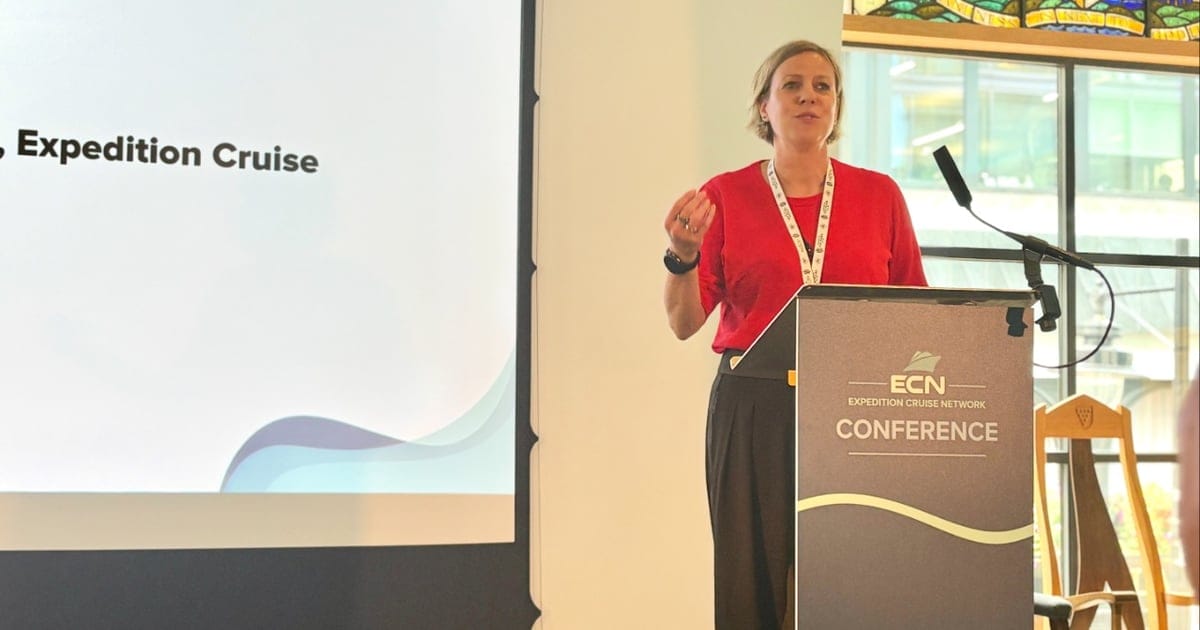
The Expedition Cruise Network launched its voluntary ECN Responsible Expedition Framework at its third annual conference in London, with 11 operators assessed in the first round.
There is a concrete problem behind it. ECN, which launched in April 2023, found through research among its advisor members that lengthy sustainability and ESG reports were difficult to interpret. Advisors also wanted a more consistent basis for comparing operators and speaking confidently with clients.
“What has been missing is a common and accessible way of looking at that complete picture and communicating it clearly to the travel trade,” said Akvile Marozaite, ECN’s CEO and co-founder.
That is a good brief. The challenge is to reduce the reading without losing the explanation.
Five stages, backed by an evidence review
Each participant has been assigned a current stage on a five-stage progression: Emerging, Developing, Integrated, Embedded or Contributing. The progression starts with the foundations of responsible operations, moves through integrating practices across the business, and extends to positive contributions beyond the voyage.
Those labels are supported by more than an operator’s declaration. Participants completed a 35-question self-assessment and submitted evidence for their answers. Responses were weighted, and submissions went through a review process involving an independent judging panel.
The assessment covers six areas: governance and sustainable management, certifications and external validation, environmental stewardship, responsibilities toward communities, cultures and destinations, guest education and expedition ethos, and contributions to conservation and positive impact.
ECN drew on sustainability principles from the Global Sustainable Tourism Council and the United Nations Sustainable Development Goals. It also included expedition-specific issues such as biosecurity and wildlife encounters, alongside citizen science, conservation partnerships and contributions to host communities and destinations.
I’m glad those expedition-specific practices are in the assessment. A broad sustainability label is much less useful if it tells an advisor little about how an operator approaches wildlife or protects the places passengers have travelled to see.
Marozaite said the assessment is complicated by the multiple functions expedition operators perform, spanning accommodation, transportation, tours and education. The framework brings those responsibilities together, including consideration of what benefits remain in a destination after a ship leaves.
Who is participating, and what comes next
The inaugural participants were Aqua Expeditions, Aranui Cruises, Australis Cruises, Golden Galapagos, HX Expeditions, Oceanwide Expeditions, Ponant, Poseidon Expeditions, Scenic Eclipse, 60South and UnCruise Adventures.
Travel advisors and consumers will be able to view participating operators and their stages in a dedicated section of ECN’s website. Participants will repeat the assessment annually to demonstrate progress, and further operators are expected to join future cycles.
The confidential feedback will cover opportunities to strengthen policies, measurement and partnerships, as well as guest education and support for conservation or research. ECN intends that feedback to help operators improve.
“Continued access to these destinations will increasingly depend on how responsibly we visit them,” Marozaite said, referring to environmentally sensitive destinations and remote communities.
Keeping detailed improvement reports private can serve that internal work. For the advisor-facing side, I want enough of the reasoning made accessible to support a recommendation. An advisor should be able to explain why an operator earned its stage, rather than merely point to the badge.