China Expands Cruises to Nowhere as Permit Rules Remain Unclear
The first trial took place in June aboard Adora Magic City from Shanghai’s Wusongkou International Cruise Terminal, followed by Tianjin Oriental’s August trials aboard Visio.
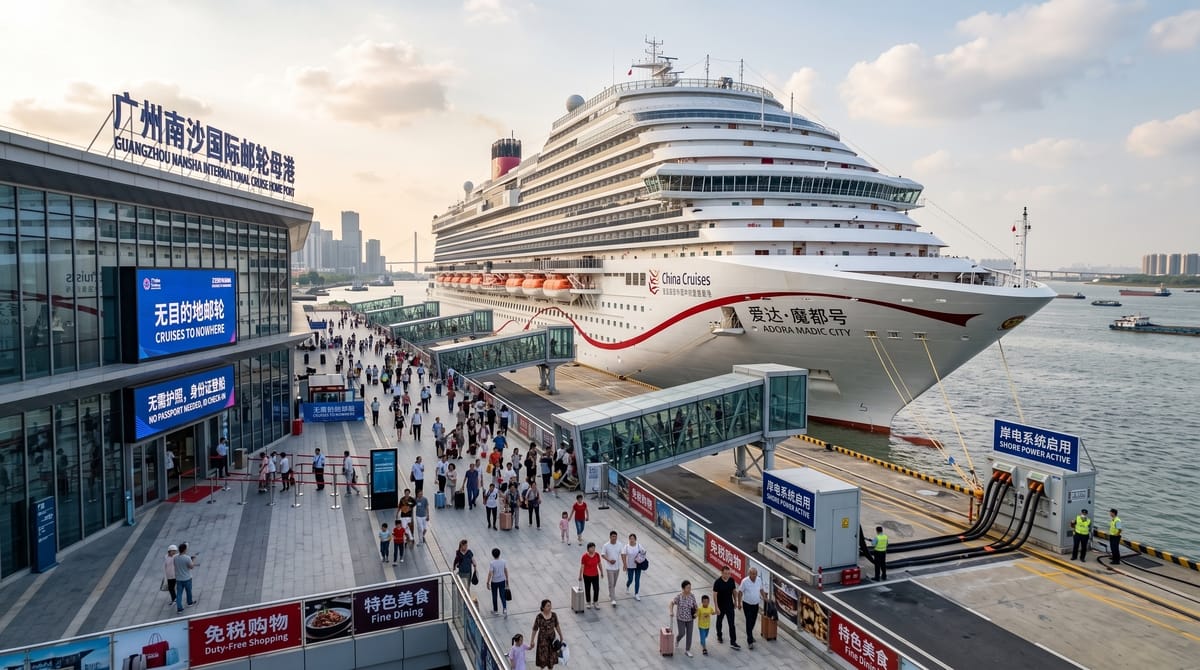
Shanghai’s simpler permits should be the model for China’s cruises to nowhere
Eligible travelers in Shanghai can apply for a dedicated entry-exit permit using identity documents, avoiding the standard passport procedure. For a three-day cruise that never calls at another port, that is a sensible bit of simplification.
I’d make that approach a priority as China expands its cruises-to-nowhere trials. Adding departure ports is useful. Making a short break easier to take gives travelers a more concrete reason to consider it.
China’s Ministry of Transport has named Xiamen, Guangzhou and Shenzhen as the next trial cities, extending a program piloted in Shanghai and Tianjin. The ministry wants non-destination cruising to become a regular product: short international voyages that leave from and return to the same Chinese port, with passengers spending the voyage at sea rather than visiting another destination.
The dedicated permits in Shanghai, described by the Ministry of Culture and Tourism, fit that proposition neatly. The complication is that the wider expansion remains a collection of approved pilots, not a single nationwide passenger framework.
A shorter trip is reaching a younger audience
Transport vice minister and ministry spokesperson Li Yang said the trials had demonstrated demand, with passengers averaging about eight years younger than those taking conventional cruises.
He attributed uptake to simpler travel documents, three-day schedules with what he described as “near shore timing and pricing,” and onboard leisure, duty-free shopping and entertainment appealing to younger travelers and families.
That is a coherent offer. Passengers are choosing a few days aboard a ship, not a compressed sightseeing itinerary. Removing a document hurdle makes sense for that kind of trip.
Li said the trials had progressed through three rounds. The first took place in June, when Adora Magic City operated from Shanghai’s Wusongkou International Cruise Terminal. Tianjin Oriental followed with trials aboard Visio in August.
He also said 14 sailings across several ships were planned from Shanghai, Tianjin and Shenzhen during the holiday period.
The permission to sail is not the whole passenger policy
Operators still need authorization covering the route, port operation, vessel and voyage plan. Ships remain subject to maritime safety, customs, immigration, quarantine and environmental requirements. Simpler passenger paperwork does not remove those obligations.
Shanghai’s pilot allows international cruise ships to sail within approved waters and return to their departure port without an intermediate call. Implementation elsewhere may require separate central-government or local approval. Official guidance does not set out a comprehensive nationwide passenger and immigration framework covering all non-destination cruises.
That distinction deserves more attention than another list of onboard attractions. Naming a trial city does not, by itself, tell a prospective passenger which documents they will need or whether they qualify.
Foreign travelers need particular care here. Eligibility must be confirmed with the relevant port and immigration authorities. China’s existing visa-free cruise-group policy covers groups of at least two foreign tourists organized or received by a Chinese travel agency, allowing stays of up to 15 days through designated cruise ports.
Those travelers must follow the scheduled itinerary and leave aboard the same ship. That exemption does not automatically establish eligibility for a cruise departing from and returning to China without a destination call.
Li said the Ministry of Transport is working on further policy development with the Ministry of Culture and Tourism, the General Administration of Customs and the National Immigration Administration.
That work should make eligibility clear and carry Shanghai’s practical simplification into the wider program. A three-day break is a much cleaner proposition when passengers do not have to work out its immigration rules port by port.