China Advances 10MW Podded Propulsors for Cruise Ships
China's domestic podded-propulsor program has advanced from four hundred-kilowatt systems in 2015 to ten-megawatt-class units, with testing in Qingdao.
China's cruise shipbuilding sector used the 8th International Cruise Ship-Building Forum and Exhibition in Shanghai to set out progress on local propulsion, repair, design and outfitting capabilities, while speakers said certification and standards gaps still constrain domestic suppliers. The program brought together shipyards, research institutes, design studios and equipment companies for sessions on integrated electric propulsion, AI-assisted naval architecture, the Yangtze River cruise market and cruise interior supply.
The benchmarks included a domestic podded-propulsor program that has reached 10-megawatt-class units and an interior fit-out market in which European contractors still hold roughly 90 percent of subcontracts even on Chinese-built ships.
Propulsion, repair capacity and AI design
Wang Shoufeng, deputy chief engineer at Shanghai Marine Equipment Research Institute, said integrated electric propulsion is now used in more than 90 percent of large newbuild projects globally. His institute is part of Shanghai-headquartered China State Shipbuilding Corporation, which built roughly one-third of all ships worldwide as of 2024.
Wang described a technology path running from current dual-fuel and diesel-electric systems to battery-hybrid configurations and, eventually, hydrogen fuel cells. China’s domestic podded-propulsor program has advanced from 400-kilowatt systems in 2015 to 10-megawatt-class units completed in 2024. New test infrastructure is operating in Qingdao.
“Our goal is to achieve self-reliant cruise design, self-reliant construction, self-reliant outfitting and localisation by 2030,” Wang said.
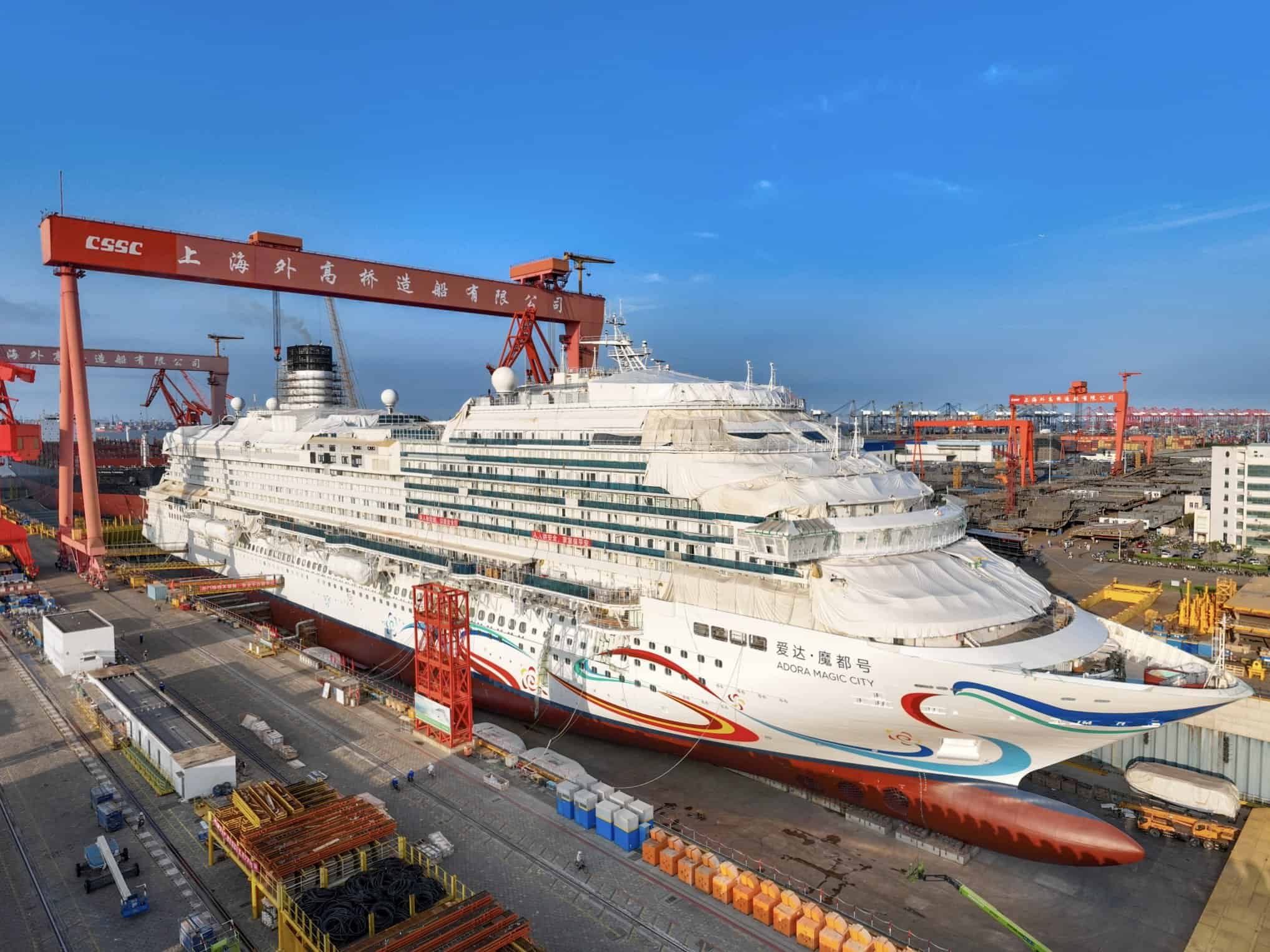
Shanghai Waigaoqiao Shipbuilding, a CSSC subsidiary, delivered China’s first domestically built large cruise ship, Adora Magic City, which began commercial service from Shanghai on Jan. 1, 2024, and has floated out the larger Adora Flora City, planned for service from Guangzhou at the end of 2026. The first two ships use a Fincantieri design developed for Carnival Corp. as their base design. The second unit is adapted for Chinese aesthetics.
Chen Gang, senior engineer at Waigaoqiao Shipbuilding and technical lead on China’s first large cruise ship program, said generative AI tools must be built around hard engineering limits, including funnel location, pool-deck relationships, sprinkler conflicts and structural material limits. “If you properly encode the engineering constraints, AI can dramatically improve design efficiency,” Chen said.
Zhang Yuting, deputy manager of the commercial department at COSCO Shipping Heavy Industry (Zhoushan), said the yard’s cruise repair work since 2017 has included projects for Royal Caribbean International, AIDA Cruises and other international operators. A new 300,000-tonne-class dry dock measuring 430 meters by 120 meters is scheduled for completion in July 2026 and is intended to handle the largest cruise ships now in service. Zhang cited the AIDACosma refit, completed while more than 1,000 crew remained onboard, as an example of the complexity of active-vessel repair work.
In a separate onboard-technology session, Wang Xuhui, independent director of Zgingke Xingye (Sichuan) Technology Group, called for dedicated edge-computing infrastructure to be installed aboard cruise ships so vessels do not depend solely on satellite links to shore systems. “Let cruise ships have their own brains, and the ocean becomes a stage of infinite possibility,” Wang said.
Peter S.S. Tan, general manager for Asia at Tillberg Design of Sweden, said cruise interiors carry commercial consequences beyond aesthetics because design companies must understand itineraries, passenger demographics and the owner’s long-term strategy. “Design is a contract a shipowner signs with a guest,” Tan said.
River cruising and supplier certification
The second day moved into classification standards, the Yangtze River cruise market and China’s interior outfitting supply chain. Jiang Zongjin of the China Shipowners Association said the Yangtze fleet has consolidated to 48 ships across 14 operators after a post-pandemic rebound. He said long-haul routes on the middle and lower Yangtze remain underdeveloped, while river cruise penetration is still below 1 percent of China’s population.
Tan Ming of the Chongqing Cruise Center presented the “Digital Cruise” platform, public digital infrastructure covering ticketing, passenger management, onboard sales and supply chain tracking. Tan reported self-checkout rates above 50 percent on some vessels and reductions in food service and excursion staffing costs.
Liu Jianbin of Shanghai Star Glory Travel compared the Yangtze with the more mature river cruise markets of Europe and the Americas, describing the Chinese market as regulated and capacity-constrained. He also pointed to expansion potential on other inland waterway systems, including the Grand Canal and the Pearl, Xiang, Gan, Huai and Songhua/Heilongjiang rivers.
On interior supply, Abby Si, sales manager of South China Building Materials (Shenzhen), said European contractors still hold roughly 90 percent of interior fit-out subcontracts, including on Chinese-built cruise ships. South China Building Materials is a general contractor on China’s domestic large cruise ship program.
Presentations from Haixing Marine Electric, Zibo Huayuan New Materials and Haining Huajianzi Textile covered marine lighting and life-safety systems, fire-resistant insulation materials and specialty textiles compliant with international flammability standards, including the French M1 rating. Speakers identified certification barriers and limited brand recognition in the cruise segment as the main obstacles for domestic suppliers, not manufacturing capability.
After the conference sessions, attendees toured Shanghai Senlin Special Type Steel Door’s production facility, where the company showed IMO-certified A60 windproof/fireproof marine doors. A60 is the SOLAS structural fire-protection class requiring 60 minutes of fire resistance, and Senlin representatives said the company is developing cruise-specific products.