Tanker Strikes and Capsizes American Heritage in New Orleans
Captain Leonard Stewart remained on the bridge, requesting assistance and keeping American Heritage alongside the dock as long as possible during the capsizing.
Updated November 24, 2026
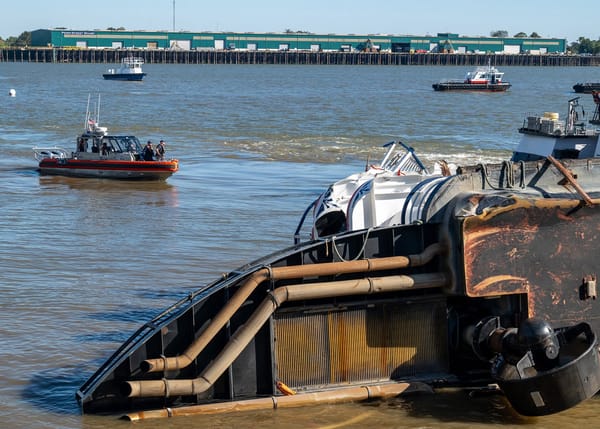
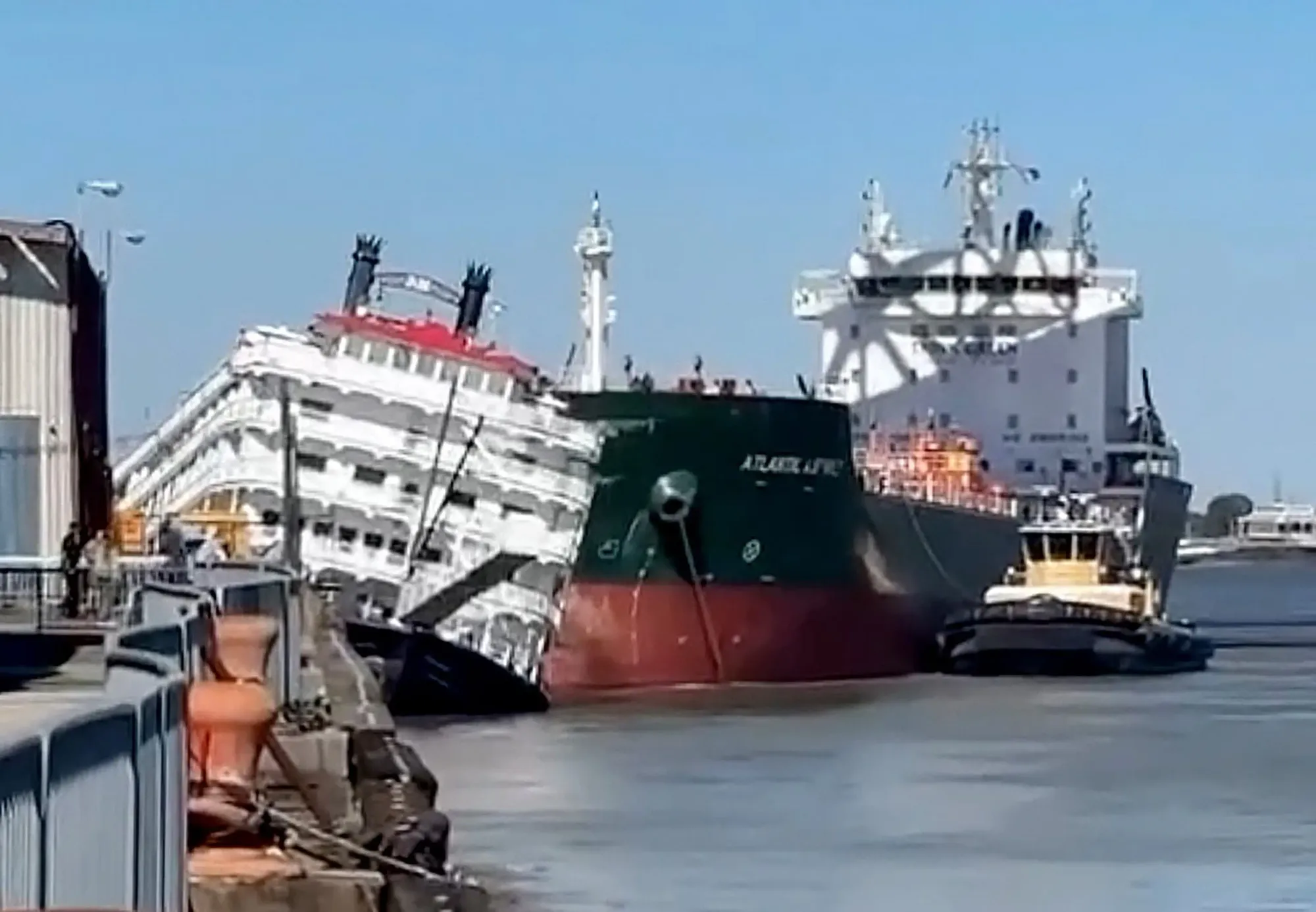
American Cruise Lines’ American Heritage capsized after the Atlantic Asphalt tanker struck it while it was docked in New Orleans on Friday, November 13. All passengers and crew survived and were accounted for, while 32 people were taken to hospitals, New Orleans Mayor Helena Moreno said.
Four people remain hospitalized, including one in serious condition and three in stable condition. Officials had initially described the injuries as non-critical.
The paddlewheel riverboat had arrived about two hours before the collision as it completed an eight-day Mississippi River cruise through Louisiana and Mississippi. Nearly 200 passengers and crew members were aboard when it was struck.
Harbor Police Chief Melanie Montroll said approximately 87 passengers escaped before the vessel capsized. The riverboat began listing within minutes of the impact, and the rescue continued as it rolled onto its side, sending people into the river.
Harbor police, firefighters, Coast Guard crews, tugboat operators and workers from nearby vessels helped evacuate the ship and retrieve people from the water. The rescue took about 45 minutes. Two Harbor Police officers who were aboard helping passengers when the ship overturned were hospitalized and later released, the port said.
American Cruise Lines credited Captain Leonard Stewart and the crew with carrying out the evacuation. In a Saturday statement, the operator said Stewart stayed on the bridge as the vessel capsized, requesting assistance and keeping it alongside the dock for as long as possible.
Investigators reconstruct the tanker’s approach
The National Transportation Safety Board’s initial reconstruction places the steering casualty aboard Atlantic Asphalt at 12:26 p.m., while the tanker was traveling upriver near the Crescent City Connection. The rudder remained to starboard, and the vessel veered toward the river’s east bank before striking American Heritage at 12:28 p.m.
At a Saturday briefing, the NTSB said investigators had recovered the voyage data recorder. Recorded audio included warnings and requests for assistance over marine radio, orders to deploy anchors and emergency ship-handling commands. Investigators continue to analyze the recordings and other electronic evidence but have not established the underlying cause of the steering casualty.
The NTSB has asked anyone with photographs or video of the collision to submit the material to witness@ntsb.gov. A preliminary report is expected within 30 days. The final report, including probable cause findings and any safety recommendations, could take 18 to 24 months.
Montroll said river conditions were normal at the time, without a high current. U.S. Coast Guard Captain Melanie Burnham, commander of Sector New Orleans and captain of the port, had identified a possible steering failure during Friday’s briefing but cautioned that its cause was unknown.
Built by Chesapeake Shipbuilding in 2015, the U.S.-flagged American Heritage is approximately 90 metres long and accommodates 150 passengers. Atlantic Asphalt, a Marshall Islands-flagged asphalt and bitumen tanker built in 2017, measures 160 metres. It was not immediately clear whether the tanker was carrying cargo when the collision occurred.
The Port of New Orleans has filed a federal maritime property-damage lawsuit against Atlantic Asphalt, Nave Shipping and Thome Ship Management. The port is seeking more than $1 million for damage to the Thalia Street Terminal, as well as cleanup, inspection, repair and other costs. A federal judge granted the port’s request for a warrant to arrest the tanker. Atlantic Asphalt has since been towed away from the collision site.
Passenger assistance and navigation restrictions
Uninjured passengers were taken to a nearby auditorium, where cruise officials conducted a roll call. Moreno said most were visiting from outside New Orleans, and many had lost identification or car keys, complicating their return journeys and efforts to contact relatives.
“They needed chargers for their phones. Some people didn’t have phones,” Moreno said.
The city has ended its on-site assistance operations and closed the Family Assistance Center. Passengers and crew members who still require assistance or information are being directed to American Cruise Lines at 203-487-9252.
The Riverfront Hilton previously accommodated survivors who did not require hospital treatment. Staff and local organizations supplied clothing, toiletries, blankets, phone chargers and food.
The Coast Guard closed nearby river traffic immediately after the collision. A safety zone remains in effect 500 feet outward between Mississippi River mile markers 95.5 and 96.5, and the alternate channel remains closed.
Limited two-way traffic is permitted through the main span, but deep-draft vessels and towing vessels handling at least 10 barges are restricted to one-way passage. Vessels must coordinate with Vessel Traffic Service Lower Mississippi River before entering the area and proceed at their slowest safe speed. Canal Street-Algiers Point ferry service, which was suspended as a precaution, resumed at 6:30 p.m. Friday.
Fuel removal precedes salvage
The Coast Guard and American Cruise Lines established a Unified Command to oversee lightering and salvage operations for American Heritage. Crews are removing more than 16,000 gallons of diesel from the capsized riverboat before salvage begins. The lightering operation is expected to take several days, subject to weather and operational conditions.
Divers began examining damage below the waterline on Sunday, November 15, and technical specialists continue to develop and review salvage plans.
Removing the riverboat could take weeks.
A containment boom remains around American Heritage as a precaution. The Coast Guard said an initial sheen at the site had dissipated and no additional pollution had been observed. The operation’s priorities include protecting response personnel, the public and the marine environment.