Coast Guard Plans Fuel Removal From Capsized American Heritage
Preliminary National Transportation Safety Board analysis found Atlantic Asphalt’s rudder stuck to starboard; it struck American Heritage two minutes later.
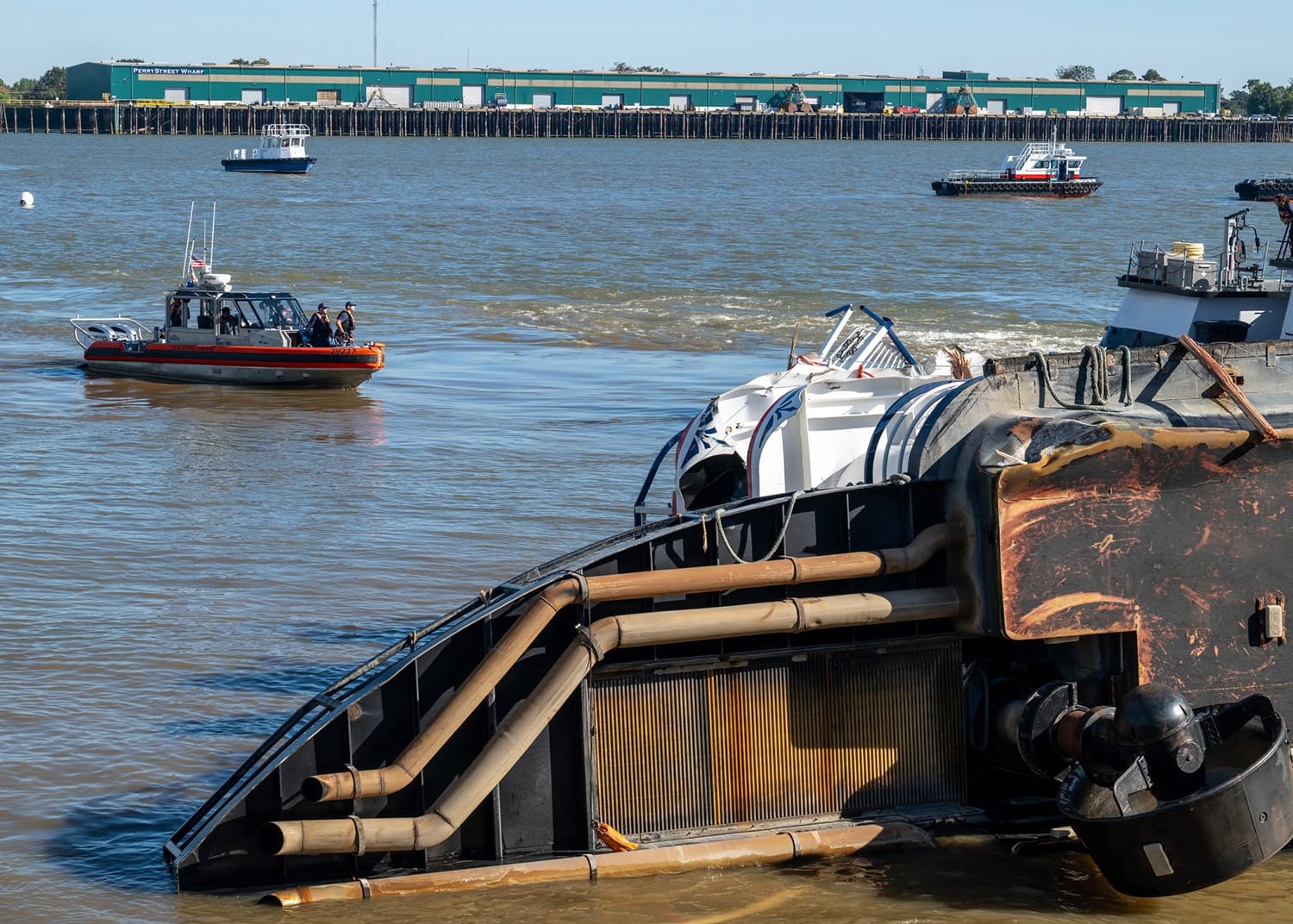
The U.S. Coast Guard is preparing to remove an estimated 16,000 gallons of fuel from American Cruise Lines’ American Heritage before recovering the capsized riverboat in New Orleans, an operation expected to take weeks. The vessel overturned after the tanker Atlantic Asphalt struck it while docked on the Mississippi River on November 13, 2026.
Everyone aboard survived, but more than 30 people were hospitalized. A unified command comprising the Coast Guard and American Cruise Lines is overseeing fuel-removal preparations and salvage planning. No firm date has been set for removing the wreck.
Coast Guard Capt. Melanie Burnham, commander of Sector New Orleans, said responders used soundings to estimate the quantity of fuel remaining aboard. “We’re working on a good plan to be able to remove that safely,” she said.
Divers began inspecting the submerged hull on November 15 to establish the extent of damage and inform the recovery operation. Technical specialists are reviewing salvage proposals, and further underwater surveys are being coordinated through the unified command. Officials have not identified the salvage contractors involved.
Containment boom remains around the riverboat as a precaution. Coast Guard personnel have not detected a fuel-tank leak, and New Orleans officials said an initial sheen at the site had dissipated without additional pollution being observed. Responders continue to monitor the river for hazardous material releases.
The Coast Guard’s New Orleans area salvage plan places responsibility for funding wreck removal on the vessel’s owner and requires Coast Guard approval before salvage work or fuel transfers begin. Its fuel-transfer checklist also calls for a Coast Guard representative to be present and for pumping to start during daylight.
Under that framework, naval architects and marine engineers assess the forces required to refloat a wreck. Underwater repairs and rigging may precede the use of crane barges or other heavy equipment to bring a vessel upright and tow it away; a vessel-specific recovery plan for American Heritage remains under development.
Built by Chesapeake Shipbuilding in Salisbury, Maryland, in 2015, the approximately 295-foot stern-paddlewheel riverboat accommodates up to 150 guests. It was renovated in 2022 and was completing an eight-day Mississippi River voyage when the collision occurred at Thalia Street Dock.
River restrictions remain as cruise terminals operate
A temporary final rule published Wednesday in the Federal Register formalizes a safety zone between Lower Mississippi River mile markers 95.5 and 96.5, extending 500 feet from the east bank. Entry requires authorization from the Captain of the Port of New Orleans because of potential debris and hazards involving salvage personnel, vessels and heavy equipment.
The rule runs through December 11, although the Coast Guard may end it earlier if conditions permit. The river remains open outside the restricted area, with limited two-way traffic through the main span of the Crescent City Connection Bridge. Deep-draft vessels and towing vessels with 10 or more barges are restricted to one-way transit, while the alternate navigation channel remains closed. Transiting vessels must coordinate with Vessel Traffic Service Lower Mississippi River and proceed at their slowest safe speed.
Upcoming American Cruise Lines sailings have been disrupted, but other cruise operations at the port are continuing as scheduled, according to Port of New Orleans spokesperson Kimberly Curth. The Julia Street and Erato Street terminals remain operational for oceangoing departures.
“Viking river cruises are also expected to continue departures from the Orange Street Wharf,” Curth said.
American Cruise Lines and city agencies have been arranging hotel accommodation and return travel for displaced passengers and crew, many of whom lost belongings and medications. Four people remained hospitalized Monday, including one in serious condition. The city closed its on-site Family Assistance Center Tuesday, directing those needing further assistance to the cruise operator.
Investigators examine tanker steering failure
Preliminary National Transportation Safety Board analysis shows Atlantic Asphalt’s rudder became stuck to starboard at approximately 12:26 p.m., sending the upriver-bound tanker toward the east bank. It struck the docked riverboat two minutes later. Investigators have not established what caused the steering malfunction.
The NTSB recovered roughly nine hours of voyage-recorder data, including bridge audio, rudder angles, engine information, speed and course. Recordings captured warning signals, radio requests for assistance and orders to deploy anchors. Investigators are still examining which anchors were lowered and how far.
NTSB board member John DeLeeuw said American Heritage capsized within 22 minutes of impact. American Cruise Lines credited Capt. Leonard Stewart with remaining on the bridge, calling for assistance and keeping the vessel alongside the dock as long as possible during the evacuation. The Coast Guard is also convening a Marine Investigation Board.
The Port of New Orleans has filed a federal lawsuit against the tanker, owner Nave Shipping and manager Thome Ship Management, seeking more than $1 million for terminal damage, alongside cleanup, inspection and business-interruption costs. A federal judge authorized the tanker’s arrest, and it is being held at Perry Street Wharf. Four American Heritage crew members have separately sued over injuries they allege they suffered in the collision.
The NTSB expects to issue its preliminary report within 30 days of the collision. Final findings and any safety recommendations could take 18 to 24 months.