Port Canaveral Plans Shared Terminal 4 for Larger Cruise Ships
The move signals a power shift in Florida cruising, where scarce berths and bigger ships are giving ports more leverage over how cruise lines deploy capacity.
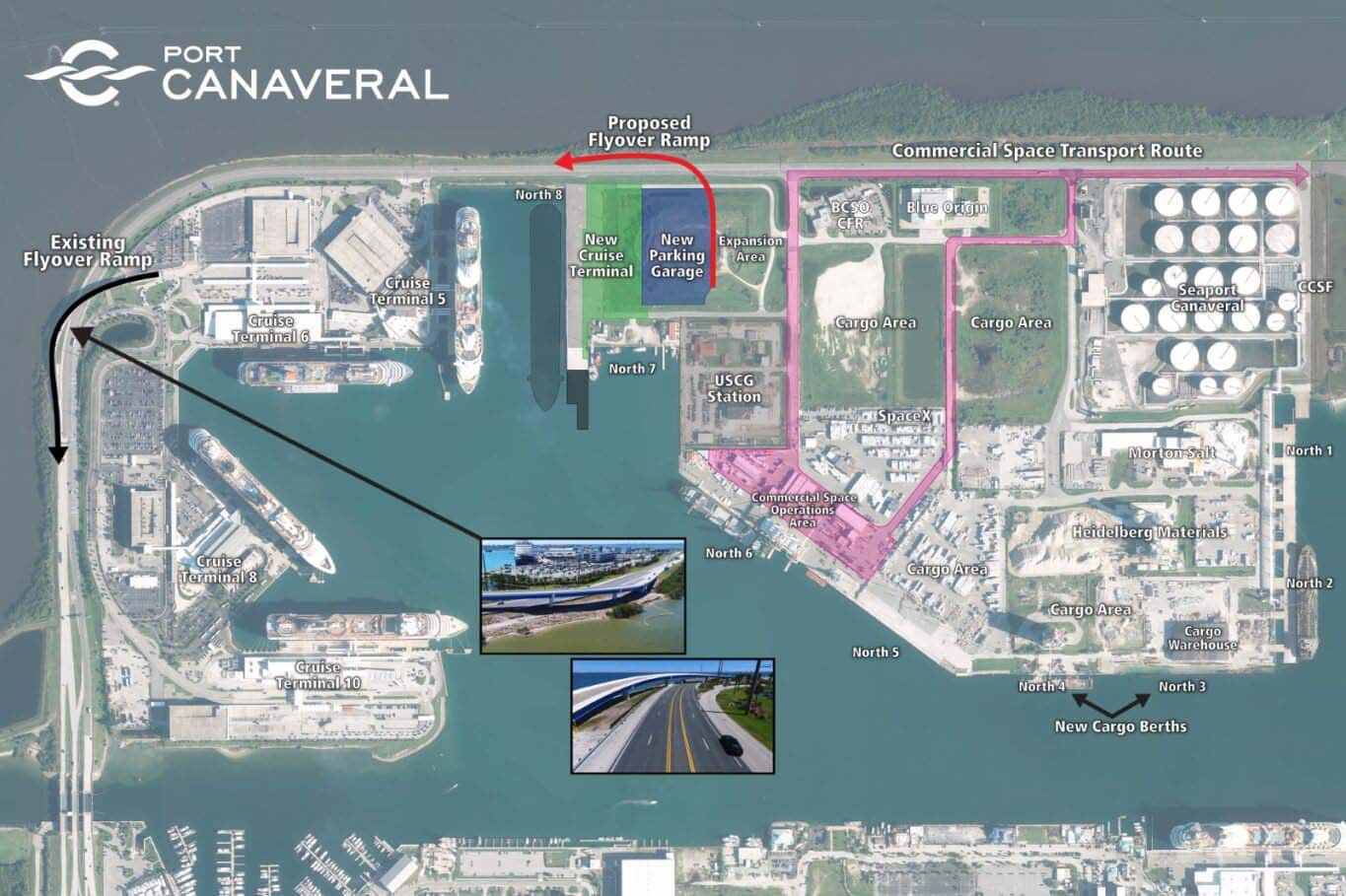
Port Canaveral is planning Cruise Terminal 4 as a shared, large-ship facility targeted for completion in 2029, with CEO Capt. John Murray warning cruise lines that more berth space will depend on how efficiently they use their current terminal assignments. The policy comes as the Space Coast port operates near capacity across six cruise terminals after handling a record 8.6 million passenger movements in fiscal 2025.
That total, up 13% from 7.6 million in fiscal 2024, put Port Canaveral slightly ahead of PortMiami’s 8.56 million and made Canaveral the world’s busiest cruise port by annual passenger movements for the first time. The port now has 18 homeported ships, seven cruise lines and more than 1,000 annual sailings competing for terminal days.
CT4 will be shared, not assigned to one brand
“Everybody wants the new terminal,” Murray told Cruise Industry News. CT4 is being designed as a shared facility, he said, not as a dedicated brand terminal.
The port intends to reserve CT4 for large ships, with access tied to how lines use their current terminals. “Until you’re utilizing the one that you have at a much higher level, we’re not giving you more space,” Murray said.
Cruise Terminal 3 illustrates the issue. The roughly 190,000-square-foot facility, built as a $150 million terminal with a 1,309-foot berth, can handle the world’s largest cruise ships, but Murray said a 3,500-passenger vessel is currently using it on a regular basis. “It’s not getting the most efficient use out of that terminal,” he said.
Canaveral already has experience moving multiple operators through the same terminal. Murray said the port has run Norwegian Cruise Line, Royal Caribbean, MSC Cruises, Disney Cruise Line and Celebrity Cruises through a common facility, with each line using its own IT network.
Cruise lines want commitments into the 2030s
Murray said discussions with cruise lines are now reaching into the 2030s as operators plan large newbuild programs and seek deployment certainty before committing capital to new ships.
For a line ordering a billion-dollar vessel, Murray said the boardroom question is straightforward: “Where is it going to be deployed from?” He said shorter agreements no longer provide the level of certainty some operators want when planning a series of ships.
Murray also linked the demand to private-island strategies and short-cruise deployment from Miami, Port Everglades and Port Canaveral. “We are, to some degree, in the power seat,” he said, adding that not every line asking for space will receive what it wants.
Terminal work is already shifting operations
Port Canaveral is also expanding Cruise Terminal 5, increasing the facility from 90,000 to 170,000 square feet. To accelerate the work, the port shifted some ship calls to Terminal 6 during the summer construction period, giving crews longer uninterrupted windows on the project. Murray said the move removed a year from the completion timeline.
Parking is becoming another capacity issue as larger ships move through the port. Canaveral is replacing an existing parking structure with a $93 million garage designed for 3,700 cars, and Murray said 80% to 85% of cruise guests arrive by car.
For big-ship operations, Murray said each terminal needs about 3,500 parking spaces. Cruise Terminal 3’s garage has more than 1,800 spaces, a capacity he said will be insufficient as larger vessels use the facility.
“We do it for one, we do it for all,” Murray said of parking-revenue arrangements with cruise lines.
Road access remains the limiting factor
The most serious constraint, Murray said, is State Road 528, the Beachline Expressway corridor connecting Orlando and Port Canaveral. Plans to widen the road from Orlando International Airport east toward the port have been discussed for more than two decades, but Murray said the Florida Department of Transportation’s current timeline now stretches to 2045 and 2050.
“We can’t last that long,” Murray said. He said traffic is already operating at high utilization and can back up for hours when an accident occurs, while the port area is also seeing growth in space manufacturing and launch activity.
The port’s growth is also changing the surrounding hotel market. Murray said there were only a few nearby hotels when he joined the port; today there are 11, with permits approved for three more. Each hotel adds about $250,000 in property tax revenue to local municipalities, he said.
“They need to be up in Tallahassee with us, holding hands, saying we need help,” Murray said of the cruise lines. “We’re not building anything else until we figure out the traffic first.”