NTSB Investigates Steering Failure in New Orleans Riverboat Capsize
About 87 passengers reached shore before the capsize, after crew gathered travelers on the third deck, distributed life jackets and began evacuating them.
Updated November 25, 2026
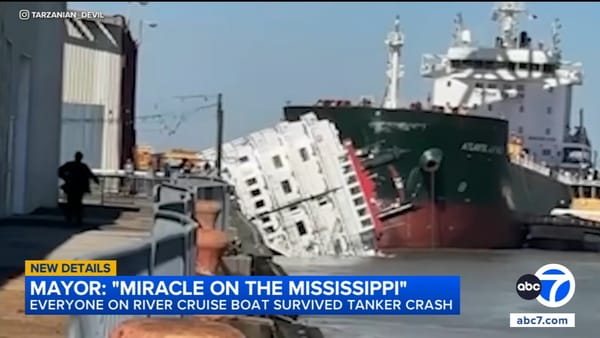
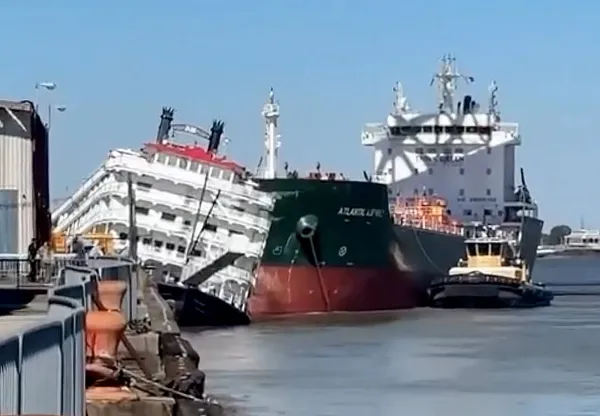
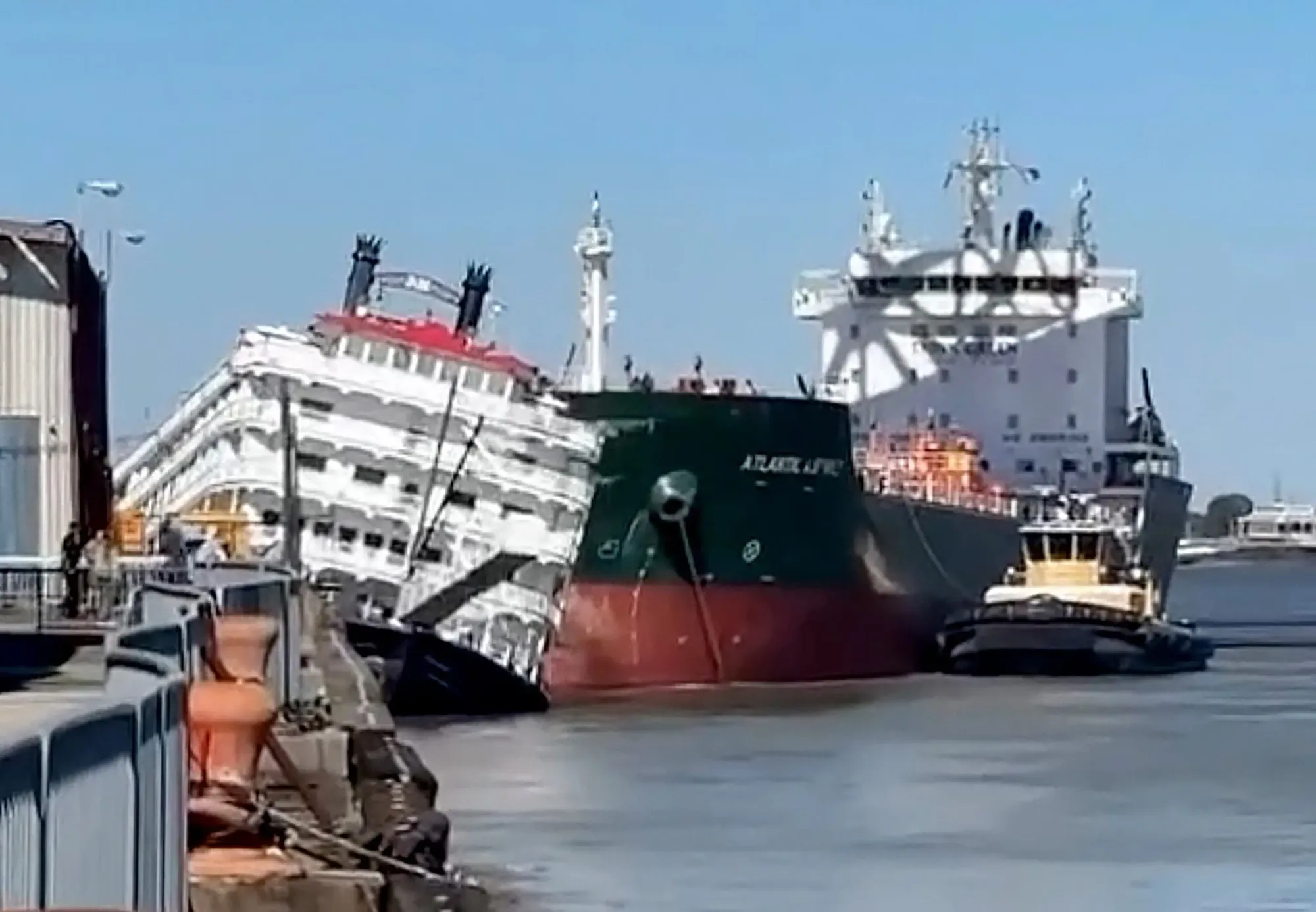
The Atlantic Asphalt tanker struck American Cruise Lines’ docked American Heritage in New Orleans on Nov. 13, 2026, causing the riverboat to capsize and sending passengers, crew and first responders into the Mississippi River.
Everyone aboard both vessels survived.
Thirty-two people were taken to hospitals, including two harbor police officers.
Preliminary evidence from the tanker’s voyage data recorder points to a steering failure about two minutes before impact. Investigators said its rudder became stuck to starboard at about 12:26 p.m., sending the vessel toward the river’s east bank. They have not determined what caused the malfunction. Atlantic Asphalt struck American Heritage at about 12:28 p.m.
The NTSB counted 140 passengers and 50 crew members aboard American Heritage. By Monday, Nov. 16, four people remained hospitalized, one in serious condition and three in stable condition, according to New Orleans officials.
The collision occurred at the Port of New Orleans’ Thalia Street Terminal. American Heritage had arrived roughly two hours earlier for disembarkation after an eight-day voyage through Louisiana and Mississippi. The NTSB said the riverboat overturned approximately 22 minutes after it was struck.
Rescue and passenger support
Harbor police, city firefighters, police officers, emergency medical personnel and the U.S. Coast Guard responded. Tugboat operators, nearby workers and crews from other vessels helped retrieve people from the river. New Orleans Harbor Police Chief Melanie Montroll said about 87 passengers got ashore before the riverboat capsized.
Passenger Joe Knab told WDSU-TV that the tanker sounded its horn several times before impact. He said the riverboat’s crew gathered passengers on the third deck, distributed life jackets and began evacuating them before the vessel rolled. Knab estimated that he spent about 15 minutes in the water.
Montroll said the decision to have passengers put on life jackets helped save lives when they were thrown into the river. Rescuers continued working as the vessel overturned and became partially submerged beside the terminal.
American Cruise Lines credited Captain Leonard Stewart and the crew with rapidly evacuating the riverboat. The company said Stewart remained on the bridge as American Heritage capsized, calling for assistance and keeping the vessel alongside the dock for as long as possible.
Passengers who did not require hospital care were taken to a nearby auditorium, where cruise officials conducted a roll call. Many travelers had lost identification, phones, keys and other belongings. New Orleans officials coordinated meals, hotel rooms and transportation, while Louisiana State Police helped passengers obtain replacement identification. The city and cruise operator also assisted with arrangements to return home. The city later closed its Family Assistance Center and directed continuing inquiries to American Cruise Lines at 203-487-9252.
Built by Chesapeake Shipbuilding in 2015 and refurbished in 2022, American Heritage has five passenger decks and accommodation for up to 150 guests. The paddlewheel riverboat is approximately 295 to 300 feet long.
Salvage and cruise operations
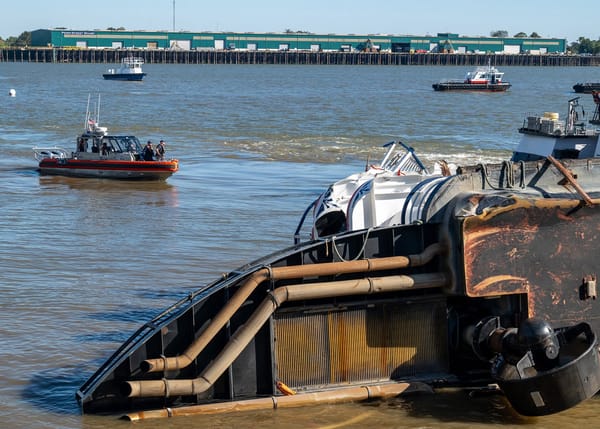
The Coast Guard and American Cruise Lines formed a Unified Command to oversee lightering and salvage operations. Divers have begun underwater inspections of the riverboat’s hull damage. Technical experts are developing and reviewing plans to right and remove the vessel. Coast Guard officials have said the work could take several weeks.
American Heritage remained on its side in about 25 feet of water. The first major step is removing approximately 16,000 gallons of fuel. A containment boom remains deployed around the vessel as a precaution. Officials said an initial sheen had dissipated and no additional pollution had been observed.
The main river channel has reopened with restrictions. Limited two-way traffic is permitted through the main span, but deep-draft vessels and towing vessels with 10 or more barges are restricted to one-way transit. A safety zone remains in effect around the salvage site, and vessels must coordinate with Vessel Traffic Service Lower Mississippi River. Canal Street-Algiers Point ferry service resumed after a temporary suspension.
The collision has disrupted upcoming American Cruise Lines sailings, but other cruise operations at the Port of New Orleans are continuing. Oceangoing departures from the Julia Street and Erato Street terminals remain scheduled. Viking river cruises are expected to continue from Orange Street Wharf. A cruise ship using Poland Street Wharf was making a previously planned port call.
Legal claims
Atlantic Asphalt was moved from the collision site and later docked at Perry Street Wharf under the custody of the U.S. Marshals Service.
The port’s Board of Commissioners filed suit within hours of the collision in the U.S. District Court for the Eastern District of Louisiana. Its complaint estimates physical damage to Thalia Street Terminal at more than $1 million and anticipates further costs for cleanup, surveys, repairs, replacement and salvage.
The suit names Atlantic Asphalt, owner Nave Shipping SA and safety manager Thome Ship Management Private Ltd. as defendants. It alleges negligent operation and maintenance, unseaworthiness and failures to comply with inland navigation rules. U.S. District Judge Wendy Vitter authorized a warrant to arrest the tanker Friday, holding it as security while the claim proceeds.
Four American Heritage crew members filed a separate lawsuit Saturday against Nave Shipping and Thome. They allege that the collision forced them into the river and caused significant physical and psychological injuries. Those allegations have not been established by the NTSB’s investigation, which does not assign legal blame.
Atlantic Asphalt is a 2017-built, 14,485-gross-ton asphalt and bitumen tanker approximately 520 feet long, registered in the Marshall Islands. Liberia-registered Nave Shipping is a subsidiary of China State Shipbuilding Corp., according to MarineTraffic. The Chinese company did not respond to an emailed request for comment from The Associated Press.
Recorder evidence under review
Investigators recovered the tanker’s voyage data recorder and downloaded more than nine hours of information. The data included bridge audio, rudder angles, engine performance, speed and course. Recordings captured the ship’s whistle and radio warnings, along with requests for assistance, commands to deploy anchors and emergency ship-handling orders.
Investigators are examining which anchors were deployed and how far they descended. Divers have also searched American Heritage for evidence that can be compared with the tanker’s recorder data. The NTSB asked anyone with photographs or video of the collision to send them to witness@ntsb.gov.
Coast Guard records show no problems were reported during the tanker’s most recent inspection on Oct. 19. The NTSB assigned a 16-member team to investigate in New Orleans and began interviewing passengers and crew from both vessels.
NTSB member John DeLeeuw said the agency expects to issue a preliminary report within 30 days. The final investigation report is expected in 18 to 24 months.