Juneau Assembly Delays Five-Ship Cruise Limit Ordinance
City Attorney Emily Wright said there is no scenario where Juneau avoids being sued, estimating defense costs at one million to four million dollars.
Updated September 23, 2026
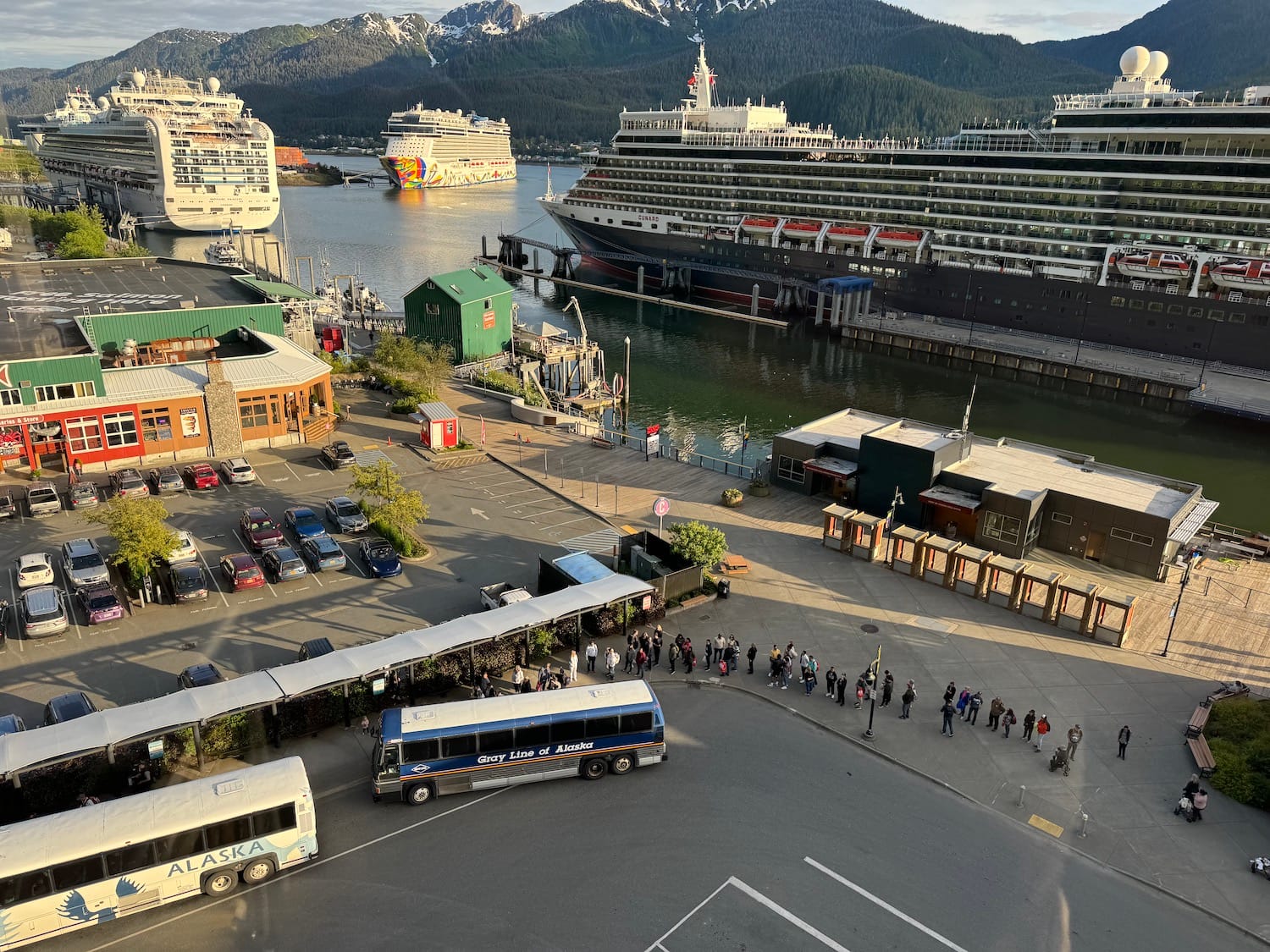
The Juneau Assembly’s Committee of the Whole voted 5-4 at its Aug. 31 work session to delay a proposed ordinance that would place the city’s voluntary limit of five large cruise ships per day into local law. The measure would make it illegal for a sixth large ship to berth within the City and Borough of Juneau.
The decision leaves the existing agreement with cruise lines voluntary and nonbinding while the Assembly awaits recommendations and tourism-impact data from its Visitor Industry Task Force. The five-ship agreement applies across the entire borough, not only to downtown docks, and is intended to account for Juneau’s overall capacity to accommodate cruise passengers. Juneau recorded 1,700,842 cruise passengers in 2025, including 1,688,738 aboard large ships.
Bar Harbor ruling shapes legal debate
Juneau’s original Visitor Industry Task Force examined the legal feasibility of cruise restrictions in 2019 and 2020. Its final report recommended limiting the number of large cruise ships in port to five per day through negotiations with the cruise industry. The Assembly accepted the report in 2020, committed to implementing its recommendations in 2023 and subsequently negotiated a memorandum of agreement with Cruise Lines International Association on behalf of its member cruise lines. The limit has operated since 2024.
The city had not previously attempted to codify the restriction because of uncertainty over whether municipalities could impose their own cruise traffic limits. That question was tested in Bar Harbor, Maine, where local business owners sued after voters approved a 1,000-passenger daily limit in 2022. A federal judge ruled in May that Bar Harbor could enforce the restriction during the peak months of July and August, when the town showed the greatest impacts.
Juneau City Attorney Emily Wright told Assembly members that the narrower ruling requires the city to document the burdens and benefits of any ordinance. In a memo, she also advised the Assembly to consider less restrictive options and explain why those alternatives were rejected.
“There is no scenario where you don’t get sued in this,” Wright said. She estimated that defending the ordinance could cost Juneau between $1 million and $4 million. She could not predict whether the city would prevail.
Assembly divides over timing
Mayor Beth Weldon proposed the postponement because of the city’s financial position and the pending task force work, including efforts to collect more information about Juneau’s tourism capacity. Deputy Mayor Greg Smith and Assembly members Nano Brooks, Maureen Hall and Neil Steininger joined her in voting to wait. Alicia Hughes-Skandijs, Christine Woll, Paul Kelly and Ella Adkison opposed the delay.
Weldon said the current agreement qualifies as a less burdensome alternative and that cruise lines have complied. The industry has also accepted a daily passenger ceiling that began this year and later ship arrivals, along with the elimination of hot berthing.
Smith said, “Don’t kick the dog if it’s not misbehaving.” Hall said she wanted more data, particularly concerning effects on the hospital. Steininger said the city should complete its homework before incurring significant legal costs.
Supporters of codification argued that the ordinance should advance to the full Assembly so residents could comment. Woll cited recurring community surveys in which most residents expressed appreciation for tourism while also calling for the city to do more to manage it. “I have seen overwhelming support for the five-ship limit,” said Adkison, who chairs the Visitor Industry Task Force. Hughes-Skandijs also noted that the task force’s assigned work did not specifically include deciding whether the cap should become law.
Douglas Island terminal raises capacity questions
The draft ordinance would apply throughout the borough, including Douglas Island, where Goldbelt Inc. is proposing a private terminal with berths for two ships. Woll said the ordinance would carry the existing boroughwide policy into code and would not prevent the Goldbelt project from proceeding.
Downtown businesses have warned that allocating two of the five calls to the proposed terminal could reduce the number of ships at nearby docks from five to three. Some residents have objected to any scenario that excludes the Douglas facility from the cap, which could allow seven ships and well over 2 million passengers per season.
Task force developing tourism-impact measures
The Visitor Industry Task Force 2.0 is scheduled to submit its recommendations this fall. Its work includes developing a framework for measuring tourism impacts and determining how infrastructure investments affect Juneau’s ability to accommodate passenger volumes. A broader data-collection program covering multiple aspects of tourism is planned for next summer.
Visitor Industry Director Alexandra Pierce said the city wants quantitative measures for assessing whether projects such as completion of the Seawalk and improvements to dock infrastructure are reducing the pressures addressed by the ship limit. The data program is separate from the Assembly’s decision on whether to codify the agreement, but its findings could inform future decisions about cruise passenger capacity.
Hughes-Skandijs said that if the Assembly ultimately declines to legislate, she expects residents may pursue another ballot initiative and would likely support that effort after leaving office.
Compare current Alaska cruise fares on Cruise Lookup.