Fuel Surcharge Clauses Resurface for Port Canaveral Cruises
Royal Caribbean Group reported about one billion dollars in fuel-swap notional value at the end of 2024, covering sixty percent of projected 2025 fuel purchases.
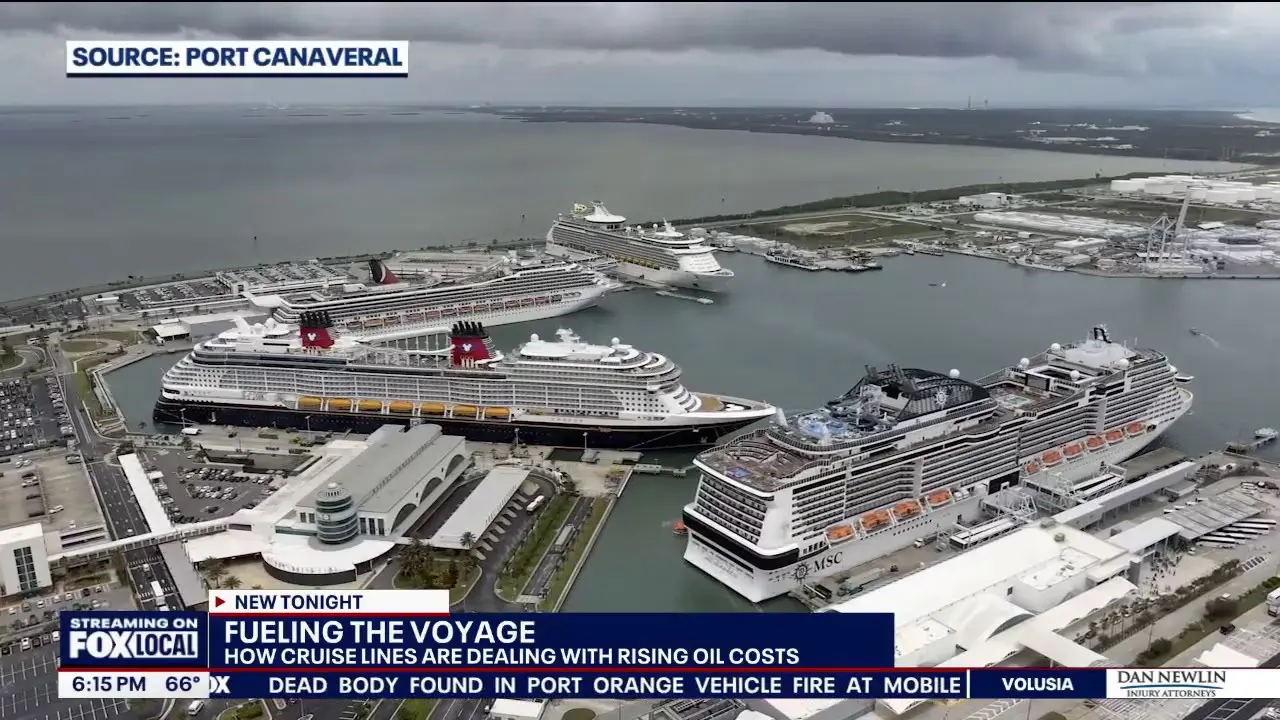
Rising diesel costs tied to the conflict with Iran are putting cruise-line fuel-surcharge clauses back in focus for passengers sailing from Port Canaveral. Carnival Cruise Line and Royal Caribbean retain contractual authority to add daily supplements under specified commodity-price conditions, while Disney Cruise Line’s published U.S. terms do not show an active surcharge.
The potential charges reach $9 per person per day at Carnival and $12 at Royal Caribbean, including for some existing or fully paid bookings. Oil futures approached $110 per barrel in recent trading, although the contract provisions give the lines discretion over whether to impose the fees.
Ticket contracts set different terms
Geraldine Blanchard, owner of Global Tours & Travel and a travel agent for three decades, said Carnival and Disney were not applying fuel surcharges. Along with Royal Caribbean, they are the three major cruise lines sailing from Port Canaveral.
Carnival’s ticket contract nevertheless allows the line to charge up to $9 per person per day when light sweet crude oil exceeds $70 per barrel. Carnival can apply the supplement without prior notice to existing reservations, including cruises that have been paid in full.
Royal Caribbean’s contract permits a supplement of up to $12 per guest per day when West Texas Intermediate crude exceeds $65 per barrel or Henry Hub natural gas rises above $3 per million British thermal units. Where permitted by law, the line can add the charge to new or existing bookings without prior notice.
Disney’s current U.S. contract says cruise fares do not include fuel supplements. The line previously introduced a surcharge for new bookings in 2008, charging $8 per day for each of the first two passengers in a stateroom and $3 per day for additional guests, subject to caps.
Blanchard said she reviews the applicable surcharge terms with customers because the policies differ by operator. She estimated that a cruise ship can burn as much as 200,000 gallons of diesel in a day.
“If they buy right as the prices go up ... the adjustments can come through their dining, the extra amenities or the on-board credit,” Blanchard said.
Operators take different approaches to fuel costs
Higher fuel prices raise ship operating costs directly, while many cruise fares and itineraries are set months before departure.
Carnival Corporation generally does not hedge its fuel prices. Its annual reporting says the company manages the risk primarily by reducing consumption through fleet and itinerary efficiency, energy-saving measures, new technology and alternative fuels.
Royal Caribbean Group uses fuel swaps accounted for primarily as cash-flow hedges. At the end of 2024, the company reported about $1 billion in outstanding fuel-swap notional value, with designated hedges covering 60% of projected 2025 purchases and 44% for 2026. Coverage in that schedule falls to 20% of projected fuel purchases for 2027.