Which Cruise Line Discounts Most After Final Payment? We Tracked 4.3 Million Fares
MSC cuts prices most often in the final 90 days. Costa cuts them deepest, by a wide margin. The two rankings almost invert, and both are honest answers.
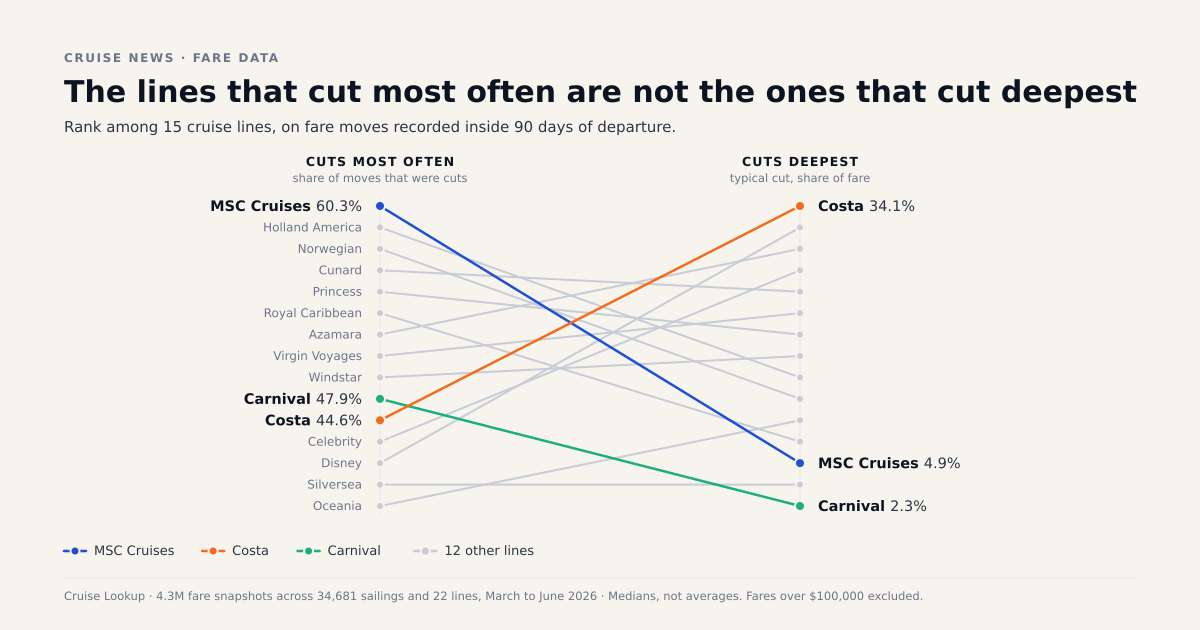
Ask which cruise line discounts most after final payment and you get two different answers, depending on whether you mean how often a line cuts or how deep the cut goes. We measured both across 4.3 million fare snapshots, and the two rankings almost invert.
MSC Cruises cut prices in the final 90 days more often than any other line we track. Costa Cruises cut them considerably less often, but when it did, the typical cut was more than a third of the fare. Both are honest answers to the same question.
Which lines cut most often
Among fare moves we recorded inside 90 days of departure, roughly the window that opens after most lines' final payment date, here is the share that were cuts rather than increases:
| Cruise line | Share of moves that were cuts | Sailings measured |
|---|---|---|
| MSC Cruises | 60.3% | 1,503 |
| Holland America | 59.4% | 224 † |
| Norwegian | 58.8% | 470 |
| Cunard | 58.2% | 123 † |
| Princess | 53.1% | 426 |
| Royal Caribbean | 51.6% | 821 |
| Azamara | 51.5% | 58 † |
| Virgin Voyages | 50.3% | 89 † |
| Windstar | 50.3% | 178 † |
| Carnival | 47.9% | 734 |
| Costa | 44.6% | 435 |
| Celebrity | 44.5% | 292 |
| Disney | 44.4% | 264 |
| Silversea | 41.4% | 180 † |
| Oceania | 35.0% | 109 † |
† Fewer than 250 sailings measured. Read these as indicative rather than settled.
A share above 50% means decreases outnumbered increases in that window. Nine of the fifteen lines cleared it, which is the headline finding on its own: this close to sailing, prices more often fall than rise across most of the fleet.
Oceania sits at the bottom at 35%, meaning an Oceania fare inside 90 days was noticeably more likely to rise than fall. Its sample is one of our smallest, so we would not build a booking strategy on it yet.
Which lines cut deepest
Same window, now ranked by the size of a typical cut. These are medians rather than averages, because a handful of world cruises and owner's suites will drag an average anywhere you do not want it to go.
| Cruise line | Typical cut as a share of fare | Typical cut |
|---|---|---|
| Costa | 34.1% | $367 |
| Disney | 20.2% | $225 |
| Azamara | 19.9% | $2,200 † |
| Celebrity | 14.9% | $136 |
| Cunard | 9.0% | $200 † |
| Virgin Voyages | 9.0% | $148 † |
| Princess | 7.1% | $112 |
| Windstar | 6.7% | $342 † |
| Holland America | 6.4% | $90 † |
| Norwegian | 6.2% | $60 |
| Oceania | 5.6% | $245 † |
| Royal Caribbean | 5.5% | $55 |
| MSC Cruises | 4.9% | $100 |
| Silversea | 3.4% | $800 † |
| Carnival | 2.3% | $15 |
Read the two tables together and the ranking nearly turns over. MSC tops the frequency table and sits third from the bottom on depth: it adjusts fares constantly, in small increments. Costa is eleventh on frequency and first on depth by a wide margin, cutting rarely and then cutting hard. Carnival is the extreme case of the MSC pattern, with a typical cut of $15.
Two figures need their context. Azamara's $2,200 median attaches to prior fares averaging about $8,938 per person, so the percentage is the fair comparison, and its 58 sailings make it our thinnest sample. Silversea shows the reverse: an $800 typical cut is only 3.4% of an ultra-luxury fare averaging around $17,500.
Why the two lists differ
Frequency and depth measure different revenue strategies. A line running short, repeating itineraries out of a busy homeport can nudge prices daily and rarely needs a dramatic move, because there is always another sailing next week to sell into. A line with fewer, longer, more seasonal departures has less room to fine-tune, so when a sailing is underbooked the correction has to be larger.
That is a pattern, not a promise. These are fleet-wide figures over one four-month window, and an individual sailing can behave nothing like its line's average. Interior and ocean-view cabins on underbooked ships move most, while sold-out suites barely move at all.
What it means if you are already booked
A cut after your final payment date is common. Of all the sailings we tracked into that window, 83% recorded at least one decrease. What you can do about it depends on the line and your fare type, and the value usually arrives as onboard credit or a cabin upgrade rather than cash back. Our breakdown of what happens when cruise prices drop after final payment covers what each major line offers and what to ask for.
The catch is that nobody tells you. Cruise lines do not notify booked guests when the fare falls, so a post-final-payment cut is only worth something if you spot it in time to call. The practical fix is to set a free price alert on your sailing in any-change mode, which emails you whenever the price moves at all.
If you have not booked yet, this data cuts both ways depending on the line you are considering. You can compare current sailings by lowest price and put an alert on anything close to your budget.
How we measured this
Based on 4.3 million fare snapshots CruiseLookup logged across 34,681 sailings and 22 cruise lines between March and June 2026. We record per-cabin prices daily and keep every change, so each record is an actual fare move rather than an estimate.
For this analysis we isolated moves recorded within 90 days of departure, the common final-payment convention, since actual final-payment dates vary by line and fare type. Each fare's first observation is excluded, because it is an import artifact rather than a price move. Cut share is decreases divided by decreases plus increases. Fares above $100,000 are excluded throughout, since a small number of world cruises and top suites otherwise distort every average. Only lines with at least 1,000 recorded moves in the window are ranked, which is why some lines we track do not appear.
Two limits worth stating plainly. Our window covers March to June 2026, so these are not year-round figures. And the lines marked with a dagger have fewer than 250 sailings measured, so their numbers are directional. Where a sample is thin we have said so rather than presenting the figure as settled.