Viking Sells 86% of 2026 Core Cruise Capacity in Early Bookings
Viking’s rapid sell-through shows premium cruising demand is holding up even as capacity grows, giving the line pricing power and a cushion against rising operating costs.
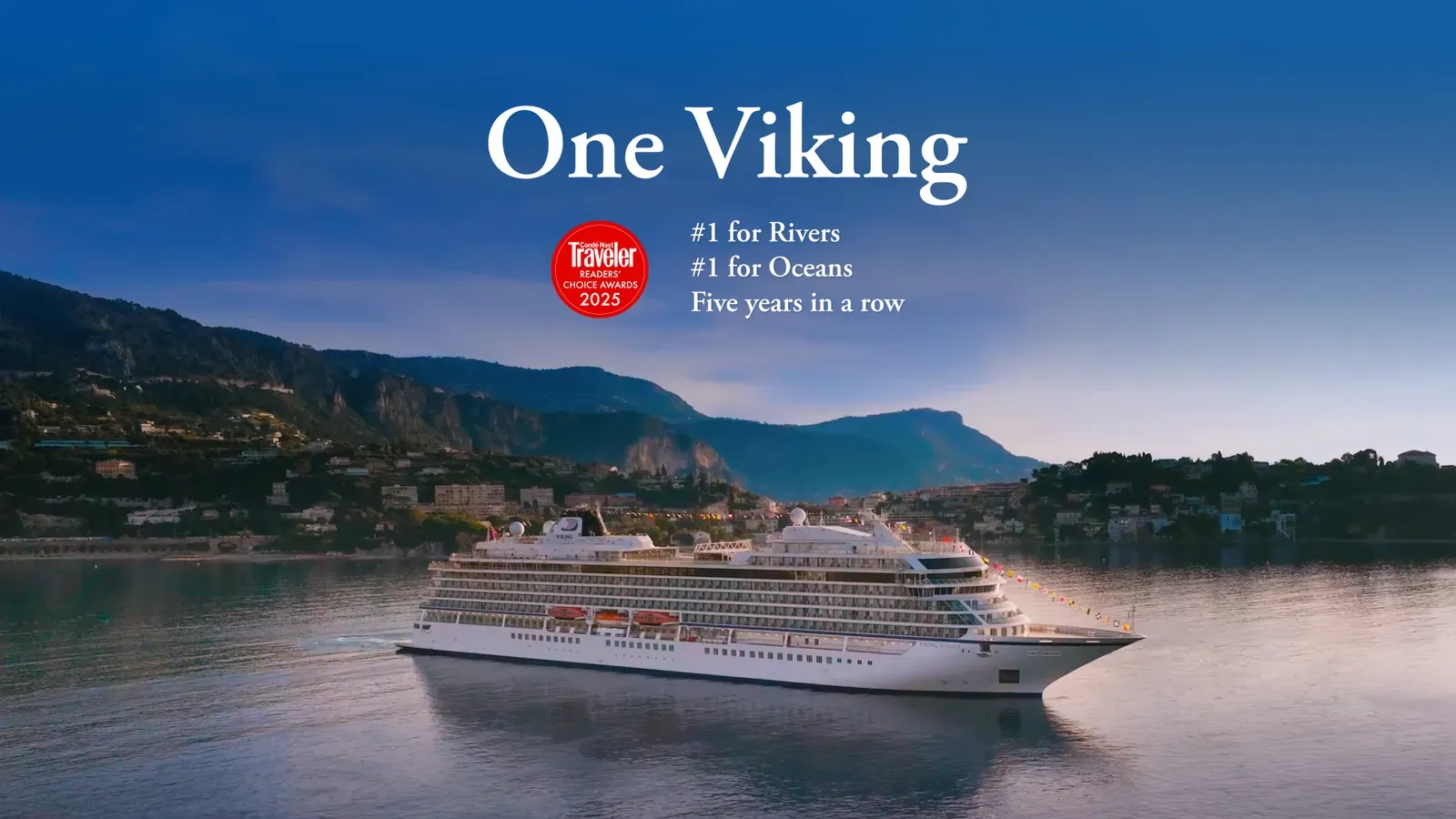
Viking Holdings reported record financial results for the fourth quarter and full year ended Dec. 31, 2025, as the cruise operator pointed to higher occupancy, pricing, and continued fleet growth. The company also said it entered 2026 with a strong early booking position, with 86% of its 2026 capacity passenger cruise days (PCDs) for its Core Products already sold as of Feb. 15, 2026.
Record 2025 revenue, earnings, and leverage improvement
For full-year 2025, Viking posted total revenue of $6,501.4 million, a 21.9% increase from 2024. Net income rose to $1,148.1 million, and adjusted net income attributable to Viking Holdings Ltd was $1,165.1 million, a 43.9% year-over-year increase.
Viking reported gross margin of $2,582.4 million for the year, while adjusted gross margin totaled $4,290.0 million, up 22.6% year over year. Net yield for 2025 was $583, an increase of 7.4% compared with 2024, and adjusted EBITDA rose 38.8% to $1,872.1 million.
Torstein Hagen, Chairman and CEO of Viking, attributed the year’s performance to execution and scale. “In 2025, we delivered exceptional financial results,” Hagen said, citing metrics including “ROIC of 45.8%” and “Net Leverage of 1.1x.”
- Diluted EPS (2025): $2.57
- Adjusted EPS (2025): $2.61
- Net leverage: 1.1x as of Dec. 31, 2025 (down from 2.4x a year earlier)
Fourth-quarter results: higher capacity, 95% occupancy, and stronger earnings
Viking said fourth-quarter capacity passenger cruise days increased 14.7% versus the same period in 2024, driven primarily by fleet growth that included six additional river vessels and two additional ocean ships. Occupancy for the quarter was 95.0%.
Quarterly revenue rose to $1,724.4 million, an increase of $374.7 million, or 27.8%, compared with the fourth quarter of 2024. Viking linked the improvement to higher capacity, improved occupancy, and higher revenue per passenger cruise day.
Gross margin for the quarter was $652.1 million, up 38.2% year over year, and adjusted gross margin was $1,106.1 million, up 27.3%. Net yield in the quarter was $546, increasing 7.7% from the prior-year quarter, while adjusted EBITDA increased 51.3% to $462.8 million.
Vessel operating expenses in the quarter were $392.6 million, and vessel operating expenses excluding fuel were $350.2 million. Viking said those costs increased 15.0% and 17.7%, respectively, mainly due to higher capacity.
Net income in the fourth quarter was $300.3 million, compared with $104.2 million a year earlier. Viking noted that the fourth quarter of 2024 included a $96.3 million loss tied to the revaluation of warrants following stock price appreciation. Diluted EPS and adjusted EPS were both $0.67 for the quarter, compared with diluted EPS of $0.24 and adjusted EPS of $0.45 in the fourth quarter of 2024.
2026 demand: 86% of Core Products capacity sold and $5.96 billion in advance bookings
In its forward demand update, Viking said that as of Feb. 15, 2026, it had sold 86% of its 2026 capacity passenger cruise days for its Core Products. The company expects operating capacity for the 2026 season to be 7% higher than the 2025 season.
Viking reported $5,960 million in advance bookings for the 2026 season as of Feb. 15, 2026, which it said is 13% higher than the 2025 season at the same point in time. Advance bookings per passenger cruise day for 2026 were $859, up 6% from the comparable 2025 point.
Leah Talactac, President and CFO of Viking, said the company is carrying momentum into the new year. “We finished 2025 with great momentum and we are entering 2026 in a very solid position with 86% of our Capacity PCDs for our Core Products already sold,” Talactac said. She added that Viking is seeing “robust demand across our products,” including from repeat guests and customers new to the brand, while emphasizing discipline as the company expands its fleet.
Liquidity and scheduled 2026 debt payments
As of Dec. 31, 2025, Viking reported $3.8 billion in cash and cash equivalents and a $1.0 billion undrawn revolver facility. Deferred revenue was $4.6 billion, and scheduled principal payments were $396.8 million for 2026.
Fleet growth, 2026 deliveries, and longer-dated ship options
Viking said it grew its river, ocean, and expedition fleets to more than 100 vessels in 2025. The company added eight new vessels during the year, including six river ships and two ocean ships, and Hagen said the expanded platform has supported destination-focused offerings worldwide.
Based on its committed orderbook, Viking expects to take delivery of two ocean ships and 10 river ships in 2026. The company also said that since its third-quarter 2025 earnings release it entered into option agreements for two additional ocean ships, with an exercise date of July 30, 2028, and delivery slated for 2034.
In expedition cruising, Viking said it entered into shipbuilding commitments for two additional expedition ships, scheduled for delivery in 2030 and 2031. Viking’s expedition expansion follows the rollout of Viking Octantis and Viking Polaris, and the company has highlighted design and product consistency as it grows across segments. Separately, the company has described a strategy of building ships with interchangeable designs intended to deliver consistent service levels and support loyalty to the brand rather than to any single vessel.
How Viking says ship design and fuel-related measures support performance
Hagen told investors that Viking’s purpose-built fleet is designed to reduce wasted space and weight, with the goal of improving fuel efficiency and guest comfort. He said Viking operates one of the youngest ocean fleets in the cruise industry and that design choices and onboard processes are intended to support efficiency and consistency as the fleet expands.
Hagen also said Viking’s ocean ships use closed-loop scrubbers, which he said can help manage fuel costs by enabling the use of more cost-efficient fuel grades. He added that streamlined onboard operations allow the company to run with leaner crew complements while maintaining service standards.
On the river side, Hagen described Viking’s ships as proprietary designs tailored to European waterways, including a hull design intended to enable three full passenger decks and higher guest capacity than the average European river vessel. He also discussed fuel arrangements in the river segment, including fixed-price fuel contracts covering a significant portion of the 2026 season.
On returns, Hagen cited typical payback periods of five to six years for ocean ships and four to five years for river vessels, and he pointed to fleet interchangeability as a differentiator supporting pricing and yield performance across vessels.
Geopolitical and itinerary-specific demand: Egypt exposure and analyst views
Viking said it has navigated geopolitical uncertainty without a degradation in booking momentum, even as it temporarily paused its Egypt operations amid tensions in the Middle East. The company has said Egypt represents roughly 3% of total capacity.
After the earnings report, Jefferies analyst David Katz raised his price target on Viking to $91 from $80 and reiterated a buy rating, pointing to the quarter’s 95.0% occupancy and stronger ocean-segment occupancy year over year. Katz also highlighted the company’s forward booking position and said itineraries near the Iran conflict represent a small portion of 2026 capacity in Egypt, adding that they had not prompted guest concerns.
BNP Paribas Senior Analyst Xian Siew also raised his price target to $91 from $88 while maintaining a positive rating, citing accelerating pricing trends. Siew said advance-booking pricing growth increased to 6.0% from 5.5% as of the prior earnings call, and he characterized the impact of a potential pause in Egypt operations as manageable at current levels.
With most of its 2026 Core Products capacity already sold, Viking has framed the next year around executing on planned 2026 ship deliveries, managing costs and fuel arrangements, and building out a longer-dated newbuild pipeline that includes additional ocean-ship options and expedition-ship commitments stretching into the next decade.
Frequently Asked Questions (FAQs)
What does “86% sold” mean for Viking’s 2026 season?
Viking said that as of Feb. 15, 2026, it had sold 86% of its 2026 capacity passenger cruise days for its Core Products.
How much did Viking report in advance bookings for 2026?
Viking reported $5,960 million of advance bookings for the 2026 season as of Feb. 15, 2026, which it said was 13% higher than the prior year at the same point in time.
What new ships does Viking expect to take delivery of in 2026?
Based on its committed orderbook, Viking expects to take delivery of two ocean ships and 10 river ships in 2026.
How does geopolitical instability affect Viking’s operations, including Egypt?
Viking has said it temporarily paused its Egypt operations amid tensions in the Middle East, and that Egypt represents roughly 3% of total capacity. The company has also said it has not seen a degradation in booking momentum, and analysts described the exposure as manageable at current levels.
What did Viking highlight as key drivers of its 2025 performance?
Management and analysts pointed to fleet growth, higher capacity and occupancy (including 95.0% occupancy in the fourth quarter), and higher revenue per passenger cruise day. Hagen also emphasized execution, ship design choices aimed at improving efficiency, and fleet consistency that Viking says supports pricing and yield as it expands.