Six Cruise Ships Exit Persian Gulf After Strait of Hormuz Reopens
Even a short closure of the Strait of Hormuz can upend global cruise schedules, accelerating a shift away from Persian Gulf winter seasons toward safer, steadier routes.
Updated May 8, 2026
Six cruise ships that had been unable to leave the Persian Gulf since late February have now safely transited the Strait of Hormuz, using a brief window of reopened commercial navigation over the weekend. Aroya Manara was the last vessel to clear the passage. AIS data placed the ship underway off Muscat, Oman, on Monday, bound for Jeddah, Saudi Arabia, with an estimated April 27 arrival.
The move allowed operators to begin repositioning vessels to planned summer deployments in Europe and the Red Sea after weeks of disruption tied to escalating hostilities involving Iran, the United States, and Israel. The Strait of Hormuz, a narrow chokepoint between the Persian Gulf and the Gulf of Oman, had been heavily restricted, leaving cruise ships effectively trapped inside the Gulf.
A brief reopening, then a rapid tightening of restrictions
The conflict began on Feb. 28, when the United States participated in a joint attack with Israel against Iran, followed by retaliatory Iranian strikes across parts of the region. In March, the Islamic Revolutionary Guard Corps declared the strait closed, disrupting maritime traffic and forcing cruise lines to halt guest operations in the area.
Iranian Foreign Minister Seyed Abbas Araghchi later announced that commercial traffic could use the waterway during a temporary ceasefire. "In line with the ceasefire in Lebanon, the passage for all commercial vessels through Strait of Hormuz is declared completely open for the remaining period of the ceasefire," he said.
The reopening proved narrow. Iranian authorities initially declared the strait open for commercial traffic on April 17, but reinstated restrictions in less than 24 hours after the United States did not lift its naval blockade affecting Iran's maritime trade. Observed commercial traffic through the corridor dropped again as security concerns intensified.
Which ships were affected, and how the outbound passage unfolded
Six cruise ships across four operators were in the region during the restrictions: MSC Cruises' MSC Euribia; TUI Cruises' Mein Schiff 4 and Mein Schiff 5; Celestyal Cruises' Celestyal Journey and Celestyal Discovery; and Aroya Cruises' Aroya Manara, also referenced as Aroya Menara or Aroya. Together, the six ships represent about 17,000 berths.
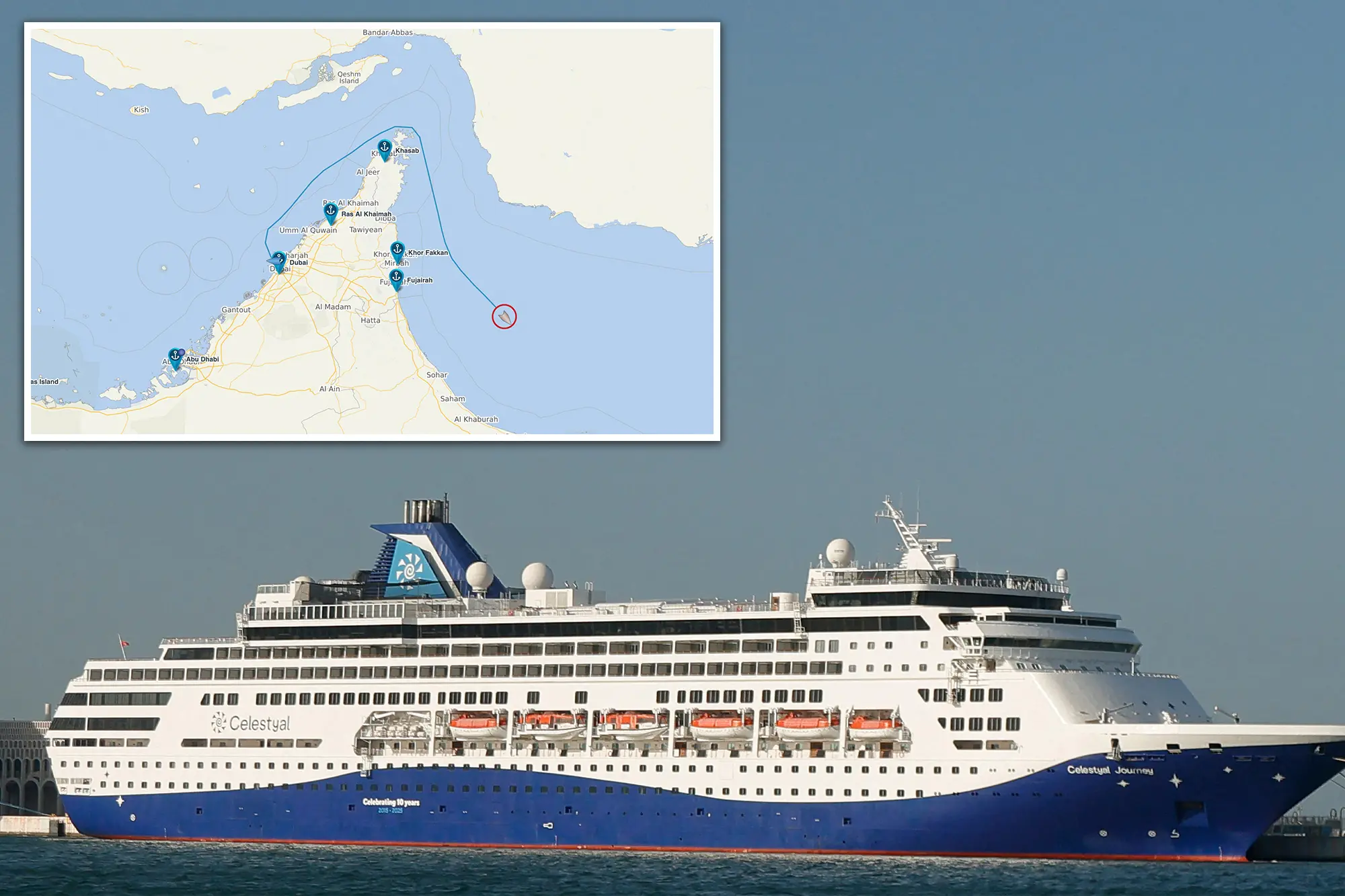
Celestyal Discovery was the first to make the outbound passage after the April 17 announcement, departing Port Rashid in Dubai at 11:36 a.m. local time, according to MarineTraffic tracking data. Celestyal Cruises said the ship, under Captain Nikolaos Vasileiou, departed the Arabian Gulf on April 17 using "a carefully coordinated voyage plan" developed with authorities and maritime security teams, and that the transit helped establish a route other operators could follow.
Additional vessels followed a similar pattern in the hours that followed and into the weekend, steering along the Omani side of the strait and rounding the Musandam Peninsula as they exited into international waters. Celestyal Journey also made the passage, with the company separately confirming its successful transit under Captain Angelos Vasilakos.
MSC Euribia, Celestyal Journey, Celestyal Discovery, Mein Schiff 4, and Mein Schiff 5 transited the strait during the weekend. Aroya Manara departed Dammam, Saudi Arabia, after the other vessels and became the final ship to clear the area.
Passenger evacuations, reduced crews, and the operational rebuild
Passengers and non-essential crew were disembarked and repatriated in March as ships remained in Gulf ports with only essential personnel required for navigation and safety. Cruise lines including MSC, TUI, and Celestyal undertook complex repatriation work, including chartering more than 40 dedicated flights.
During the repositioning, operators moved ships without guests and with reduced onboard staffing, a step aimed at lowering operational exposure during transit through a volatile corridor. MSC Group Cruise Division Executive Chairman Pierfrancesco Vago said earlier in the disruption that MSC brought MSC Euribia down to minimum manning while the ship remained unable to reposition, and that the situation led to itinerary changes and cancellations tied to the ship's planned Northern Europe deployment.
With ships now outbound, operators face the practical task of rebuilding full onboard staffing levels before guests return. That includes flying crew back to the vessels, completing onboarding procedures, and restoring hotel, dining, and entertainment operations that may have been scaled down during the layup period. TUI Cruises said crew in Cape Town and Malta will rejoin Mein Schiff 4 and Mein Schiff 5 as the ships are prepared for regular operations. Dozens of cruises were called off while ships waited for safe passage out of the region.
Return-to-service dates and redeployments in May
Cruise lines have begun outlining restart timelines based on published schedules and company updates. Several itineraries in Northern Europe, the Eastern Mediterranean, and the Red Sea are expected to proceed as scheduled once ships complete repositioning and re-crewing.
- MSC Euribia is sailing toward Northern Europe, with departures scheduled for May 16 from Kiel, Germany, and May 17 from Copenhagen, Denmark.
- Celestyal Discovery is repositioning to the Eastern Mediterranean and is scheduled to resume passenger operations on May 1 with a short cruise from Lavrion, Greece.
- Celestyal Journey is repositioning toward Europe and is set to begin Mediterranean itineraries in early May, including a May 2 restart in Greece.
- Mein Schiff 5 is heading back to Europe with a planned return to service on May 15 from Heraklion, Greece.
- Mein Schiff 4 is returning to Europe with a scheduled restart on May 17 from Trieste, Italy.
- Aroya Manara is sailing to Jeddah for a May 14 restart, followed by Red Sea cruises from Saudi Arabia and a later Eastern Mediterranean deployment from Istanbul.
MSC Cruises, in a brief statement, said: "MSC Cruises confirms that MSC Euribia has departed Dubai, has safely transited the Strait of Hormuz, and is now en route to Northern Europe," adding that the passage "was completed in close coordination with the relevant authorities." The company also said the ship's May 16 Kiel and May 17 Copenhagen departures will operate as originally scheduled, and that guests affected by earlier cancellations will be contacted about options to transfer bookings.
MSC Euribia, the largest of the vessels at 184,700 gross tonnage, departed Dubai with a skeleton crew onboard. The liquefied natural gas-powered ship is scheduled to recommence its Northern Europe season with the May 16 sailing from Kiel.
TUI Cruises confirmed the safe transit of Mein Schiff 4 and Mein Schiff 5. "We would like to thank the captains and crews, as well as all those involved who supported and enabled the safe passage with great professionalism and prudence," the company said. Wybcke Meier, Chief Executive of TUI Cruises, said, "The past weeks have presented all of us with extraordinary challenges," adding that the line was pleased it could "return swiftly to regular operations" and deploy its fleet as planned.
Security routing and longer transits as operators weigh options
Operators have pointed to the importance of coordinated routing and security planning, including steering close to Oman's shoreline to limit exposure near Iranian territory. Celestyal Cruises has described collaboration with maritime security teams and regional authorities to create a coordinated route for its outbound movement.
Ship-specific routing now varies. AIS data showed Celestyal Discovery with a destination of Suez, while Celestyal Journey and Mein Schiff 5 listed Cape Town, South Africa. Mein Schiff 4 was expected to follow a similar route, and TUI said both of its ships were setting course for Cape Town before returning to their regular schedules. Aroya Manara is taking a separate route around the Arabian Peninsula to Jeddah, its Red Sea homeport.
Early signs of longer-term deployment changes
The disruption has also put future Persian Gulf deployment plans under closer scrutiny. MSC World Europa has announced a shift away from Persian Gulf itineraries for next year, opting instead for Caribbean sailings.
Aroya Cruises is taking a different approach. The line plans a 2026-27 winter return to Arabian Gulf itineraries departing from the United Arab Emirates, Qatar, and Saudi Arabia. Celestyal has not yet said how it plans to handle the 2026-27 winter season.
Political reactions continued as the maritime picture evolved. President Donald Trump publicly welcomed Iran's decision to reopen the strait, while also saying it was not sufficient to lift Washington's counter-blockade affecting Iran's maritime trade. The next near-term milestone is the restart of guest operations beginning May 1 and continuing through mid-May as each vessel completes repositioning, re-crewing, and provisioning.