Crews Remove Diesel Before American Heritage Salvage
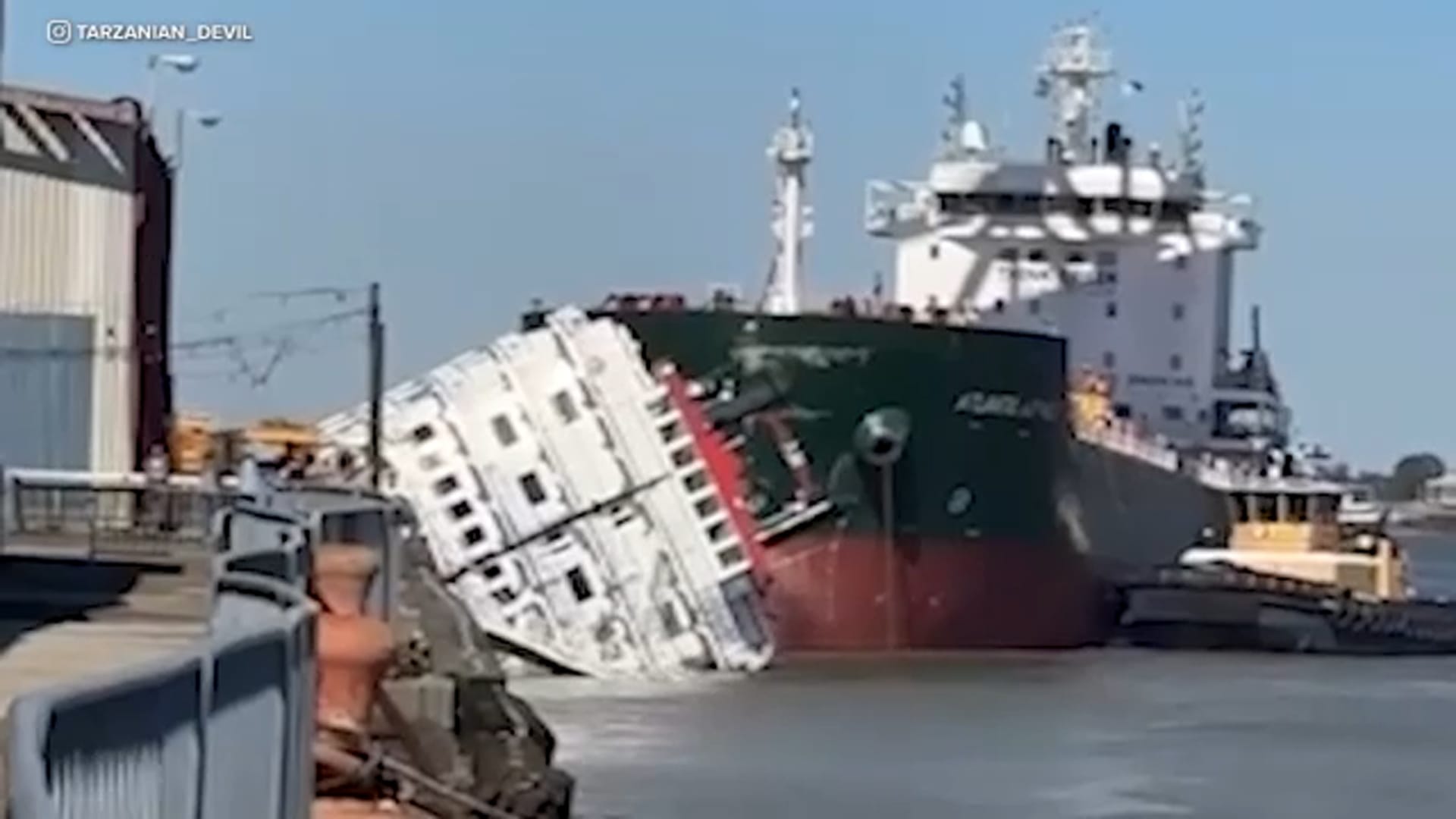
Before salvage can begin, crews must remove about 16,000 gallons of diesel from American Heritage, which remains on its side beside the Thalia Street Terminal.
American Heritage’s 22 Minutes Before Capsizing Need a Full Accounting
American Heritage overturned about 22 minutes after a tanker struck it at its New Orleans berth on Friday. About 80 people had been evacuated before the riverboat rolled, according to New Orleans Harbor Police Chief Melanie Montroll. There were 190 passengers and crew aboard.
All survived. That is an extraordinary outcome, but it does not explain how the evacuation unfolded. The cruise industry needs those 22 minutes reconstructed in detail, including the decisions that helped people survive and the circumstances that left rescuers recovering people from the river.
The National Transportation Safety Board is examining the emergency response alongside the tanker’s steering failure. I’m glad it is. Procedures that helped save lives deserve more than a passing mention in a collision report.
Four people remained hospitalized Monday, one in serious condition, city officials said. The other three were stable. Thirty-two people were initially taken to hospitals, including two Harbor Police officers who entered the river when the vessel rolled.
Dr. Jennifer Avegno, New Orleans’ deputy mayor of health and human services, said many initial injuries came from people being knocked down or struck by falling objects.
The life jackets belong in the investigation
Passenger Joe Knab told WDSU-TV that American Heritage’s crew gathered passengers on the third deck and distributed life jackets before the vessel overturned. Montroll credited the use of those jackets with helping passengers survive until rescuers reached them.
Nearby tugboats, other vessels, port workers and emergency responders helped recover people from the water. NTSB member John DeLeeuw put the count aboard at 140 passengers and 50 crew members.
“We are also going to investigate the things that went right,” DeLeeuw said Sunday.
That is the right approach. The evacuation count alone cannot establish whether the response was effective or inadequate. The sequence matters: how passengers were moved, how life jackets were distributed and how the response continued after the riverboat rolled. Those are practical questions for an industry whose emergency procedures have to work with passengers aboard, not just read well on paper.
The collision occurred at about 12:30 p.m. Friday near the Crescent City Connection bridge as passengers were beginning to disembark. American Heritage was completing an eight-day Mississippi River cruise. Built by Chesapeake Shipbuilding in 2015 and refurbished in 2022, the paddlewheeler accommodates up to 150 guests.
Steering failure is established. Its cause is not.
The approximately 520-foot, Marshall Islands-flagged tanker Atlantic Asphalt was traveling upriver toward an oil facility in Reserve, Louisiana, with 19 crew members and a local pilot aboard.
NTSB investigator-in-charge Bart Barnum said a steering failure left the tanker’s rudder fully to starboard, sending it toward the east bank and the docked riverboat. Investigators have not determined what caused that failure.
The NTSB recovered the tanker’s voyage data recorder and has reviewed bridge recordings. Crew interviews were scheduled to begin Monday. The inquiry covers personnel, equipment and environmental conditions and is not a criminal investigation.
Coast Guard records document an autopilot malfunction reported aboard the tanker in July 2024 and a loss of communication between the bridge and main engine the following month. Both problems were subsequently corrected. No problems were reported during the tanker’s most recent Coast Guard inspection.
Those earlier incidents are relevant history, not an established explanation for Friday’s collision.
Fuel removal comes before salvage
American Heritage remained on its side and partially submerged beside the Thalia Street Terminal. Coast Guard Capt. Melanie Burnham said removing it could take weeks. Crews must first safely extract approximately 16,000 gallons of diesel fuel. Burnham told CNN on Monday that hazardous-material removal work was underway.
A 500-foot safety zone remained in effect Monday morning, with vessel traffic restricted to one-way movements between Mississippi River mile markers 95.5 and 96.5. Officials asked residents and visitors to avoid the immediate riverfront work area.
The tanker has been towed away. Its manager, OSM Thome, said Saturday that it was stable at anchor and undergoing damage assessments, with its crew safe and accounted for.
New Orleans officials arranged food, hotel accommodations and transportation for riverboat passengers. Louisiana State Police helped travelers obtain replacement identification after belongings were lost in the river. Family assistance inquiries have transferred to American Cruise Lines at 203-487-9252.
Damage claims are already in court
The Board of Commissioners of the Port of New Orleans filed suit Friday in the U.S. District Court for the Eastern District of Louisiana against the tanker, its Liberia-registered owner, Nave Shipping SA, and Singapore-based manager Thome Ship Management.
The port alleges negligence and estimates physical damage to the Thalia Street Terminal will exceed $1 million. It also seeks compensation for cleanup, inspections, repairs and other losses. Chief U.S. District Judge Wendy Vitter authorized the tanker’s arrest. The port has requested its eventual sale to satisfy its claims, but no sale has been ordered.
Four American Heritage crew members, Tashika McKnight, LeQuan Askew, Paulina Ward and Zayvion Strozier, filed a separate lawsuit Saturday alleging serious, lasting injuries. Their attorney, Hugh Lambert, told CNN he was seeking damages for physical and psychological harm, although the extent of their physical injuries had not yet been determined.
Nave Shipping and Thome Ship Management did not immediately respond to CBS News’ requests for comment on the port’s lawsuit. OSM Thome separately said it was cooperating with local authorities investigating the collision.
Investigators are asking witnesses to send photographs or video to witness@NTSB.gov. DeLeeuw said a preliminary report is expected within 30 days, with final findings and safety recommendations expected in 18 to 24 months.
Explaining why the tanker hit American Heritage is essential. For cruise operators, so is establishing what protected people when the riverboat overturned. All 190 survived. The safety lesson lies in knowing exactly how, rather than letting that remarkable total stand in for an answer.