Carnival Orders LNG Ships to Expand Port Access
Each vessel will have about 1,650 guest cabins and be built at Fincantieri’s Marghera yard; Carnival has not yet named the ships or announced their routes.
Carnival’s Smaller-Ship Order Is a Welcome Alternative to Going Bigger
Carnival has ordered two ships of about 130,000 gross tons while preparing to introduce a 230,000-gross-ton class. Good. I’d rather see the line leave room for different itineraries than make its biggest ship the template for every new order.
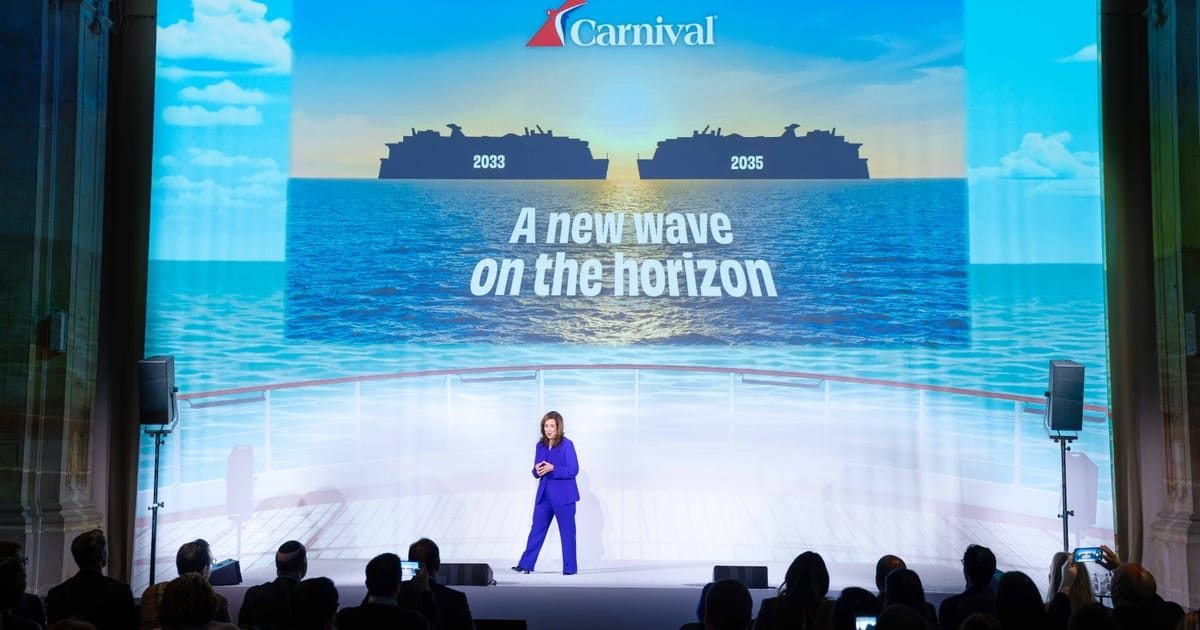
The stated purpose of the smaller design is to expand port access and itinerary options. That is the most promising part of the plans Carnival Cruise Line President Christine Duffy unveiled at its Next Wave event in New York on November 19, 2026. More pools and a bigger water park were also on the agenda. Ships that can widen the destination list deserve at least as much attention.
The two vessels are contracted with Fincantieri for delivery in 2033 and 2035. Each will have approximately 1,650 guest cabins and will be built at the Italian shipbuilder’s Marghera yard. Their dual-fuel propulsion systems will use LNG as the primary fuel.
These are smaller ships by Carnival’s forthcoming standards, not small ships. But the substantial difference from Ace Class gives the line a useful alternative to building everything at its largest scale.
“With a 29-ship fleet, we know our guests appreciate choices,” Duffy said. She said passengers enjoy the amenities of Carnival’s largest Excel Class vessels but “also love the intimacy our smaller ships offer.”
Carnival has not named the new ships or their class, and it has not identified their routes. That last omission matters most. The case for this design becomes much stronger when there are actual itineraries showing what the smaller size makes possible.
The contract remains subject to financing and other customary conditions. Fincantieri did not disclose its value and said the design could become a platform for vessels across other Carnival Corporation brands.
According to Carnival Corporation CEO Josh Weinstein, the agreement brings the group’s orderbook to 12 ships for delivery through 2039 across Carnival Cruise Line, Princess Cruises and AIDA Cruises.
Destiny shows how big Carnival is still willing to go
This order is no retreat from megaships. Carnival Destiny, the first of three Ace Class vessels, is due in 2029 with capacity for approximately 6,160 guests at double occupancy and nearly 8,000 at maximum capacity. Its sister ships are scheduled for 2031 and 2033.
Carnival’s first detailed look at Destiny suggests a ship trying to give adults and families more clearly separated territory. I like that decision. On a vessel designed for that many people, where activities sit matters alongside how many there are.
A four-deck adult-only area will include Carnival’s first adult-only staterooms, a larger Serenity retreat and an exclusive rooftop pool deck.
Family venues and attractions will occupy nearly twice as much space as on Carnival’s newest ships, according to the line. A consolidated family area will bring together miniature golf, arcades and dining.
The new Dr. Seuss Splash Station will feature water cannons and a separate area for children wearing swim diapers. Drawing on The Cat in the Hat and Thing One and Thing Two, it expands the Seuss at Sea program through Carnival’s 13-year relationship with Dr. Seuss Enterprises.
Destiny will have eight pools, six of them infinity pools, with more than 11,200 square feet of water surface. Plans include Carnival’s first main pool area facing outward toward the ocean and a sea-facing lanai with several pools, dining venues and bars.
Other additions include 25 new dining and bar experiences, venues with ocean views spanning multiple decks, an exclusive aft pool on Deck 18 and a redesigned Limelight Lounge. Construction of the LNG-powered ship began at Fincantieri’s Monfalcone yard in July 2026.
Celebration Key gets bigger, while drinks packages go ashore
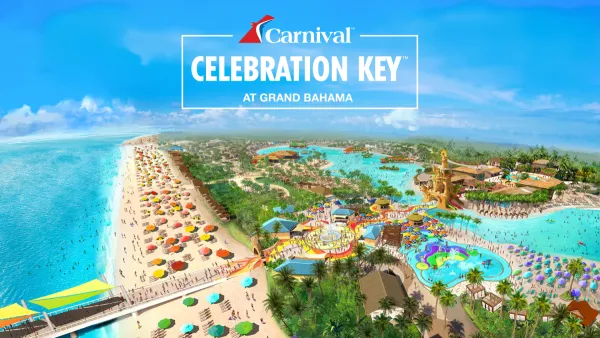
Carnival is also expanding the destinations its ships already serve. Celebration Key on Grand Bahama will gain capacity for 3,000 additional guests in 2028 and another 3,000 in 2030.
The destination opened in July 2025 and currently accommodates more than 13,000 visitors daily. Carnival says it has received more than 3.25 million guests.
The 2028 phase will add a heated pool with a beach-style entrance and swim-up bar, plus a group waterslide for four or five riders. A children’s water-play area will have five slides, a climbing structure and a drenching bucket.
The 2030 phase will bring a water park with 18 slides and a lazy river that Carnival says will be the cruise industry’s longest. Plans also include float-up bars, water-accessible cabanas and an exclusive area with an infinity pool, additional beach access, restaurants and bars.
Carnival has not announced opening months or whether the new attractions will cost extra. An attraction’s appeal depends partly on whether it is included in the day or becomes another purchase.
At RelaxAway, Half Moon Cay, Serenity Beach is scheduled to open in spring 2027 as a complimentary retreat for guests aged 21 and older. Dedicated loungers and beverage service are planned, with daybeds and cabanas available at an extra charge.
A more immediate change arrives in February 2027, when CHEERS!, CHEERS! Zero Proof, Bottomless Bubbles and CHEERS! Social will become valid at both Celebration Key and RelaxAway, Half Moon Cay. Carnival has not confirmed whether every beverage sold ashore will qualify.
Extending those packages is a sensible move. A package that follows passengers ashore is more useful than one that stops at the gangway.
But I’d put more value on a genuinely different choice of ports than an eighteenth waterslide. Carnival has committed to a ship design intended to make that possible. The itineraries for 2033 and 2035 will show how much of that opportunity it actually uses.
Compare Carnival sailings by price on Cruise Lookup.