Aurora Expeditions Completes Its Largest Antarctic Season
Aurora’s expanded Antarctic footprint points to rising demand for polar expedition travel as operators add capacity while pushing into harder-to-reach regions.
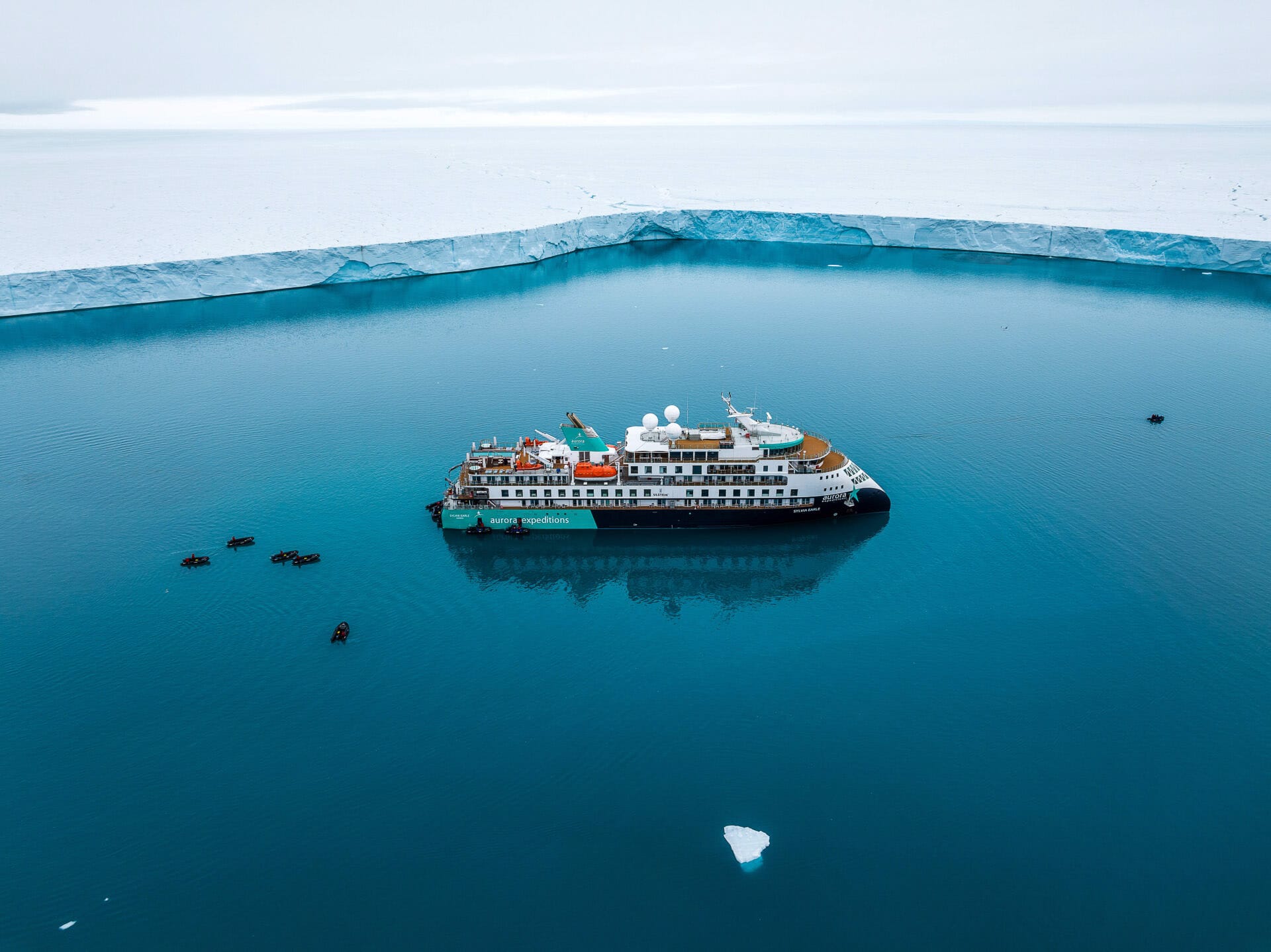
Aurora Expeditions has completed its largest Antarctic season to date, operating 30 voyages with an estimated 819 landings and reporting a 30 percent rise in expeditioners from 56 nationalities. The 2025-26 program also put the new Douglas Mawson into service and returned the company to East Antarctica after a 15-year gap.
For the first time in Aurora’s 35-year history, the company operated three ships in Antarctica simultaneously. Aurora did not disclose the absolute expeditioner count behind the 30 percent increase or the prior-season baseline used for comparison.
Michael Heath, chief executive officer at Aurora Expeditions, called the season “a significant milestone” for the company and said “operating three ships in the region for the first time reflects both our heritage and how we continue to evolve.”
Douglas Mawson expands the Antarctic fleet
The program included the November launch of Douglas Mawson in Sydney ahead of the vessel’s inaugural Antarctic season. The 2025-built ship joined Greg Mortimer, built in 2019, and Sylvia Earle, built in 2022, as Aurora’s third current expedition vessel.
Douglas Mawson carries 154 passengers in total, with Aurora’s expedition-voyage capacity listed at about 130 guests, matching the expedition cap used across the fleet. The 104-meter ship has 86 cabins, Polar Class 6/Ice Class 1A credentials and an Ulstein X-BOW hull designed to reduce slamming, vibration and fuel use in rough seas.
Aurora said Douglas Mawson reached 78 degrees 44.405 minutes south during the season, which the company described as the southernmost voyage in history. The ship’s deployment also supported Aurora’s return to East Antarctica for the first time in 15 years.
Activities, science and operational tools
The season introduced Active Antarctica voyages with 14 included activities. Expeditioners recorded 2,835 polar plunges across the program. Onboard teams delivered 269 lectures.
Guests also contributed thousands of hours to citizen science programs, including whale and seabird monitoring, oceanographic data collection and polar ecosystem observation. Aurora said the season brought AI-powered routing technology and microplastic filtration systems into Antarctica, along with drone-supported scouting to help bridge teams assess ice and landing sites in real time.
Aurora did not name suppliers for the routing or filtration systems, nor did it publish a ship-by-ship breakdown of the 30 Antarctic voyages.