Viking Libra Floats Out as First Hydrogen-Powered Cruise Ship
Hydrogen propulsion is moving from pilot projects to full ships as cruise lines chase access to strict-emissions destinations. Viking's bet could reshape how newbuilds meet future rules.
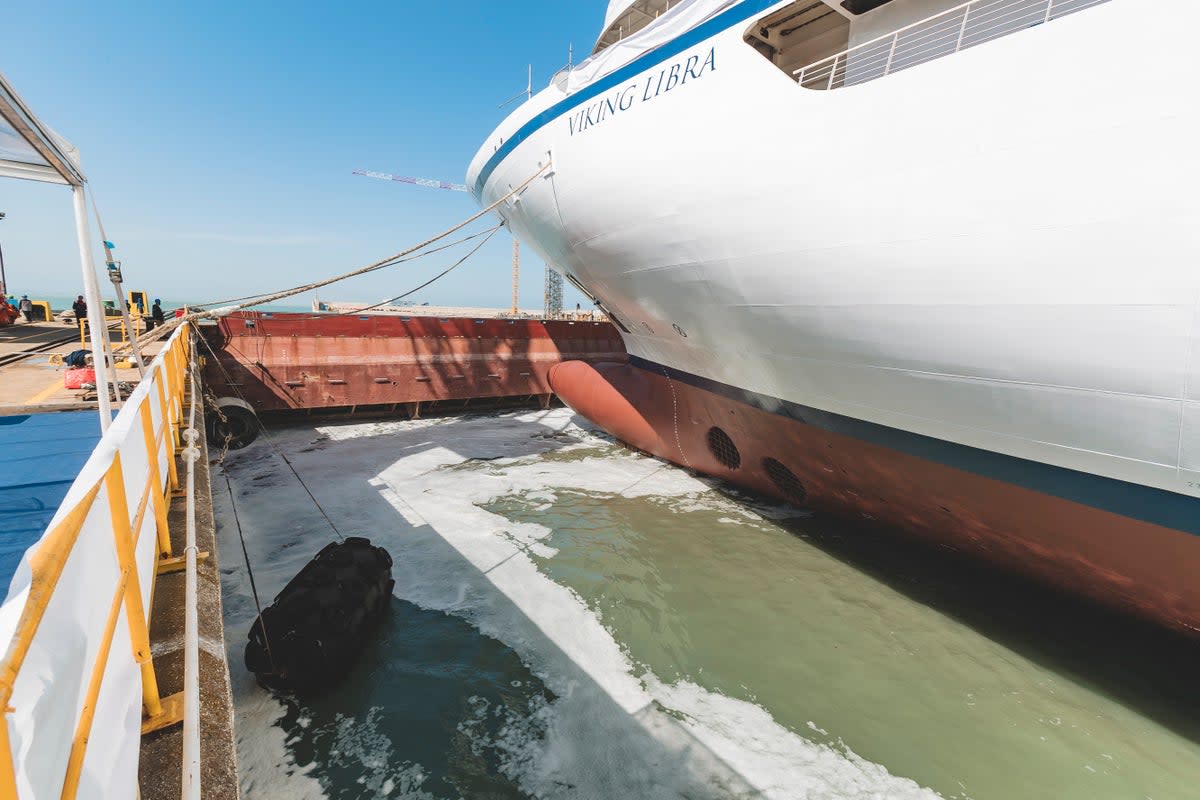
Viking has floated out Viking Libra at Fincantieri’s Ancona shipyard in Italy, marking the first time the 998-guest ship touched water and moving the newbuild into its final phase of construction ahead of a planned November 2026 delivery.
The company is billing Viking Libra as the cruise industry’s first hydrogen-powered vessel designed to operate with zero emissions, a capability Viking says can help support access to areas with strict environmental requirements.
Float-out milestone at Fincantieri’s Ancona shipyard
The float-out ceremony began with a ceremonial cord-cutting that initiated the flooding of the building dock, a process that takes about two days to fully set the ship afloat. With the ship now out of the dock, Viking Libra is set to be moved to a nearby outfitting dock for completion of onboard spaces, systems, and finishing work.
Attendees included Gilberto Tobaldi, Director of the Ancona Shipyard at Fincantieri, along with Viking representatives including Karine Hagen, Executive Vice President of Product, and Enrico Prunotto, Senior Vice President of Ocean Passenger Operations.
How Viking describes Libra’s hydrogen and fuel-cell approach
Viking says Viking Libra will use a hybrid propulsion setup incorporating liquefied hydrogen and polymer electrolyte membrane (PEM) fuel cells, with the fuel-cell system designed to generate up to six megawatts of power. The company has described the technology as enabling zero-emission operations during certain navigational phases, including in environmentally sensitive regions such as the Norwegian fjords.
Torstein Hagen, Chairman and CEO of Viking, tied the project to the company’s broader design direction, saying: “From the beginning, our approach to ship design has focused on reducing fuel consumption, and the Viking Libra is our most environmentally friendly vessel yet.”
Hagen also characterized the investment as long-term, adding: “Investing in hydrogen was a principled choice for Viking, offering a true zero emission solution, and we look forward to welcoming the world’s first hydrogen powered cruise ship to our fleet.”
Ship size, capacity, and key specifications
Viking classifies Viking Libra as a small ship, consistent with the rest of its ocean fleet. When completed, the vessel is expected to be about 54,300 gross tons, with 499 staterooms for up to 998 guests, and an inaugural season planned for the Mediterranean and Northern Europe.
- Size and accommodations: The ship is expected to measure about 54,300 gross tons and offer 499 staterooms, for a maximum capacity of 998 guests.
- Delivery and first deployment: Viking has set delivery for November 2026, with an inaugural season planned in the Mediterranean and Northern Europe (without additional detail on exact itineraries or homeports in the available announcements).
- Hydrogen and fuel-cell output: The PEM fuel-cell system is designed to generate up to six megawatts of power as part of the ship’s hybrid propulsion configuration.
Fuel-cell supplier and the plan for hydrogen loading
Viking has said the hydrogen and fuel-cell portion of the power system is being enabled through Isotta Fraschini Motori (IFM), a Fincantieri subsidiary focused on advanced fuel-cell technologies.
The project also incorporates a containerized approach for hydrogen storage and loading, a design Viking and Fincantieri have positioned as a way to address practical challenges tied to hydrogen supply and bunkering.
Earlier hydrogen testing and the next ship in the series
Viking Libra follows earlier hydrogen-related work by Viking and Fincantieri. In November 2022, Fincantieri delivered Viking Neptune equipped with an experimental hydrogen fuel cell module intended for onboard power generation and to inform future development; that low-temperature PEM-type system was described with a nominal power output of 100 kW.
The Viking Libra project was previously announced in April 2025, and Viking has also identified a follow-on hydrogen-powered ocean ship, Viking Astrea, which is under construction with delivery planned for 2027.
How other cruise operators are pursuing lower-emission technology
Viking’s hydrogen initiative comes as other cruise lines also pursue alternative fuels and lower-emission solutions. MSC Cruises has introduced LNG-powered vessels including World Europa and World America, while Hurtigruten and Havila Voyages have highlighted advancements tied to climate-neutral and biogas-powered sailings. Hurtigruten has also set a goal to debut a zero-emission ship by 2030, powered by advanced battery packs.
With Viking Libra now afloat and outfitting underway, the next major milestones will center on system installation, integration, and testing as the ship works toward its scheduled November 2026 delivery, followed by the planned arrival of the hydrogen-capable Viking Astrea in 2027.
Frequently Asked Questions (FAQs)
What is the significance of the Viking Libra’s propulsion system?
Viking says Viking Libra’s hybrid system combines liquefied hydrogen with PEM fuel cells to support zero-emission operations during certain phases of navigation, including in environmentally sensitive regions such as the Norwegian fjords.
When is the Viking Libra expected to enter service?
Viking Libra is scheduled for delivery in November 2026, and Viking has said the ship’s inaugural season is planned for the Mediterranean and Northern Europe.
How does hydrogen bunkering work for the Viking Libra?
Viking and Fincantieri have described a containerized approach for hydrogen storage and loading, designed to help address practical challenges related to hydrogen supply and bunkering.
What other hydrogen-powered ships are under development by Viking?
Viking has said Viking Astrea is under construction and is planned to be hydrogen-powered as well, with delivery scheduled for 2027.
Are other cruise lines investing in green technologies?
Yes. The sources cite MSC Cruises’ LNG-powered ships World Europa and World America, as well as Hurtigruten and Havila Voyages’ work tied to climate-neutral and biogas-powered sailings; Hurtigruten has also stated an aim to debut a zero-emission ship by 2030 powered by advanced battery packs.