Galveston Weighs Royal Caribbean Deal for Cruise Terminal 14
Under the proposal, the port would build the pier, berth and parking while Royal Caribbean would construct the terminal and receive seven-day preferential berthing.
Updated September 19, 2026
Galveston Wharves trustees deferred a preliminary agreement for a fifth cruise terminal with Royal Caribbean Group while unanimously approving an operating license that will bring Margaritaville at Sea to the port in October 2027.
The board voted Aug. 25 to give port staff more time to negotiate the Cruise Terminal 14 proposal with Royal Caribbean. A final development agreement would cover financing, construction and operations before returning to trustees for approval. Margaritaville at Sea, meanwhile, will become Galveston's seventh cruise line and add Friday departures to the port's schedule.
Cruise Terminal 14 negotiations continue
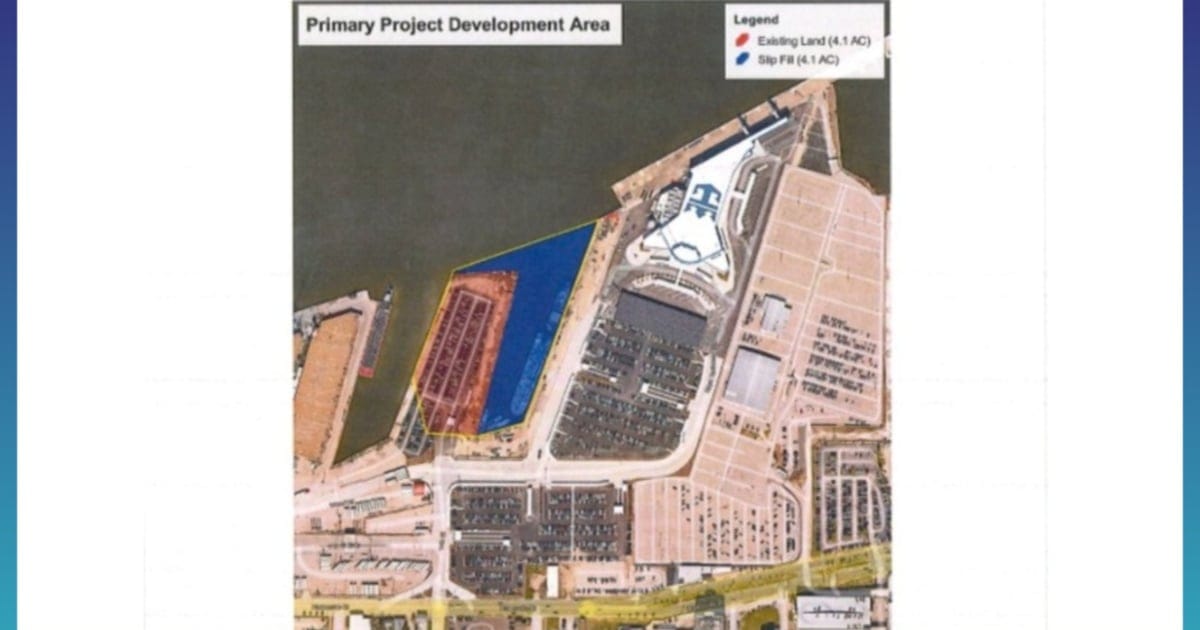
The proposed Cruise Terminal 14 would sit between Royal Caribbean's Cruise Terminal 10 and the planned site for Battleship Texas, immediately east of Cruise Terminal 16. That terminal serves MSC Cruises and Norwegian Cruise Line.
The project would divide responsibilities along the lines of the port and Royal Caribbean's $125 million Cruise Terminal 10 development, which opened at Pier 10 in 2022. Galveston Wharves would fill the slip east of Pier 14 and construct a new pier and berth capable of accommodating Royal Caribbean's approximately 248,663-gross-ton Icon-class ships. The vessels are about 1,197 feet long and carry 5,610 passengers at double occupancy.
The port would also modify Cruise Terminal 16 so ships using that facility could berth farther west. Parking, potentially including a garage, would be another port responsibility, and Galveston Wharves would keep all parking revenue.
Royal Caribbean would develop and build the passenger terminal and receive seven-day preferential berthing. The terminal is designed to handle approximately 2 million passenger movements annually, enough to support two weekend ships combined with a five-, five- and four-day sailing rotation. The port's four existing cruise terminals already handle almost 4 million passenger movements a year.
Port Director and CEO Rodger Rees said Galveston would be honored to welcome Icon of the Seas. The ship is scheduled to begin sailing from Galveston in August 2027 and would initially use Royal Caribbean's existing Pier 10 terminal. Cruise Terminal 14 could open no earlier than 2030.
Preliminary financial terms remain subject to negotiation
The deferred memorandum of understanding outlined a proposed 20-year ground lease followed by four optional 10-year extensions. Its base fee would begin at $8.70 per passenger and rise 3% annually, with Royal Caribbean keeping the right to modify the fee. A separate passenger-movement charge tied to the amount assessed at Cruise Terminal 10 would increase 3% every five years.
At the projected volume, the base passenger fee would produce approximately $17.5 million in the first year, when rent would be about $4 million. By year 20, passenger-fee revenue is projected to approach $31 million, while rent would be about $5 million. Across the maximum 60-year period, the revenue stream has an estimated present value of $479 million using a 6% discount rate.
Most of the proposed memorandum would be nonbinding. Its capital-allocation provision, if approved in a future agreement, would require Galveston Wharves to prioritize funding for Cruise Terminal 14 over other port-funded cruise terminal developments until the port completed its portion of the work.
The exclusivity terms would still allow discussions concerning Cruise Terminal 25, where Carnival Cruise Line has preferential berthing, and Cruise Terminal 28, where Disney Cruise Line has priority. Neither Royal Caribbean nor the port has committed to building Cruise Terminal 14, and exclusive negotiations are continuing.
According to the port, existing cruise operations support more than 4,547 jobs and generate $733 million in business revenue, $291 million in personal income and $25 million in state and local taxes annually. A separate economic impact study estimated that a fifth terminal would add 1,500 jobs, $278 million in business revenue, $91.5 million in personal income and $7.9 million in state and local taxes.
Margaritaville at Sea approved for 2027 arrival
The approved Margaritaville at Sea license initially covers 13 months, from Oct. 1, 2027, through Oct. 31, 2028, with two five-year renewal options. Operations will primarily use Cruise Terminal 28, with some calls at Cruise Terminal 25.
At Cruise Terminal 28, the line will pay $18.61 per passenger movement in 2027 and $19.17 in 2028. Cruise Terminal 25 use will cost $20.17 per movement. An additional city-services wharfage charge will be 27 cents per movement in 2027 and 28 cents in 2028, and annual increases during renewal periods will be capped at 3%.
Margaritaville at Sea will guarantee at least 200,000 passenger movements during the initial term, rising to 210,000 in the first renewal and 220,000 in the second. The license does not identify which ship will serve Galveston, but CEO Christopher Ivy told trustees the ship would be announced in September. Paradise currently sails year-round from the Port of Palm Beach, Islander operates from Port Tampa Bay, and Beachcomber is scheduled to enter service at PortMiami in January.
“We're very pleased to welcome Margaritaville at Sea to Galveston. This new service rounds out our cruise schedule with Friday sailings and gives our guests even more choices for when and where they want to cruise,” Rees said.
Port investments continue
Fitch Ratings upgraded Galveston Wharves revenue bonds from A to A+, citing sustained cruise growth, financial performance and capital investment. The port issued approximately $198.5 million in bonds in 2024 to finance construction of its fourth cruise terminal.
The port is also investing more than $8.5 million in six vehicle and pedestrian projects, supported by $7.4 million in state and federal grants and nearly $1.1 million from operating reserves. A separate engineering study will examine refurbishing and reopening the elevated walkway at 25th Street and Harborside Drive to connect downtown with Cruise Terminal 25.
See cruises departing Galveston on Cruise Lookup.