Developers Propose New Tampa Bay Cruise Port to Bypass Skyway Bridge
With cruise ships getting taller, ports are scrambling for new gateways. Tampa Bay’s proposal could keep the region competitive while intensifying scrutiny of estuary impacts.
SSA Marine and Tampa-based Slip Knott LLC are exploring a proposal to build a new cruise port at the mouth of Tampa Bay in Manatee County, a concept they say would allow larger modern ships to serve the region without needing to pass under the Sunshine Skyway Bridge.
Branded as the Knott-Cowen Cruise Port, the project is still in an early planning stage and would require zoning changes, permitting, environmental review, and public hearings before any construction could begin. Developers estimate that, even if approved, construction would take about three to five years.
Why developers say Tampa Bay needs a second cruise gateway
Port Tampa Bay has hosted cruise operations for decades and recently posted record passenger activity, but the Sunshine Skyway Bridge restricts which ships can physically reach the current cruise terminals. Coverage and project descriptions cite the bridge’s vertical clearance at roughly 180 to 190 feet, depending on reference point and conditions.
Those limits rule out many newer ship classes. Public discussion around the proposal has cited ships that exceed the Skyway’s clearance, including Oasis-class, Excel-class, Prima-class, and Icon-class vessels, with one account placing Icon-class ships at nearly 250 feet in height.
Developers argue the Knott-Cowen location, positioned seaward of the bridge on the Gulf side, would eliminate the need for large ships to transit Tampa’s narrower channels and pass under the Skyway. The approach is also framed as a time-saver, with ship transits in and out of Tampa’s channels described as taking about two hours before reaching the bridge, and the proposed site described as roughly 24 nautical miles from the existing Port Tampa Bay cruise facilities.
Where the proposed terminal would be built, and what county filings show
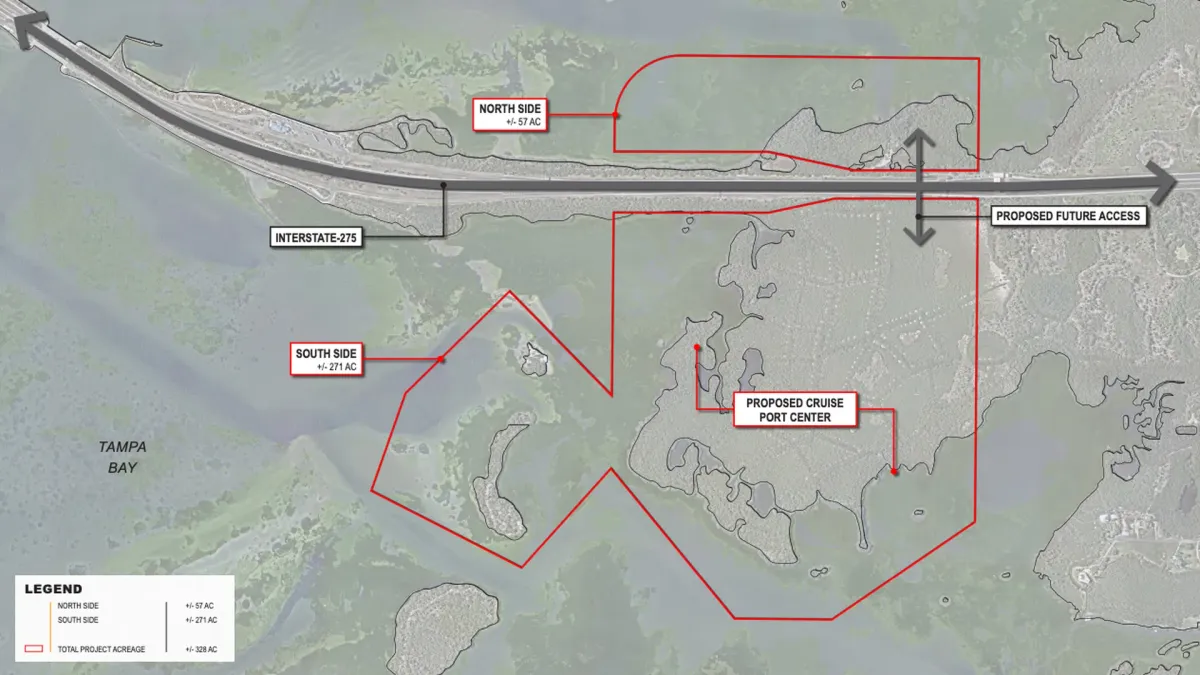
The concept centers on the Knott-Cowen tract, a coastal property in Manatee County adjacent to the Sunshine Skyway Bridge, with the cruise port area shown at the south end of the tract near Terra Ceia, an unincorporated community with fewer than 500 residents. Developers have described the concept as a multi-berth cruise facility with supporting infrastructure, but specific design renderings and a finalized terminal layout have not been publicly detailed in the materials cited in available coverage.
The overall site is widely described as roughly 328 acres, while a map submitted in county filings shows a total of 308 acres included in project materials, broken out as follows:
- Total shown in project materials: 308 acres, according to a map submitted in county filings.
- South of Interstate 275: 271 acres.
- North of Interstate 275: 57 acres.
County filings also depict road access using north and south I-275 exits, and include nearby islands such as Paradise Island and Skeet Key in the project’s mapped area.
Economic projections, and Port Tampa Bay’s recent cruise volume
SSA Marine has promoted the proposal as a major economic driver for West Central Florida. Early estimates cited in project materials and repeated in coverage include more than 31,000 jobs tied to construction and related activity and about $1.6 billion in labor earnings.
Separate projections tied to ongoing operations cite more than 13,000 jobs once the port is operational, along with about $40 million annually in tax revenue, figures that would be subject to review during the public approval process.
The proposal has also been discussed in the context of current demand at Port Tampa Bay. In fiscal year 2025, Port Tampa Bay recorded about 368 cruise ship sailings and handled more than 1.6 million cruise passengers, described as a record for the port.
SSA Marine Cruise Division President Stefano Borzone has framed the new facility as additive to existing cruise business. “Our new port will complement existing cruise activities in the region by being able to service the newer, larger ships that would otherwise be unable to visit due to the Sunshine Skyway Bridge’s height restrictions,” Borzone said. In another statement, he described the port as serving “newer, larger, low-emissions cruise vessels” that cannot access Port Tampa Bay because of the Skyway’s height restriction.
Rattlesnake Key purchase, and SSA Marine’s conservation commitments
A prominent element of the announcement involves Rattlesnake Key, an undeveloped island adjacent to the proposed port area. SSA Marine said it acquired the approximately 710-acre Rattlesnake Key property in October 2025 for $18 million through a subsidiary called the Rattlesnake Key Preservation Company.
Borzone framed the acquisition as a conservation move, saying, “Our intent in purchasing the property is to remove any possibility of private commercialization and ensure its conservation.” He added, “We recognize Rattlesnake Key is a treasured local community asset.”
Developers have described the island as a natural buffer and have said there will be no commercial construction on Rattlesnake Key itself. The proposed cruise terminal, however, would be located nearby, and debate has centered on what construction and potential dredging could mean for surrounding waters and habitats.
Environmental concerns and growing local opposition
The port concept has drawn criticism from environmental advocates and some nearby residents, particularly because the area shown in county filings is within or adjacent to protected waters tied to the Terra Ceia Aquatic Preserve and the broader Tampa Bay estuary. Critics have focused on potential dredging, water quality, habitat disruption, and traffic impacts, along with concerns about mangroves, seagrasses, and marine ecosystems.
Peter Clark, president and founder of Tampa Bay Watch, warned in a published interview that a large industrial facility in the area “would certainly raise concerns for our water quality, critical habitat for fish and wildlife, and the recreational value” that depends on a healthy estuary.
Maya Burke, assistant director of the Tampa Bay Estuary Program, described the project area as among the most ecologically rich parts of Tampa Bay. “For a proposal like what was floated today, protecting what already exists wouldn’t be nearly enough,” she said, adding that significant habitat creation would be needed to offset losses.
On public radio, Justin Tramble, executive director of Tampa Bay Waterkeeper, criticized the plan as a “clown proposal,” arguing the location’s ecological value is being underestimated. Rusty Chinnis, a fisherman and chairman of Suncoast Waterkeeper, also raised concerns about dredging impacts near the site and said, “I can’t see any benefit really,” calling the potential impacts on the area “very negative.”
Organized opposition has also taken shape online and in planned events. A Change.org petition associated with “Save Rattlesnake Key,” started by Manatee County resident Corey McKeever, was described as surpassing 9,000 signatures in one update and cited at roughly 12,000 in another as opposition grew. Suncoast Waterkeeper also circulated a separate petition that was nearing 2,000 signatures at the time described. An in-person rally opposing the proposal has been announced for Feb. 14 at Seabreeze Park in Terra Ceia.
Permitting path, dredging questions, and political reaction
The proposal remains in a pre-application stage in county records, and no firm timeline for approvals has been set in the public coverage. Before construction could begin, the project must move through Manatee County’s review process, including public hearings before the planning commission and the Manatee County Board of County Commissioners.
Filings with Manatee County include an intent to seek rezoning for industrial development and an amendment to the county’s Comprehensive Plan. A letter from Manatee County Development Services also indicated the proposal qualified for the county’s Rapid Response program, a review track intended for projects expected to have significant economic impact.
The port concept has also been linked to dredging. County filings referenced a plan to dredge in the area using rights the developers say were granted by the State of Florida to the property roughly 70 years ago, a detail expected to be scrutinized as environmental review proceeds.
As controversy grew, Manatee County’s state legislative delegation publicly opposed the concept. State Representative Will Robinson wrote, “I cannot think of a worse place to put a cruise ship terminal,” and argued that economic projections are secondary if the location is fundamentally incompatible with a large cruise operation.
State Senator Jim Boyd and Robinson also announced they were withdrawing House Bill 4073, a separate measure that would have changed the governance structure of the Manatee County Port Authority overseeing SeaPort Manatee. In a delegation statement explaining the move, they said the proposed cruise terminal “has understandably created public angst,” and that the timing raised concerns about changes in control and jurisdiction.
Manatee County government has said the Board of County Commissioners had not yet considered the cruise port concept on an agenda at the time of a published statement, adding that any evaluation would occur through a public process considering economic, community, and environmental impacts. Slip Knott LLC declined at least one request for an interview in local coverage.
Frequently Asked Questions (FAQs)
Where is the proposed Knott-Cowen Cruise Port located?
The concept places a new cruise terminal on the Knott-Cowen tract in Manatee County near Terra Ceia, on the Gulf side of the Sunshine Skyway Bridge. County filings depict road access using north and south I-275 exits, and project mapping has also shown nearby islands, including Paradise Island and Skeet Key.
Why can’t the newest mega-ships use Port Tampa Bay today?
To reach Port Tampa Bay’s cruise terminals, ships must pass under the Sunshine Skyway Bridge, which is commonly cited at roughly 180 to 190 feet of vertical clearance. That clearance prevents many newer ship classes, including some of Royal Caribbean’s largest designs, from reaching the existing Tampa cruise terminals.
How long would it take to build the cruise port if approved?
Developers estimate construction would take about three to five years, but only after zoning, permitting, and public hearings are completed. One estimate in the coverage also suggests operations would not begin until the end of the decade at the earliest.
Will Rattlesnake Key be developed as part of the project?
No. SSA Marine said its subsidiary bought the approximately 710-acre island in October 2025 for $18 million for conservation and that there will be no commercial development on Rattlesnake Key, though the proposed terminal would be located nearby.
What approvals are required before construction can start?
The project would need Manatee County zoning and permitting approvals, including public hearings before the planning commission and county commissioners, and additional environmental and regulatory review tied to dredging and coastal impacts. County filings also reference an intent to seek rezoning for industrial development and an amendment to the county’s Comprehensive Plan.