Southampton Study Links Cruise Pollution to Lung Inflammation
Researchers measured air quality at six sites and found the highest concentrations near the cruise terminal area, with vanadium the most enriched element.
Updated July 14, 2026
Ultrafine air pollution from cruise ships at the Port of Southampton may inflame lung cells and reduce their antiviral defenses, according to University of Southampton research that found the metal vanadium increased infection by rhinovirus and coronavirus in laboratory tests. The study linked higher particle concentrations to cruise vessel presence and wind direction, and found metals including vanadium, nickel and cobalt in air samples taken around the port.
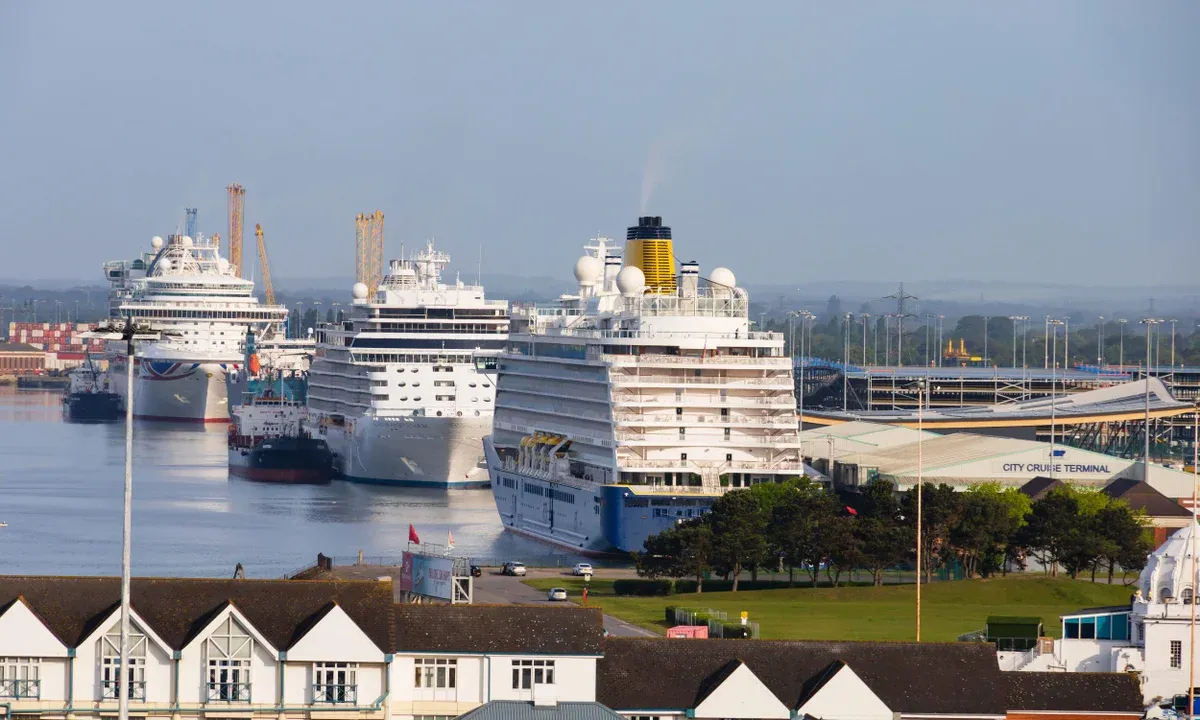
The findings add a health dimension to emissions-at-berth scrutiny in Southampton, which handles around three million passengers annually across five passenger terminals. The experiments used lab-grown cells and particle doses far higher than daily real-world exposure, and the study did not measure health outcomes among nearby residents. Associated British Ports challenged parts of the methodology and said regulated emissions remained within national limits.
Researchers identify a cruise-emissions fingerprint
University of Southampton scientists measured air quality between February 2018 and March 2020 at five locations inside the Port of Southampton: a truck gate, a scrap metal yard, a research dock, a container ship terminal and a cruise ship terminal. A sixth station at the University of Southampton, about five kilometers away, recorded background city air for comparison. Researchers also collected winter samples at the cruise terminal, when cruise traffic was lower.
Nat Easton, the lead researcher, told the BBC: “We see increases in concentration when the wind was coming from the direction of the cruise ships, and when cruise ship presence was higher.”
The cruise terminal stood out during the busy summer season. Ultrafine particles collected there were enriched with vanadium, nickel and cobalt compared with the other sites and background city air, and those same metals were not elevated at the cruise terminal in winter. Vanadium and nickel are associated with heavy fuel oil, while cobalt was identified by the authors as a possible additional signature.
In laboratory testing, researchers exposed human lung lining cells from the airways and from deep in the lungs to ultrafine particles collected from the port environment. They observed stronger inflammatory responses and lower activity in antiviral genes, suggesting the cells were less able to respond to respiratory viruses.
Further testing pointed to vanadium as the main driver. When the metals were tested individually, vanadium alone reproduced the inflammation and reduced antiviral defenses seen with the cruise-terminal ultrafine particles; nickel and cobalt did not. Human airway cells exposed to vanadium produced more copies of rhinovirus-16, a common cold virus, and coronavirus infection rose nearly fivefold compared with untreated cells.
Professor Matthew Loxam said the team had identified “a clear air pollution ‘signature’ coming from cruise ships burning fuel in ports.” He added that ultrafine particles in those emissions “are essentially unregulated and generally not monitored.”
“We found that exposure of cells to these particles, and vanadium — the most enriched element in the particles — was both pro-inflammatory and facilitated the replication of viruses,” Loxam said.
ABP questions conclusions as shore power features in response
Associated British Ports, which owns and operates the Port of Southampton, said it was proud of its emissions-reduction work but disputed the study's conclusions. “Emissions like nitrogen dioxide and particulate matter are well within National Air Quality Objective mean annual limits,” ABP said. “We are concerned about some important aspects of the methodologies of the study and the strength of inference of some of findings that have been presented to the media.”
The British Ports Association pointed to Southampton's shore power program, which allows equipped cruise ships to connect to the electrical grid while alongside rather than relying on shipboard diesel generation for hotel loads. Southampton's Horizon terminal opened in 2021 as the UK's first cruise shore-power facility.
Current air-quality rules do not set specific limits for ultrafine particles or their chemical makeup, the study said. Ships in Southampton operate inside a sulfur-control regime that has capped fuel sulfur at 0.1 percent since 2015, but vessels may use exhaust scrubbers to meet sulfur limits, and those systems do not effectively capture sub-micrometer particles carrying metals such as vanadium.
Cruise ships can require up to roughly 10 megawatts for hotel loads while docked, according to the study, including power for lighting, kitchens and air conditioning. The British Ports Association said ports continue to invest in cleaner fuels, electrification and low-emission technologies.