Oil Above $100 Puts Unhedged Carnival in Fuel Cost Spotlight
A sudden oil shock is testing cruise lines’ pricing power just as they court early bookings. Carnival’s no hedge approach puts a spotlight on who can defend margins without surcharges.
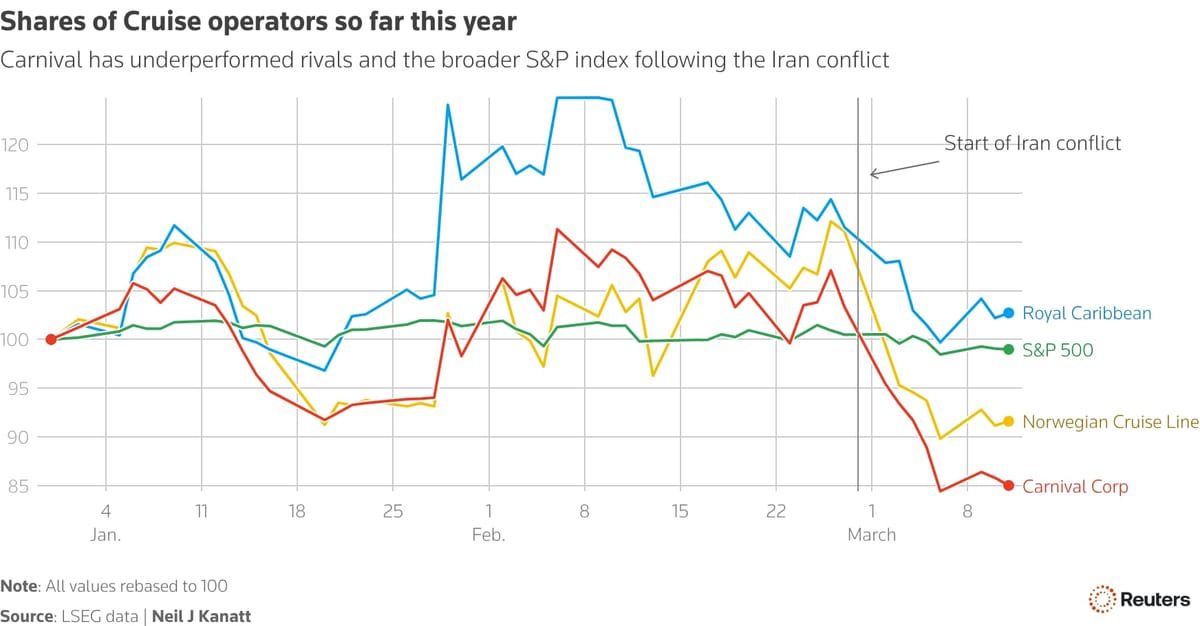
Brent crude has climbed above $100 a barrel amid Middle East supply worries tied to the conflict involving Iran, quickly raising fuel costs for cruise operators during the industry’s peak “wave season” booking period. Analysts have flagged Carnival Corp as the most exposed among major U.S. cruise companies because it does not hedge fuel prices, leaving it more directly exposed to oil price swings.
Oil jumps on Middle East supply risks
Oil prices have risen more than 35% since the conflict began, driven by attacks on oil and transport facilities across the Middle East and concerns about disruptions to energy flows through the Strait of Hormuz. Brent futures crossed $100 per barrel, up from $72.48 before the conflict.
Iran has warned that oil prices could spike much higher, with the country saying crude could reach $200 a barrel. For cruise companies, higher oil translates into higher operating costs because ships consume large volumes of marine fuels, including heavy fuel oil and marine gas oil.
Why Carnival stands out on fuel exposure
Cruise operators commonly use fuel hedging to limit exposure to sudden swings in oil prices, typically through financial contracts designed to lock in prices for a portion of expected future consumption. Carnival is the only major U.S. cruise operator that does not hedge, a choice analysts say leaves the company more vulnerable when oil rises.
Company filings show that a 10% change in fuel cost per metric ton would reduce Carnival’s 2026 net income by about $145 million, versus $57 million for Royal Caribbean under the same scenario. CFRA analyst Alex Fasciano also pointed to Carnival’s larger fleet as a factor that increases total fuel consumption relative to peers.
- 2026 sensitivity disclosure: A 10% change in fuel cost per metric ton would reduce 2026 net income by about $145 million for Carnival, compared with $57 million for Royal Caribbean, based on company filings.
- What the 2022 oil spike showed: Carnival’s fuel costs were 17.7% of revenue in 2022, compared with 12.1% for Royal Caribbean and 14.2% for Norwegian Cruise Line.
Carnival’s strategy: efficiency over financial hedges
Carnival has argued it prefers operational measures to manage fuel costs rather than hedging. In an emailed statement, the company said, “Our best hedge against fuel costs is to use less, so we focus on using less fuel in the first place.”
Carnival said it has reduced fuel use by 18% since 2011, even as passenger capacity increased by more than 38% over the same period. The company has also said it does not see a long-term net benefit from hedging fuel prices.
Carnival is scheduled to report first-quarter results on Friday, which is expected to focus attention on management’s fuel assumptions and cost controls if oil prices remain elevated.
How Royal Caribbean and Norwegian quantify the risk
Royal Caribbean has used fuel hedging and has hedged over half of its fuel needs for 2026. It has also said it will not impose additional fuel surcharges, pointing to strong booking volumes and financial confidence. Royal Caribbean’s recent performance has included EPS forecasts described as record-breaking and load factors exceeding 109%, and the company has reinstated its dividend while also running a buyback program, including $504 million in the fourth quarter of 2025 alone.
In a separate development, Royal Caribbean did not respond to a request for comment about fuel exposure.
Norwegian Cruise Line has provided its own sensitivity measure, saying a 10% change in fuel costs would reduce full-year earnings by 7 cents per share. Morningstar Research calculations equate that change to roughly a $90 million decline in net income. The company has also said it has not updated its fuel hedges since its early March earnings.
More broadly, analysts have said Norwegian’s 2026 outlook has disappointed stakeholders, citing execution missteps and capacity mismatches in key regions. Activist investor Elliott Management has continued to push for structural changes at Norwegian, including refreshed board leadership.
Passenger pricing: surcharges are rare in the U.S., but common in parts of Asia
Major U.S. cruise brands including Carnival, Royal Caribbean, and Norwegian Cruise Line have not imposed supplementary fuel charges so far, but passenger contracts generally allow them under certain conditions. Norwegian’s contract language reserves the right to charge up to $10 per guest per day if oil prices exceed $65 per barrel, while Royal Caribbean’s passenger contract similarly allows fuel surcharges of up to $12 per day as fuel costs rise. Such levies remain discretionary and may be imposed retroactively, including on pre-paid bookings.
In Asia, some operators have already moved to pass through higher fuel costs. Genting Dream passengers departing from Singapore or Malaysia now pay a surcharge of SGD15 per guest per day, while Star Voyager and Star Navigator passengers face nightly charges as high as HKD 200 and NTD 600, respectively.
Wave season pressure and signs of demand caution
The rise in fuel costs is hitting during wave season, typically January through March, when cruise companies lean on promotions and discounted fares to lock in bookings for the year. Analysts have warned that geopolitical uncertainty could deter U.S. travelers from booking higher-priced European itineraries, particularly transatlantic voyages that generally operate in the third quarter and can contribute disproportionately to cruise operators’ income.
Barclays analyst Brandt Montour said that even without ships operating in the Middle East when the conflict began, the shock can still affect demand. “Despite zero direct exposure to the Middle East, shocks like this one have the potential to step up consumer hesitation in the booking process, especially for Americans thinking of traveling abroad,” Montour said.
Goldman Sachs analyst Lizzie Dove similarly said the situation could weigh on U.S. customers booking Europe trips, especially transatlantic cruises with higher price points.
Itinerary exposure is limited, but fuel costs hit every sailing
While the conflict has raised concerns about safety and routing in parts of the Middle East, major cruise operators had no ships in the region when hostilities began, limiting near-term itinerary disruption tied directly to deployments there. Fuel prices, however, affect operations regardless of route, and higher bunker costs can pressure margins quickly, especially for operators with larger fleets or less protection from hedges.
With Brent above $100 a barrel and wave season underway, analysts and investors have said they will be watching earnings commentary for any changes in fuel assumptions, demand trends, and whether operators lean on cost controls, itinerary and speed optimization, or pricing adjustments for future bookings.
Frequently Asked Questions (FAQs)
What is fuel hedging for a cruise line?
Fuel hedging typically uses financial contracts to lock in, or limit exposure to, future fuel price changes. Cruise lines use it to reduce the impact of sudden oil price swings on operating costs.
Why does Carnival Corporation not hedge fuel prices?
Carnival has said it prioritizes reducing fuel consumption over hedging and argues hedging does not provide a long-term net benefit. In an emailed statement, the company said, “Our best hedge against fuel costs is to use less, so we focus on using less fuel in the first place,” and it reported cutting fuel use by 18% since 2011 while expanding capacity by more than 38%.
Are fuel surcharges being implemented by U.S. cruise lines?
No major U.S.-based cruise lines have announced supplementary fuel surcharges so far, though passenger contracts can allow them under certain conditions. Norwegian’s terms allow charges up to $10 per guest per day if oil prices exceed $65 per barrel, and Royal Caribbean’s contract allows fuel surcharges up to $12 per day as fuel costs rise.
What actions are Asian cruise lines taking to address fuel cost increases?
Some Asian operators have introduced surcharges for passengers to offset rising fuel costs. Genting Dream passengers departing from Singapore or Malaysia now pay SGD15 per guest per day, while Star Voyager and Star Navigator passengers face nightly charges as high as HKD 200 and NTD 600, respectively.
Are cruise itineraries being affected by the Middle East conflict?
Major cruise operators had no ships in the Middle East when hostilities began, which limited immediate itinerary disruption tied directly to deployments there. Analysts have said the broader shock can still influence consumer sentiment, particularly for Americans considering travel abroad, and rising fuel prices can pressure cruise line margins regardless of itinerary.