Meyer Werft Unveils 82,000-GT Battery-Electric Cruise Ship Concept
If big ships can run on batteries, shore power becomes cruise industry infrastructure, and Europe’s tightening emissions rules could reward lines that electrify first.
Meyer Werft has outlined a concept for what it says could be the cruise industry’s first fully battery-electric ship at mainstream scale, a study it calls Project Vision that was presented during Seatrade Cruise Global in Miami.
A concept study aimed at scaling up battery-electric cruising
Project Vision is not a newbuild order, Meyer Werft said, but a design study intended to show how existing technology could be expanded to an 80,000-plus gross ton cruise ship on itineraries where frequent recharging between ports is feasible. The concept is designed for 1,856 passengers and is described at around 275 meters (about 902 feet) long, with a concept gross tonnage figure of roughly 82,000.
Tim Krug of Meyer Werft’s Concept Development Group said the shipyard’s goal is to bring decarbonization forward on a practical timeline. “We asked ourselves how we can use innovation to reduce CO2 and contribute to decarbonization not in 50 years, but much sooner,” Krug said. He added: “We enable a reduction in greenhouse gas emissions of up to 95%.”
- Concept name: Project Vision
- Length: About 275 meters (about 902 feet)
- Passenger capacity: 1,856
- Size: Approximately 82,000 gross tons (Meyer Werft concept figure)
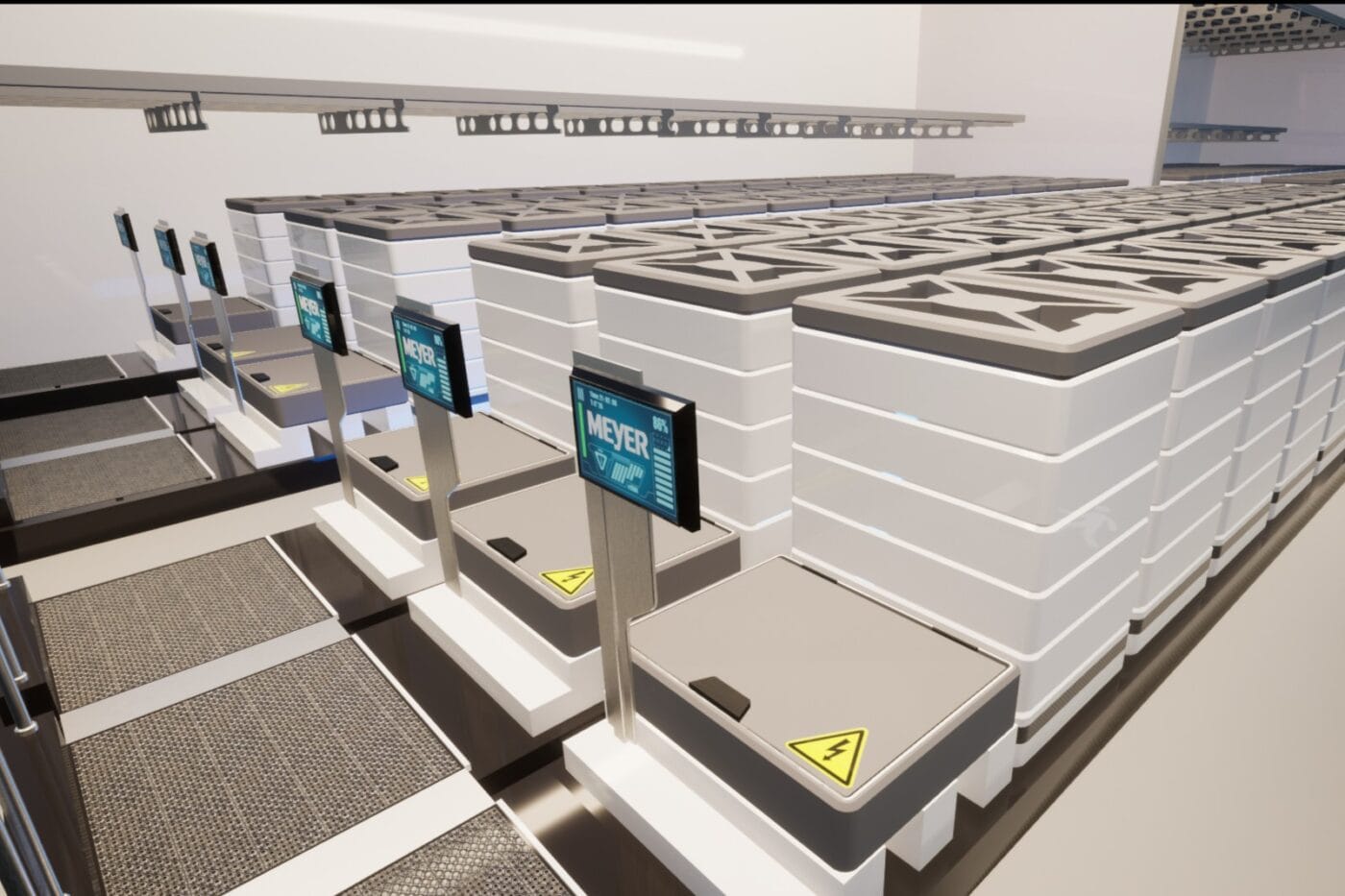
- Battery partner: Corvus Energy (Norway)
- Claimed emissions impact: Up to a 95% reduction in greenhouse gas emissions versus conventional marine-fuel propulsion (Meyer Werft estimate)
How the ship would operate on battery power alone
Meyer Werft’s operational premise is that a large cruise ship could complete selected regional routes entirely on battery power, then recharge during port calls. The shipbuilder has pointed to European itineraries as a best fit, citing Barcelona-to-Civitavecchia (the port area serving Rome) as an example route where onboard power needs could be met by batteries recharged at ports.
The concept’s feasibility is tied to how often the ship would need to recharge and for how long, which in turn depends on shore-side electrical capacity and charging equipment at ports.
Battery supplier and technology readiness claims
The battery system in the concept is supplied by Norway-based Corvus Energy, which specializes in marine energy storage. Corvus Energy CEO Fredrik Witte framed the move toward a fully electric cruise ship as a signal that the enabling technology is ready for wider adoption. “Scaling to fully electric cruise ships shows the world that the technology is safe, mature and ready to change the game,” Witte said.
Johannes Bade, responsible for the development program behind the Vision concept at Meyer Werft, said the shipyard views the approach as achievable using current solutions. “With battery electric cruise ships, we offer a competitive product that relies on existing technologies,” Bade said. He added, “We are opening up entirely new opportunities for our customers to operate sustainably and profitably in the long term.”
Design changes: no funnel, reworked decks, and an indoor aqua park
By removing combustion engines and their related exhaust systems, Meyer Werft says the concept would change both a ship’s external profile and its internal layout. Without exhaust, the design eliminates the traditional funnel and the vertical exhaust-treatment trunk that typically runs through a ship’s interior, which the shipyard says could free volume and allow public spaces and top-deck areas to be reworked.
On the upper decks, Meyer Werft expects more open sightlines and redesigned sun decks because prime outdoor space would no longer be occupied by the funnel structure.
The concept is also presented as an all-weather ship, with weather-protected areas designed to keep key guest spaces usable year-round, including on itineraries in cooler or rainier climates. Among the features highlighted is an indoor aqua park located at the stern in an enclosed glass structure, shifting an attraction that is often open-air into a controlled environment.
Meyer Werft also links battery-electric operation to guest comfort, saying the absence of large combustion engines should reduce onboard vibration and mechanical noise compared with traditional engine-room arrangements.
Europe’s policy and port infrastructure assumptions
Meyer Werft has tied its route assumptions and timeline to policy and infrastructure developments in Europe. The European Union’s Fit for 55 package aims to cut greenhouse gas emissions by at least 55% by 2030 compared with 1990 levels, with a longer-term goal of climate neutrality by 2050, and it includes measures that add tighter emissions requirements and financial costs tied to carbon output on voyages involving EU ports.
In parallel, rules call for passenger ships to connect to shore power at major European ports starting in 2030. In the Project Vision concept, Meyer Werft expects around 100 ports across Europe to have the required charging capability by that timeframe, which it says would be central to enabling battery-only operations on many regional sailings.
A hybrid option for longer voyages, plus wider industry context
While Project Vision is framed as a 100% battery-electric ship for selected itineraries, Meyer Werft also describes a hybrid configuration for longer routes. In that version, smaller onboard generators would supplement the battery system, enabling longer itineraries and open-ocean crossings, including transatlantic voyages, while still reducing emissions compared with traditional propulsion arrangements.
The concept arrives as cruise operators and suppliers pursue lower-emission options that include hybrid technologies, alternative fuels such as LNG and methanol, and expanded shore power use. Meyer Werft also positioned Vision alongside other zero-emission ship initiatives, including Hurtigruten’s Sea Zero project in Norway, while describing Project Vision as targeting mainstream cruise customers at a much larger passenger scale.
Questions raised about safety and real-world performance
The concept has also prompted debate about the safety and reliability of large-scale battery propulsion, including concerns raised online about fire hazards and how battery-powered systems would perform in severe weather. Some commenters have argued for a phased approach that starts with hybrid designs, an option Meyer Werft says can be incorporated for customers that need additional range and redundancy.
Timing, and what would need to happen next
Meyer Werft said the core components for the concept are already available and that once a customer commits, construction could fit within a typical newbuild timeline. Thomas Weigend, Chief Sales Officer at Meyer Werft, outlined the shipyard’s suggested schedule: “If ordered this year, we could already deliver the first ship in 2031,” he said.
For Project Vision to move beyond a concept study, the next steps would include a newbuild contract and detailed engineering work to match the ship’s operating profile with real-world charging capability at the ports it intends to serve.
Frequently Asked Questions (FAQs)
When could Meyer Werft deliver a fully battery-electric cruise ship like Project Vision?
Meyer Werft has said the first ship could be delivered in 2031 if a cruise line places an order soon. Chief Sales Officer Thomas Weigend said, “If ordered this year, we could already deliver the first ship in 2031.”
How would a battery-electric cruise ship recharge between ports?
The concept assumes frequent charging at ports with shore-side electrical infrastructure. Meyer Werft expects around 100 European ports to have the necessary charging capability by 2030, aligning with wider shore power requirements for passenger ships at major European ports starting that year.
Is Project Vision limited to short European cruises?
Meyer Werft says the concept is optimized for shorter routes where recharging between ports is feasible, and it has cited European itineraries such as Barcelona to Civitavecchia. The shipyard also describes a hybrid configuration with smaller generators to support longer voyages, including transatlantic crossings.
What design differences come with removing the funnel and exhaust systems?
Meyer Werft says eliminating the funnel and the vertical exhaust-treatment shaft would change how space is used onboard, enabling different top-deck layouts with more open views and allowing alternative arrangements for interior public areas. The shipyard also expects lower vibration and mechanical noise in guest areas without large combustion engines.
What are the safety concerns associated with battery-powered ships?
Concerns raised in public discussions include potential fire risks and questions about reliability in severe weather. Meyer Werft and Corvus Energy have argued that the underlying technology is ready for scale, with Corvus CEO Fredrik Witte saying, “Scaling to fully electric cruise ships shows the world that the technology is safe, mature and ready to change the game.”