DeSantis Signs SB 302 to Curb Dredging in Terra Ceia Aquatic Preserve
The move draws a hard line for Florida’s cruise growth, signaling that mega-ship expansion will flow through existing Gulf ports rather than new terminals in protected waters.
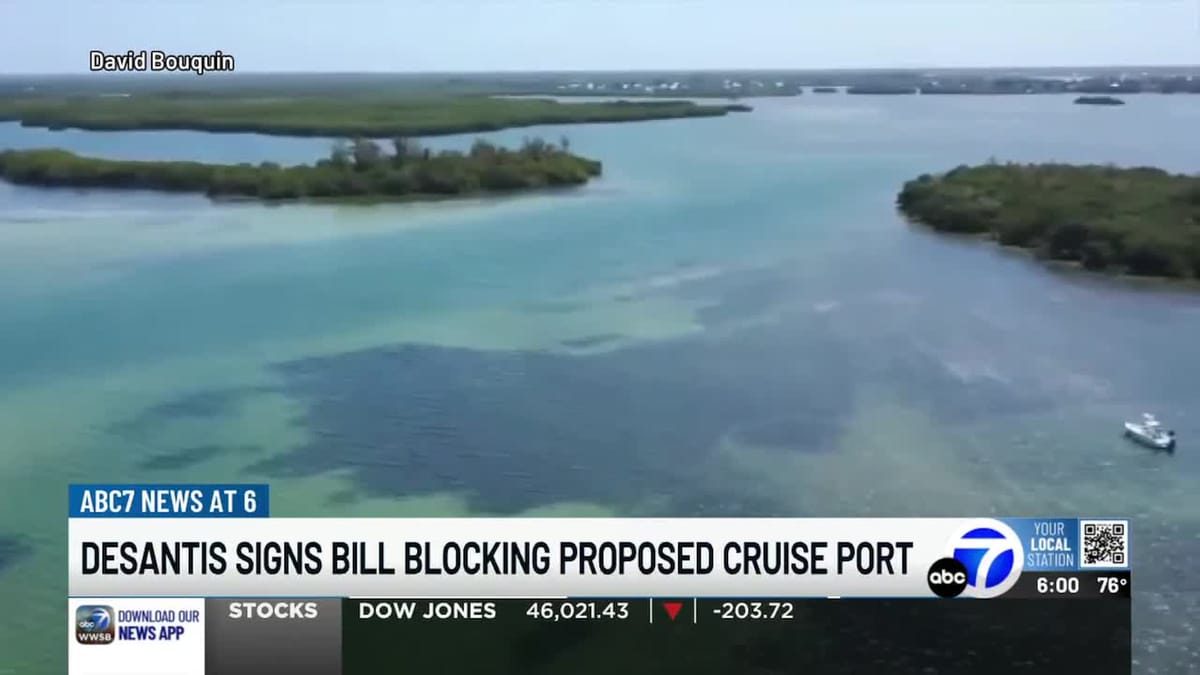
Florida Gov. Ron DeSantis signed Senate Bill 302 on March 19, 2026, creating new limits on dredging and filling in the Terra Ceia Aquatic Preserve, a change that state leaders say would prevent the dredging needed for a proposed deep-water cruise terminal in northwest Manatee County.
The bill signing, held in Bradenton, followed weeks of escalating debate over a port concept introduced publicly in early 2026 by terminal operator SSA Marine and Tampa-based Slip Knott LLC. Developers had been exploring a multi-berth cruise facility near the Sunshine Skyway Bridge as a way to accommodate large ships that cannot pass under the bridge to reach Port Tampa Bay.
How SB 302 was amended to restrict dredging in Terra Ceia
SB 302 began as a coastal resiliency measure and was later amended to address Terra Ceia. State Sen. Jim Boyd (R-Bradenton) filed the Terra Ceia-related amendment on Feb. 18, and the Florida Senate adopted the amended bill the next day on a 38-0 vote. The Florida House later approved matching legislation on a 109-0 vote on March 9.
The new law restricts the ability of the Board of Trustees of the Internal Improvement Trust Fund to approve dredging or filling of submerged lands within the Terra Ceia Aquatic Preserve, with exceptions for limited categories of projects. At the March 19 signing event, DeSantis said the measure “would not allow the dredging that would be necessary” to turn the area into a commercial cruise terminal.
SB 302 is scheduled to take effect July 1, 2026.
Why Terra Ceia became the focal point
The Terra Ceia Aquatic Preserve spans about 2,000 acres and was designated in 1984. State officials and environmental advocates have described it as ecologically significant, including marine habitats such as mangrove forests, seagrass beds, and tidal wetlands.
Florida Department of Environmental Protection (DEP) Secretary Alexis Lambert said Florida’s aquatic preserves include “some of the most ecologically significant” areas in the state, and pointed to Terra Ceia’s designation as intended to protect waters for scientific value as well as natural beauty.
The cruise terminal concept near the Sunshine Skyway Bridge
SSA Marine and Slip Knott LLC outlined a concept for a modern cruise terminal on roughly 328 acres known as the Knott-Cowen tract, described as near Rattlesnake Key and Paradise Island and positioned west and south of the Sunshine Skyway Bridge. Developers pitched the location as a way to serve large cruise ships that cannot clear the bridge to reach existing Tampa Bay terminals.
The Sunshine Skyway Bridge has about 180 feet of vertical clearance, which backers of the concept said is too low for some of the cruise industry’s newest and tallest vessels. Coverage of the proposed facility also described it as intended to accommodate modern mega ships, including Royal Caribbean’s Icon- and Oasis-class vessels, and as requiring extensive dredging to create or deepen a channel suitable for large ships.
As part of its broader activities around the site, SSA Marine disclosed the acquisition of Rattlesnake Key, an adjacent 710-acre island in lower Tampa Bay. The company has described the purchase as supporting conservation goals and preventing future commercial development of the island.
What the law still permits inside the preserve
Supporters of SB 302 emphasized that the Terra Ceia language is not a blanket prohibition on all dredging. Instead, it limits approvals to defined purposes and sets a higher threshold for findings intended to protect water quality and the preserve’s utility.
- Public navigation and documented public necessity: Minimum dredging tied to public navigation projects or a documented public necessity.
- Limited boating access projects: Limited dredging and filling for marinas, public boat ramps, piers, docks, and related channels and access roads, subject to findings intended to protect water quality and the preserve’s utility.
- Public health and environmental quality: Dredging aimed at eliminating conditions considered hazardous to public health, including addressing stagnant waters and related features when the work is determined to be in the public interest.
DeSantis also described the law as emphasizing “passive recreational” uses, such as fishing and boating, rather than enabling a new commercial cruise port. He said the measure requires permits to be handled at the state level and subject to public notice.
Officials’ arguments: existing port capacity and local impacts
At a March 19 press conference at Pier 22 in downtown Bradenton, DeSantis argued that another cruise port was unnecessary in the region. “There’s not really a need to add another port in the middle of a conserved area, especially given Tampa Bay is already home to three deep-water ports, including SeaPort Manatee right here in Manatee County,” he said.
DeSantis also said the cruise-terminal concept, as discussed publicly, “would have a major change in the lifestyle and the environment” for people in the area.
Boyd framed the effort as supportive of cruising but opposed to this location. “We support the cruise industry, but just not there,” he said, adding that the bill signing would “protect that area for generations to come.”
State Rep. Will Robinson Jr. (R-Bradenton) also spoke in support of the restrictions. “This is one of the most pristine areas in our state, and we don’t need mega cruise ships in this area,” Robinson said.
Opposition campaigns and environmental concerns
The proposed terminal drew sustained community and environmental opposition in Manatee County, including public rallies and petitions. Petition totals cited during the debate ranged from at least 12,000 signatures to more than 19,000 signatures, with other accounts describing nearly 20,000 signatures.
Suncoast Waterkeeper and other advocates argued that dredging for a mega-ship terminal could harm water quality and disrupt marine life, warning that the scale of work required to support a commercial cruise facility would permanently damage the area. Tampa Bay Waterkeeper Executive Director Justin Tramble also spoke publicly during the legislative process, emphasizing the preserve’s significance and urging stronger protections around dredging proposals in the area.
Resiliency provisions beyond Terra Ceia
While the Terra Ceia amendment drew the most attention locally, SB 302 also sets broader coastal resiliency direction for DEP, including work on guidelines for nature-based approaches intended to help communities withstand storms and flooding.
DeSantis said the bill directs DEP toward nature-based solutions for flood and storm impacts, including rehabilitating wetlands, restoring oyster reefs, and expanding mangrove coverage statewide.
What happens next for SSA Marine and Slip Knott
Supporters of the bill said SB 302 makes the proposed cruise terminal infeasible under the new limits because it restricts the dredging needed for large-scale commercial development. At the same time, the law does not categorically prohibit all activity in the preserve, and the developers are not barred from pursuing other avenues.
Developers could still pursue steps through local and federal processes, including potential rezoning discussions and additional permits, with agencies cited in coverage including the Southwest Florida Water Management District and the U.S. Army Corps of Engineers.
SSA Marine has not issued a public statement responding to the signed law’s impact. Before final passage, SSA Marine spokesperson Sally Dee said on March 9 that the company “looks forward to continuing to share our vision” and remains committed to “an open dialogue” with elected leaders and the community. As of the signing date, there was no announced timeline for whether the developers would modify, pause, or withdraw the concept.
Other actions during DeSantis’ Bradenton visit
During the same Bradenton visit, DeSantis also signed House Bill 1417, which removes the Environmental Regulation Commission from Florida law and shifts environmental rulemaking processes within the state’s framework. He also discussed plans related to the Sunshine Skyway fishing piers, including rebuilding a damaged pier on the Manatee County side and extending the northern pier in Pinellas County.
With SB 302 set to take effect on July 1, the immediate focus in Manatee County is whether any local land-use or permitting steps move forward for the cruise-terminal concept under the new state limits on dredging in the Terra Ceia Aquatic Preserve.
Frequently Asked Questions (FAQs)
When does Florida’s SB 302 take effect?
SB 302 is scheduled to take effect on July 1, 2026.
Why was the proposed cruise terminal located near the Sunshine Skyway Bridge?
The site west and south of the Sunshine Skyway Bridge was promoted as a way to serve large cruise ships that cannot clear the bridge to reach Port Tampa Bay. Coverage put the bridge’s vertical clearance at about 180 feet, which developers said is too low for some of the industry’s newest and tallest vessels.
Does SB 302 ban all dredging in the Terra Ceia Aquatic Preserve?
No. The law restricts approvals and allows only limited dredging for specified purposes, including certain navigation-related work, defined public necessities, limited marina and boating-access projects under protective conditions, and some projects tied to public health or environmental quality.
Have SSA Marine and Slip Knott LLC said whether they will cancel the cruise terminal plan?
As of the March 19 signing, SSA Marine had not publicly announced whether it will abandon, pause, or redesign the concept. Before final passage, SSA Marine spokesperson Sally Dee said on March 9 that the company “looks forward to continuing to share our vision” and remains committed to “an open dialogue” with elected leaders and the community.