Carnival Authorizes $2.5B Buyback After Record Q1 Profit
Carnival’s new targets signal a cruise industry shifting from recovery to disciplined value creation, leaning on efficiency and ship upgrades to weather fuel shocks.
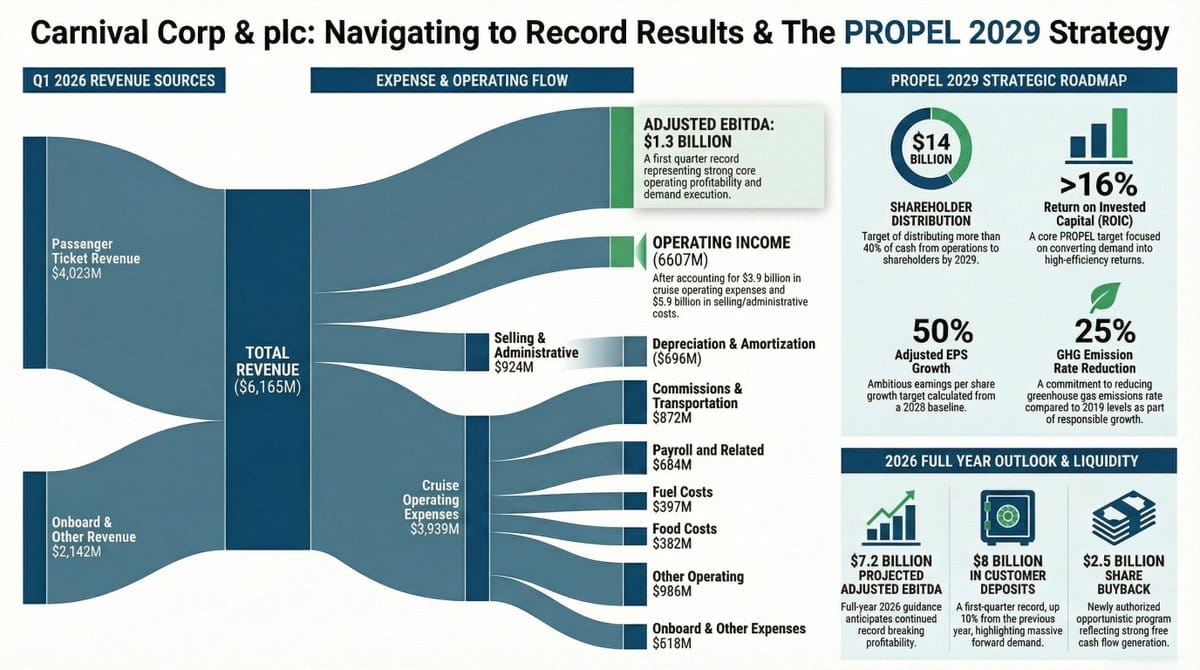
Carnival Corporation opened fiscal 2026 with record first-quarter revenue of $6.2 billion, as Chief Executive Officer Josh Weinstein pointed to strong demand and operational improvements during the company’s earnings call. The company reported net income of $258 million for the quarter and introduced “PROPEL,” a new set of long-term targets through 2029, while its board also authorized an initial $2.5 billion share repurchase program.
Record quarter metrics and on-board momentum
Carnival’s fiscal first quarter ran from Dec. 1, 2025, through Feb. 28, 2026, a period that includes the industry’s peak Wave Season booking window. The company reported diluted earnings per share (EPS) of $0.19 and adjusted EPS of $0.20, representing a year-over-year increase of about 50%.
Adjusted EBITDA reached a first-quarter record of $1.3 billion. Carnival said gross margin yields increased by nearly 10%, while net yields (in constant currency) rose 2.7%, exceeding prior guidance by more than one percentage point.
On costs, cruise costs per available lower berth day (ALBD) increased 4.9%. Adjusted cruise costs excluding fuel per ALBD (in constant currency) rose 5.3%, which the company said was better than its guidance. Carnival also reported a 4.7% decrease in fuel consumption per ALBD, reflecting ongoing efficiency initiatives.
Occupancy across Carnival’s fleet was 103%, matching the record level from the prior year. The company also cited stronger onboard revenue trends and increased pre-cruise purchases, including onboard sales booked ahead of sailing.
Bookings pulled forward, with 2026 inventory largely sold
Carnival said demand has kept 2026 sailings largely sold well ahead of departure. The company reported double-digit booking growth year over year, with roughly 85% of 2026 capacity already booked at historically high prices (in constant currency), and demand extending into 2028 sailings.
“We delivered an incredibly strong start to the year, achieving our highest level of bookings ever,” Weinstein said, adding that the company’s 2026 booked position has been pulled forward at high pricing levels in constant currency.
Customer deposits reached a first-quarter record of nearly $8 billion, about 10% higher than the prior-year period, with the company also noting that 2026 availability is tighter than at the same point last year.
Fuel pressure reshapes the 2026 earnings outlook
Carnival maintained expectations for continued yield improvement and cost discipline in 2026, while emphasizing the impact of higher fuel prices following geopolitical developments in the Middle East. The company said its guidance incorporated fuel purchased in March and early April and assumed Brent crude averages of $90 per barrel for the rest of April and May, $85 in the third quarter, and $80 in the fourth quarter.
Weinstein discussed the operational impact of the escalating Iran war, which he said has disrupted oil flows through the Strait of Hormuz, a route he said handles about 20% of global oil supply. In a separate update tied to the same earnings release period, Carnival reduced its full-year adjusted EPS expectation to about $2.21, down from its prior outlook of up to $2.48, reflecting higher fuel costs.
The company also said it now anticipates nearly $150 million in operational improvement in full-year adjusted net income compared with its December outlook, driven by better net yields and lower non-fuel costs that partially offset fuel pressure.
Carnival’s no-hedging stance and efficiency playbook
On the earnings call, analysts asked whether Carnival would reconsider fuel hedging. Weinstein rejected that approach and emphasized consumption reduction, saying, “Our focus forever, and will continue to be forever, is use less.”
Weinstein said efficiency measures have saved the company approximately $650 million since 2019, and he also cited about $250 million tied to per-unit consumption reductions achieved since 2023. He described initiatives that include tighter itinerary and arrival-time management, HVAC optimization, and successive rounds of the company’s “Service Power Package” initiatives that provide brands with fuel-saving options to install on ships.
Weinstein also linked itinerary planning and destination development to fuel management, citing investments in Caribbean destinations such as Celebration Key and a planned pier at Half Moon Cay, which he said are positioned close to key homeports.
PROPEL targets through 2029
Weinstein said the company is moving to a new multi-year framework after progress on its prior “SEA Change” targets. “With this strong foundation in place, we are focused on the next chapter of value creation for Carnival,” he said while introducing PROPEL, which he described as “Powering Growth and Returns, Responsibly.”
Under PROPEL, Carnival set targets to be achieved by 2029 that combine shareholder-return ambitions with balance sheet and emissions goals, including:
- Greater than 16% return on invested capital
- More than 50% adjusted EPS growth from 2025
- More than 40% of cash from operations distributed to shareholders, which Carnival quantified as approximately $14 billion
- A net debt to adjusted EBITDA ratio of 2.75x
- A reduction in greenhouse gas emissions rate of more than 25% versus 2019 levels
Weinstein framed the strategy as a combination of measured capacity growth, stronger commercial execution, continued productivity work, and investment aimed at returns, including ship refurbishment programs and the expansion of Carnival’s exclusive destinations.
Capital returns: buybacks, dividends, and timing constraints
Carnival’s board approved an initial $2.5 billion share repurchase authorization. Chief Financial Officer David Bernstein linked the decision to free cash flow generation and the company’s shareholder-return plans.
“Initiating an opportunistic buyback program reflects our strong and growing free cash flow generation and ongoing commitment to return value to our shareholders,” Bernstein said. He added that Carnival expects more than $800 million in total dividend distributions during 2026 and reiterated the company’s longer-term goal of returning about $14 billion to shareholders through 2029.
Carnival said the share buyback will begin after shareholder meetings expected on April 17, 2026, citing legal requirements connected to an open voting period related to unifying its dual listed company structure. The authorization does not have an expiration date.
Fleet modernization prioritized over new ship growth
While demand remains strong, Weinstein signaled that near-term capacity growth will remain constrained, with an emphasis on refurbishment and modernization rather than aggressive newbuild expansion. He pointed to the AIDA Evolution program and said upgraded ships have delivered improved yields and passenger satisfaction scores comparable to newer vessels.
“An 18-year-old ship can look and feel like a one-year-old ship,” Weinstein said, as he discussed results under AIDA Evolution. He also said another Carnival brand is expected to announce a major revitalization program in April, without identifying which brand.
Weinstein argued that older tonnage can be a meaningful driver of performance, saying, “Some of the best yields and net promoter scores come from our oldest ships.” On new ships, he said Carnival has no new ships debuting in 2026 and expects roughly one new ship per year thereafter across its portfolio during the PROPEL period, with only a limited number of debuts currently slated during that timeframe.
Europe demand signals amid conflict-driven uncertainty
Carnival said European booking patterns have shifted somewhat amid geopolitical uncertainty, with Weinstein acknowledging softness particularly around Eastern Mediterranean itineraries. At the same time, he said the company has not seen meaningful cancellation trends for upcoming European sailings. “We’re really not seeing anything significant to talk about with respect to cancellation trends,” he said, adding that demand varies by region, including differences between Eastern and Western Mediterranean itineraries and Northern Europe.
During Wave Season, Carnival cited strong Northern Europe performance, including Holland America Line reporting a 30% increase in demand and a 50% surge for Northern European itineraries.
Weinstein also said Carnival previously repositioned ships away from the Middle East, leaving its brands with limited exposure to the region. Fitch Ratings’ John Kempf said a prolonged period of higher fuel costs would affect Carnival, while also pointing to the company’s scale and liquidity as tools to manage volatility, and he cited strong sector-wide bookings as evidence that cruise demand has remained resilient despite broader economic uncertainty.
Carnival’s near-term calendar includes the April 17, 2026, shareholder meetings tied to its corporate structure unification vote, which the company said must occur before the new buyback program can begin. Investors will also be watching fuel price developments and the expected April update on another brand-wide fleet modernization initiative.
Frequently Asked Questions (FAQs)
What is Carnival’s PROPEL strategy?
PROPEL is Carnival’s long-term framework through 2029. It sets targets that include more than 50% adjusted EPS growth from 2025, greater than 16% return on invested capital, returning more than 40% of cash from operations to shareholders (which Carnival quantified as about $14 billion), maintaining a 2.75x net debt-to-adjusted EBITDA ratio, and reducing greenhouse gas emissions rates by more than 25% versus 2019.
When will Carnival’s $2.5 billion share buyback start?
Carnival said the repurchase program will commence after shareholder meetings expected on April 17, 2026, citing legal requirements connected to an open voting period related to unifying its dual listed company structure. The company said the authorization has no expiration date.
Does Carnival hedge fuel prices?
No. Weinstein said Carnival is not reconsidering its approach to fuel hedging and is focused instead on reducing fuel consumption through measures such as itinerary and arrival-time management, HVAC optimization, and the company’s “Service Power Package” efficiency initiatives.
Why is Carnival focusing on fleet revitalization instead of new ships?
Carnival is emphasizing refurbishment and modernization to drive returns while keeping near-term capacity growth constrained. Weinstein highlighted results from the AIDA Evolution upgrades and said older ships can deliver strong performance, adding that “some of the best yields and net promoter scores come from our oldest ships.” He also said another brand is expected to announce a major revitalization program in April.
What is Carnival’s approach to technology and travel advisors?
Carnival said it plans to use AI strategically without diminishing the role of travel agents, which the company views as vital partners in bringing new customers to cruising. Weinstein emphasized that travel advisors will remain central to Carnival’s business model.